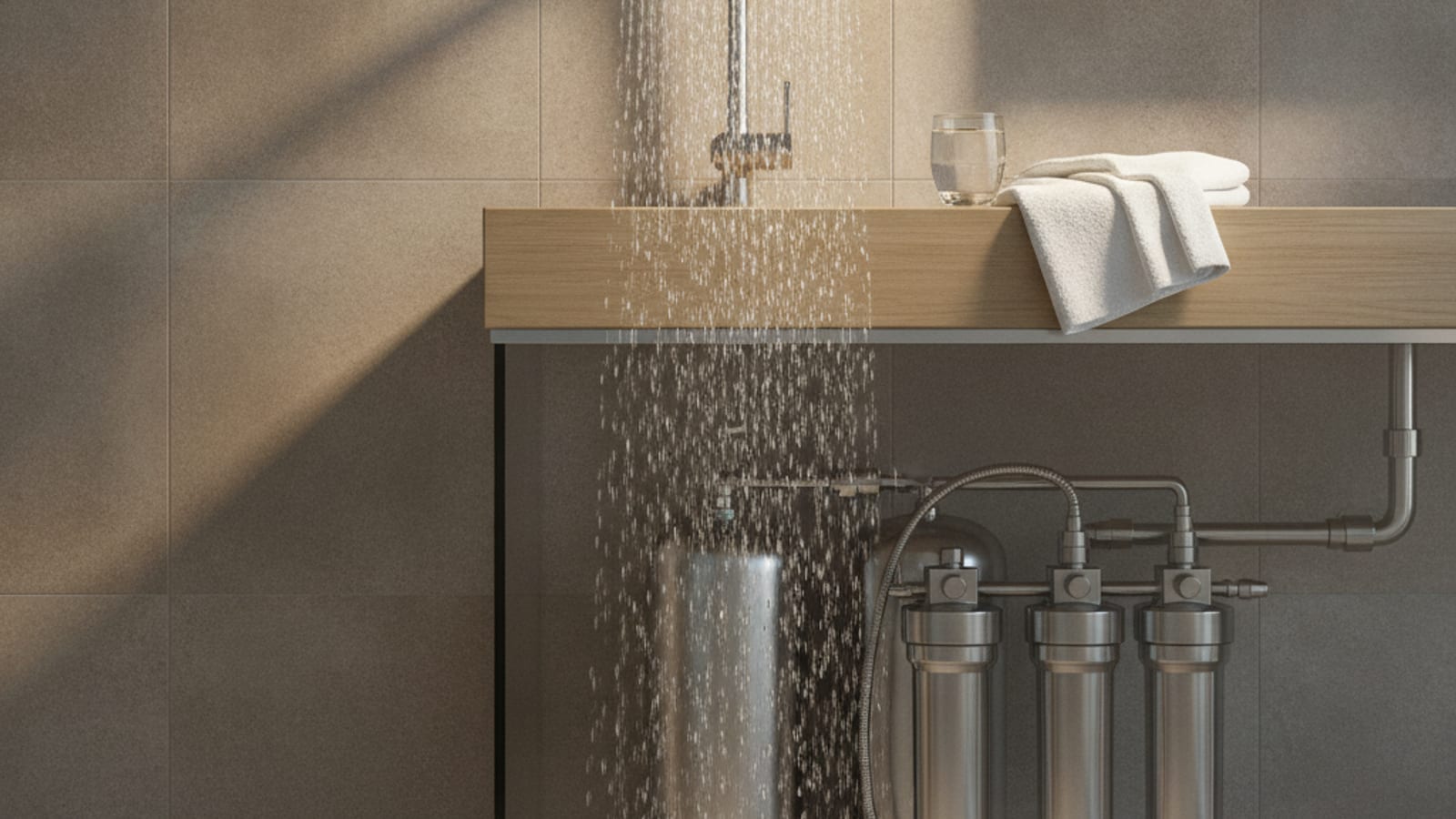
The City of San Diego reports that its drinking water typically averages about 16 grains per gallon (276 ppm) and can range from 16 to 18 grains per gallon depending on area and water demand. Under the U.S. Geological Survey’s water hardness classification, those figures are in the very-hard range. Other utilities and private wells can differ, so check the current report for the utility serving your address.
If you’ve noticed your hair feels dull, dry, or harder to manage since moving to San Diego, or if you’ve been here for years and have just accepted it as normal, the water is worth considering. But there’s a lot of overblown content online about hard water and hair loss specifically, and it’s worth being clear about what the evidence actually shows and where the claims exceed the science.
What hard water does to hair
Hardness describes dissolved calcium and magnesium in water. People sometimes attribute roughness, dullness, dryness, or changes in lather and rinsing to their water, but those observations do not identify a medical cause and do not prove that hardness is responsible.
Disinfectant type also varies by utility and operating conditions. Your utility’s current water-quality report is the right place to identify it rather than assuming every San Diego tap has the same chemistry.
What the evidence shows about hair loss specifically
This is where the honest answer diverges from what you’ll find on a lot of filtration company websites.
Hair that breaks along the shaft and hair that sheds from the root are different observations. Looking at strands, a drain, or a brush at home cannot establish the cause of either one.
A 2013 laboratory experiment indexed by PubMed exposed hair strands collected from 15 volunteers to hard or distilled water for 30 days. Under those test conditions, the researchers found no significant difference in tensile strength or elasticity. Because the experiment tested collected strands rather than living follicles or people with clinical hair loss, it does not establish whether hard water causes or prevents a medical form of hair loss.
The evidence available for this article does not establish that hard water causes follicle-level hair loss, breakage, dryness, dullness, or scalp irritation. A treatment proposal should address a measured water condition and an exact equipment claim, not promise a hair or scalp result.
If you’re experiencing significant shedding, noticeable thinning, or persistent scalp symptoms, discuss them with a qualified clinician rather than treating water equipment as a diagnosis or medical remedy.
What softer, dechlorinated water realistically does
Changing hardness or a specifically identified disinfectant may change how shower water feels and how hair-care products behave. Results vary by person and by the treatment used.
Softened water may change lathering and rinsing, while a filter with an exact certified reduction claim may address a specified disinfectant or other substance. Neither category guarantees less breakage, better scalp health, longer-lasting color, or a medical benefit.
Scalp and skin effects worth noting
Skin and scalp symptoms have many possible causes. If you or your children have eczema, persistent irritation, or another diagnosed condition, ask a clinician for medical guidance. Your utility report and appropriate testing can help identify the water conditions at the property; the water solutions for sensitive skin and eczema page explains treatment questions to discuss with a provider.
What a whole-house system changes about your shower
A whole house water filtration system is installed at the point of entry and can treat water before it reaches the home’s fixtures. Its actual treatment scope depends on the exact equipment and its certified reduction claims.
Salt-free conditioning is different from ion-exchange softening: it does not remove calcium and magnesium hardness ions. If you are comparing a PF1025 or any other conditioner, ask for the exact model documentation and any applicable IAPMO/ANSI Z601 scale-reduction claim. For disinfectant reduction, compare the exact filter’s certified claim with the disinfectant named in the serving utility’s current report.
Material type or treatment category alone does not prove performance. Ask what the system is certified to reduce, what it does not address, and what maintenance it requires.
The bottom line
Hard water can leave mineral deposits and change how hair feels, but the evidence does not establish it as a cause of follicle-level hair loss. A water-treatment system also cannot promise improved hair, scalp comfort, or a medical outcome.
Water conditions may be one factor in hair care, but treatment should not be presented as preventing or reversing hair loss.
Start with your serving utility’s current report. A free in-home water test from an independent provider can screen selected field measurements and help discuss next steps, but it is not a laboratory analysis or proof that the water is safe from every contaminant. Filter Pros San Diego introduces homeowners to independent licensed providers; the provider supplies the recommendation and written scope.
Call (858) 400-6508 with any questions.
Related reading: