Yes: a salt-based water softener sends water down the drain during regeneration, the rinse that recharges the resin. That is not the same as reverse osmosis waste water, which rejects water while the unit makes drinking water. How much leaves the drain depends on the exact model, how it is sized for your house, and whether it regenerates on demand or on a timer. No honest page can name a single gallon figure that fits every Mira Mesa garage and every East County well.
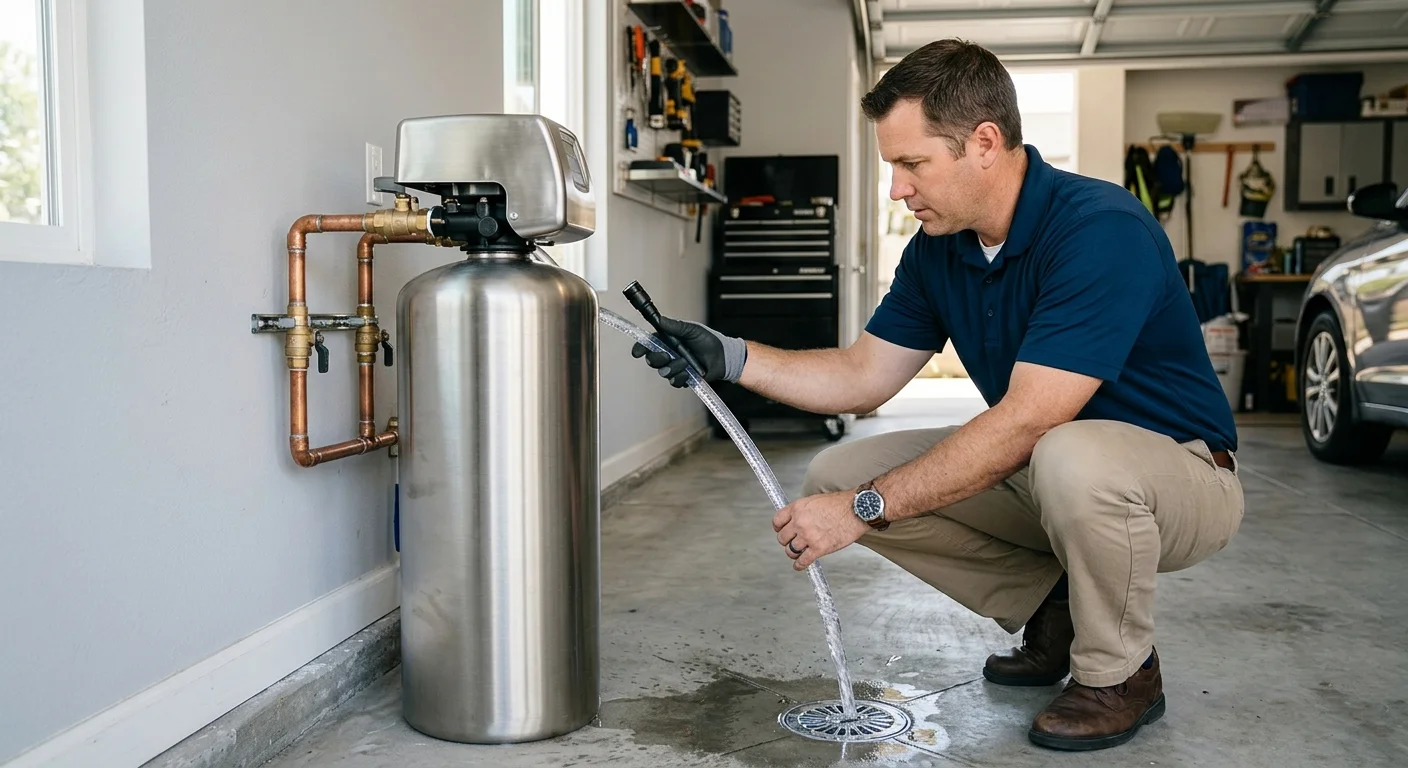
Why a salt-based softener uses water during regeneration
A salt-based softener is an ion-exchange tank. Hard water flows through resin that holds calcium and magnesium. Those minerals are what USGS calls hardness, reported as calcium carbonate. The resin does not stay charged forever. When it fills up, the control valve starts regeneration.
Brine from the salt tank washes the resin. Hardness ions come off. Fresh sodium or potassium goes back on. That used brine, plus rinse water, leaves through the drain line. That discharge is the water people mean when they ask how much water a softener uses. It is process water, not a leak, and it is supposed to stop when the cycle ends.
The U.S. EPA’s May 2026 water-softener guide is the federal consumer source we follow on this point. Size the unit from measured hardness and household water use. Leave irrigation out of that math when the lawn is on a separate line, which is common in San Diego summers. Demand-initiated regeneration follows actual use and hardness. A timer fires on a clock even if nobody ran a shower. Oversizing can waste water. So can a unit that is too small and regenerates constantly.
NSF/ANSI 44 is the standard that covers ion-exchange softeners that reduce calcium and magnesium. A listing is not a ranking. Compare the exact model’s certified claim, rated working capacity, and water and salt efficiency. The label on a unit in Kearny Mesa does not describe a different model in Oceanside.
Household water still flows during a normal cycle. Dual-tank designs keep one tank in service while the other regenerates. Single-tank units may send hard water through for a short window. That is a service detail, not a reason to invent a drain volume.
Persistent flow at the drain is not regeneration. The EPA guide says ongoing drain flow can mean a malfunction. If the line runs for hours, treat it as a fault, not as “that’s just what softeners do.” A licensed pro can isolate the unit with the bypass and find whether the valve, drain, or brine side is stuck.
What you can check without guessing gallon figures
Skip the internet numbers that claim a cycle always uses a round gallon count. Those figures are not in any source we can stand behind, and they are not a San Diego measurement. You can still judge waste without inventing a total.
Watch the drain line during a known regeneration. It should run, then stop. If it never stops, that is the softener that keeps running and draining problem, not normal water softener regeneration water use.
Read the control head. Demand or metered regeneration follows water through the tank. A timer regenerates on a schedule. After a week away, a timer can still dump a cycle you did not need. That is one reason the EPA guide prefers matching regeneration to use.
Confirm the bypass. A bypass valve routes water around the tank. If the unit sits in bypass, you still have hard water and you may still have a drain issue if the valve is faulting. Confirm bypass by running a cold tap, and follow the exact model manual. Do not force a stuck handle.
Look at salt use as a clue, not as a gallon meter. A brine tank that empties far faster than the manual describes can mean extra regenerations. A hardened crust, a salt bridge, can also block brine and send the valve into odd cycles. That is a maintenance fault. It is not a reason to guess a monthly waste total.
Ask for the model’s NSF/ANSI 44 listing and its stated water and salt efficiency. That is the comparison the EPA tells shoppers to make. It still is not your field result. Feedwater hardness, household gallons, and a wrong size change the real drain volume.
Irrigation is the other San Diego trap. A unit sized as if it treated the whole yard will cycle more than a house-only design. The EPA guide says exclude irrigation demand when that water does not go through the softener. Many City and county lots keep the landscape on a separate clock. Tell the licensed pro which fixtures the tank will actually serve.
None of this produces a universal “how much water is wasted by a water softener” number. The honest answer is: regeneration uses water on purpose, the amount is model-specific, and a drain that never shuts off is broken.
How salt-free conditioning compares on discharge
Salt-free conditioning is a different job. The EPA guide is plain: salt-free equipment does not remove hardness ions. It is not softened water. Evaluate the exact scale-reduction claim, including IAPMO/ANSI Z601 where that is the test the maker cites. Do not treat a conditioner as a softener with the salt tank removed.
Because there is no brine regeneration, there is no brine discharge from that process. No bags of salt. No sodium added by ion exchange. Filter Pros refers homes that want that path to salt-free water conditioning, including PF1025-style conditioning: no salt, no sodium, no brine to the drain. That is a discharge difference. It is not a promise that scale will vanish on every tap in Chula Vista or Ramona.
A salt-based install still has a role when the goal is true ion-exchange softening. The licensed pros we send for water softener installation size that equipment from a test, not from a neighbor’s tank. Many of those installs use medical-grade stainless steel tanks rather than fiberglass with a plastic liner. Stainless does not change regeneration physics. It does change what you are putting in a damp garage.
People mix this comparison with reverse osmosis. RO is point-of-use drinking water. It makes treated water and reject water while it runs. A whole-house softener is not an RO membrane. If the worry is the kitchen reject line, read the RO waste page. If the worry is the garage drain during regen, you are in this article.
Drinking softened water is a separate question from drain waste. University of Nebraska–Lincoln Extension estimates sodium is added at about 8 mg/L for each grain per gallon of hardness removed. Their example: 10 gpg hardness yields about 80 mg/L sodium after treatment. That is an estimate of added sodium, not a measured San Diego tap. People on restricted sodium diets should ask a physician. Many homes take drinking and cooking water from a kitchen cold line that bypasses the softener. Some units can use potassium chloride instead of sodium chloride, with professional guidance.
A 2011 trial in English hard-water areas found no primary eczema-severity benefit from an ion-exchange softener plus usual care versus usual care alone. Do not buy a tank as medical treatment. Buy it for hardness control, then decide salt-based versus salt-free on discharge, sodium, and the actual scale claim.
Local discharge and restriction questions to verify
San Diego County is not one plumbing code and not one sewer rule. The City of San Diego is not Helix Water District. A private well in the backcountry is not a City tap. Write down your serving utility before you argue with a sales sheet.
For City of San Diego taps, two City publications describe hardness and they are not the same measurement. The Public Utilities plumbing page says drinking water typically averages about 16 grains per gallon, or 276 ppm, and can range from 16 to 18 gr/gal (272 to 284 ppm) depending on demand and area of the City. The City’s 2025 Consumer Confidence Report for Public Water System 3710020 lists plant totals in grains per gallon: Alvarado averaged 13.8 (11.9–15.8), Miramar 14.1 (11.7–16.6), Otay 14.2 (11.7–15.8), and purchased treated water 8.5 (3.18–13.6). Those CCR rows are 2025 plant and purchased ranges. They are not a countywide number and not a well result.
Helix Water District, which publishes for its own customers, says water at 10 or more grains per gallon is considered hard. It also says imported Colorado River and State Water Project supply averages about 14 grains. That is a statement about imported supply, not about one kitchen tap in La Mesa or El Cajon. Confirm the current report for the address. The San Diego County Water Authority is the regional starting point for who wholesales water to many retailers.
Local softener bans and city-by-city salt restrictions are not a figure we can assert from our claims file. If that is the objection, read whether salt-based softeners are restricted in San Diego and then call the city or sewer agency that actually sets the rule for your parcel. A page that invents an ordinance number is worse than a page that says to verify.
Brine going to a sewer or septic is the same kind of local question. We do not have a verified countywide discharge limit or a sewer-fee adder to publish. The agency that owns the collection system sets that. On a septic tank, the EPA guide says check with the septic manufacturer or local service provider about overload, warranty, and performance before a softener goes in. That is a phone call, not a blog statistic.
Inside the City of San Diego, water-softener installation is listed among Simple No-Plan Plumbing/Gas Permit work for eligible properties. Historic-property rules can change the route. That is City jurisdiction guidance. It is not a countywide permit rule, and it is not evidence of a prohibition. Unincorporated county land and other cities have their own counters.
Test hardness before you change equipment
The waste-water objection is usually a buying block next to salt. The fix is not a bigger tank from a photo. It is a hardness number for this house, then a size that matches indoor use.
USGS classifies hardness as calcium carbonate: 0–60 mg/L soft, 61–120 moderately hard, 121–180 hard, and over 180 very hard. Its calculator uses about 17.1 mg/L per grain per gallon. That is classification guidance. It is not a home safety certificate and it does not predict your bill.
City and Helix figures above tell you the public systems publish hard or near-hard water. They do not tell you the grain count at a Clairemont hose bib this week. Blends move. Wells are a different chemistry. CDC well guidance still applies if you are on a well: use a state-certified lab, and match treatment to what you actually found.
Filter Pros San Diego is the referral office, not the contractor. We arrange a free in-home water test. A separately licensed water-filtration pro reads that result, sizes the equipment, and, if you hire them, installs it under your contract with them. Check a pro’s license on the CSLB license lookup before anyone opens a drain line.
Bring three facts to that visit: indoor versus irrigation piping, whether anyone in the house is on a sodium-restricted diet, and whether the property is on sewer or septic. Those three change the regen conversation more than any national gallon slogan.
If the test supports ion exchange, compare NSF/ANSI 44 efficiency on the exact model and insist on demand-initiated regeneration unless the manual says otherwise. If the goal is scale reduction without brine, compare the salt-free claim on its own terms. If the kitchen is the only worry, RO waste is a different math. Do not stack all three and call it one drain.
A correctly sized, demand-initiated softener still uses water when it regenerates. That is the trade for removing hardness ions. What you can refuse is a timer that fires in an empty house, a tank sized for a lawn it does not treat, and a drain that never stops.
When to call us
Call when a drain line runs without a regeneration, when you are choosing between salt-based and salt-free equipment, or when you need hardness tested before anyone sells a tank. Filter Pros San Diego sets up the test and connects you with a licensed water-filtration pro who sizes and installs under your own contract. Call us at (858) 400-6508 to set up a free in-home water test.