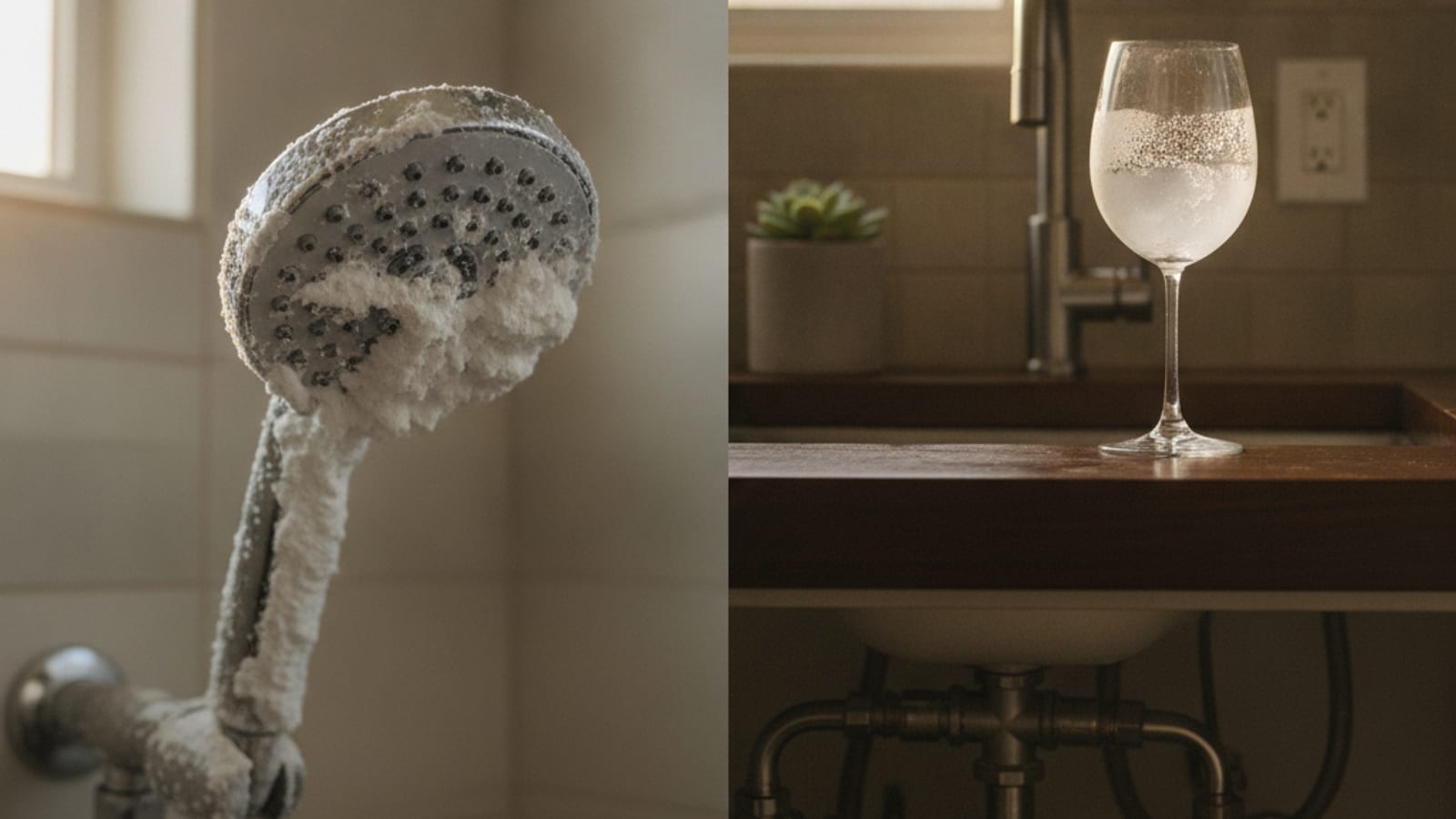
The City of San Diego reports that its drinking water typically averages about 16 grains per gallon (276 ppm) and ranges from 16 to 18 grains per gallon depending on area and water demand. That figure applies to the City’s system, not every utility or private well in the county.
For context, the U.S. Geological Survey classifies water above 10.5 gpg as “very hard”. The City’s reported range falls in that classification. White deposits on fixtures or glassware can be a reason to measure hardness, but appearance alone does not establish the condition of hidden plumbing or appliances.
What hard water does to your water heater
Heating can make hardness deposits easier to notice, so a water heater is one place to check the manufacturer’s scale and maintenance guidance. Symptoms such as reduced hot-water performance or an error code have multiple possible causes and require diagnosis.
Do not estimate a heater’s remaining life or replacement cost from hardness alone. Equipment type, installation, maintenance, operating conditions, access, parts, and warranty all affect the outcome. Use the heater manual and a qualified service provider for an equipment-specific assessment.
Dishwashers and washing machines
Cloudy glassware, deposits around spray openings, changes in cleaning, or residue on laundry can prompt a hardness check. They are not a diagnosis by themselves: detergent amount, wash settings, equipment condition, and other water characteristics can also matter.
Follow the appliance and detergent manufacturers’ instructions for the measured hardness at the property. Compare any treatment proposal with the appliance requirements instead of relying on a universal claim about detergent savings or appliance life.
Fixtures, plumbing, and showerheads
White deposits around fixtures can be consistent with hardness, while a flow or pressure change may also come from debris, a valve, supply pressure, or another plumbing issue. Document where the symptom occurs and compare it with a measured hardness result before selecting treatment.
Do not infer pipe condition from an exterior deposit. A plumber can evaluate recurring restriction, leaks, corrosion, or fixture damage when those symptoms are present.
Skin, hair, and shower experience
People may notice differences in lather, rinsing, residue, or how shower water feels. Those experiences vary and do not establish a health condition or guarantee a benefit from treatment.
Persistent skin or scalp symptoms deserve clinical guidance. Select water equipment for an identified water concern and an exact certified claim, not as a medical treatment.
How to evaluate cost
There is no supported single annual cost for hard water in a San Diego household. Start with the costs you can document: current utility use, manufacturer-required maintenance, an actual repair diagnosis, replacement parts, and consumables for the exact treatment model.
Ask each provider for a written quote that separates equipment, installation, permits when applicable, maintenance, replacement media, and warranty terms. That gives you a usable ownership comparison without assuming a percentage savings or an appliance failure date.
Two approaches to the problem
Salt-based water softening
Traditional ion-exchange softeners reduce calcium and magnesium hardness. Compare the exact model’s NSF/ANSI 44 certification, rated working capacity, salt and water efficiency, regeneration controls, maintenance, and installation requirements. Tank material by itself does not establish performance, service life, or water quality.
Salt-free conditioning (template-assisted crystallization)
Salt-free conditioning does not remove calcium and magnesium hardness ions, so it should not be described as producing softened water. If you are considering a PF1025 or another conditioner, ask the independent provider for the exact product documentation, maintenance requirements, installation conditions, and any applicable IAPMO/ANSI Z601 scale-reduction claim. Material or product category alone does not prove performance. Learn more about hard water solutions.
The right fit depends on your home
The best choice between a softener and a salt-free conditioner depends on measured hardness, household water use, treatment goals, installation conditions, maintenance preferences, and the exact model’s documented performance. Check current requirements with the authority that has jurisdiction over the address; the City of San Diego lists eligible water-softener work under its Simple No-Plan plumbing permit route, but scope and property conditions affect the permit path.
The starting point is knowing your actual water hardness, not a regional average. A free in-home water test from an independent provider can screen selected field measurements, but it is not laboratory analysis or proof of safety from every contaminant. Filter Pros San Diego introduces homeowners to independent licensed providers; the provider gives the recommendation and written scope.
Call us at (858) 400-6508 or schedule online. We serve homeowners throughout San Diego County.
Related: Whole house water filtration for San Diego homes | Chlorine and chloramine removal | What a water softener costs in San Diego | Whole house filtration cost