The cartridge on a Clairemont counter has a tiny NSF/ANSI line. The box next to it only says certified. Those marks are not a ranking of NSF 42 vs 53 vs 58, and they are not a promise that one unit treats every contaminant at a City of San Diego tap or a private well.
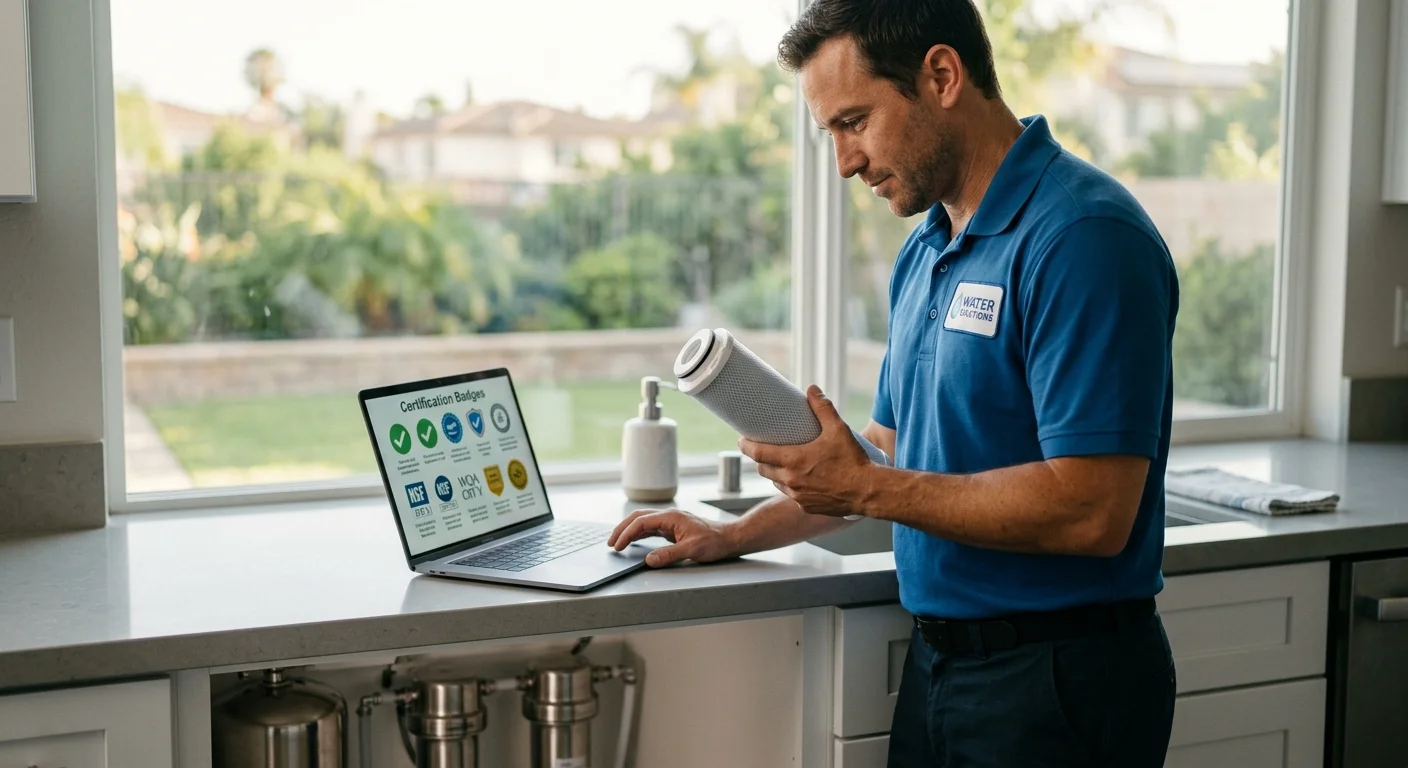
What the numbered NSF/ANSI marks actually cover
The number on a filter is a scope. It is not a score. NSF writes the standard. ANSI is in the name because that is how the standard is published. Shoppers mix the numbers because the box prints them in the same type size.
NSF/ANSI 42 covers certified aesthetic reduction claims. NSF/ANSI 53 covers specified health-effect contaminant claims. NSF/ANSI 58 covers reverse osmosis systems. NSF/ANSI 44 covers ion-exchange softeners that reduce calcium and magnesium hardness. Forty-four is a different machine. Don’t read it as a drinking-water cartridge mark.
A standard is not a performance ranking. Certification does not establish reduction of every contaminant. NSF 42 is not weaker than 53. NSF 53 is not stronger than 58. Each file answers a different question about one listed model. Verify that model’s applicable certified reduction claim. If the claim is not on the listing, it is not a certified claim.
Some products also show NSF/ANSI 401. NSF’s directory includes specific model and replacement-element pairs with a microplastics reduction claim under 401. That does not mean every 401 filter has the claim. It does not set a particle size or a percentage. If microplastics is the concern, read that exact pair. Don’t infer it from 42, 53, or 58.
This site could not confirm a public, complete compound list for 42, 53, or 58 beyond those scoped roles. Marketing that names a chemical is still marketing. The current NSF product listing for the model is the record. Search it by the number on the housing and on the replacement element.
For a San Diego County house, the water comes first. A City of San Diego meter, a Helix Water District address in La Mesa or El Cajon, and a well in unincorporated county land are not the same supply. The numbered mark has to match a confirmed concern at that tap. A generic “NSF certified” line does not do that work.
Separate 42, 53, and 58 claims
Keep the three numbers in separate files. One product can be listed to more than one standard. Each listing still has to be read on its own. Shoppers asking whether 53 or 58 is better, or whether 42 is better than 53, are asking the wrong question. Neither number ranks the other.
NSF/ANSI 42 is the aesthetic file. It covers certified aesthetic reduction claims: how the water tastes or looks, when the listing names that claim. This site could not confirm a locked contaminant list for 42 beyond that aesthetic scope. Check the current NSF product listing for the model. If the listing does not name the aesthetic claim you care about, the 42 mark does not cover it. NSF 42 is enough when the confirmed concern is aesthetic and the listing matches it. It is not a health-effect claim. Don’t treat 42 as a stand-in for 53 or 58.
NSF/ANSI 53 is the health-effect file. It covers specified health-effect contaminant claims. Specified is the load-bearing word. The mark does not mean the cartridge reduces every health-related contaminant. It means the listed claims were the ones tied to that model. If you only have a 42 listing and you need a health-effect claim, you still need 53, or another listed standard that actually names that contaminant.
NSF/ANSI 58 is the reverse osmosis file. That is what NSF 58 means: it covers reverse osmosis systems. It is not a trophy. Fluoride reduction under 58 is an optional exact-model claim. CDC home-treatment guidance says RO may reduce fluoride. It does not set a removal percentage. The City of San Diego’s November 2024 water-quality FAQ describes a fluoride adjustment target of 0.7 ppm for City supply. That is a City target, not a countywide tap reading and not a legal-limit statement. Other retail providers, blends, and wells differ. Confirm the serving utility’s current report.
An under-sink carbon system and an RO system are different tools. Compare carbon filtration and reverse osmosis against the concern you confirmed. Then read each model’s listed claims. RO produces treated water and reject water. Performance and efficiency are model-specific. EPA WaterSense states that labeled units demonstrate at most 2.3 gallons of reject water per gallon treated under its criteria. That is a label criterion, not field performance for every kitchen. EPA also gives national examples of five or more reject gallons per treated gallon, and up to ten for some inefficient units. Those are EPA examples, not a promise for a Mira Mesa install.
Match the mark to a confirmed water concern
Identify the water concern first. EPA’s home-treatment guidance is direct: no single technology removes every contaminant. Point-of-use devices treat a selected tap. Point-of-entry systems treat water entering the residence. An under-sink drinking water filter and a reverse osmosis drinking water unit are both point-of-use. They do not treat the showers, the laundry, or the rest of the house.
San Diego County is not one tap. City of San Diego Public Utilities describes typical City drinking water around 16 grains per gallon, or 276 ppm, with a range of 16 to 18 grains (272 to 284 ppm) depending on demand and the area of the City. That figure is for the City system. It is not countywide. It does not describe private wells.
Helix Water District says water at 10 or more grains per gallon is considered hard. It also says imported Colorado River and State Water Project supply averages about 14 grains. That is a statement about imported supply, not your kitchen faucet.
The City’s 2025 Consumer Confidence Report (Public Water System 3710020) reports total hardness by plant for that year. Alvarado averaged 13.8 grains per gallon (11.9 to 15.8). Miramar averaged 14.1 (11.7 to 16.6). Otay averaged 14.2 (11.7 to 15.8). Purchased treated water averaged 8.5 (3.18 to 13.6). Those are plant and purchased-water ranges. They are not a tap result for every address. The older City plumbing-page figure and the 2025 plant table are different City publications covering different measurements.
If the meter is in East County on Helix, in the South Bay on another retailer, or on a well, pull the report that matches the address. The San Diego County Water Authority describes treated regional supply at a high level. Your retailer’s current Consumer Confidence Report is the document for the house.
Hardness sits with NSF/ANSI 44 for ion-exchange softeners. This site could not confirm a general 42, 53, or 58 hardness-reduction claim. Don’t buy a drinking-water cartridge as a softener.
For PFAS, use a PFAS-specific listing check. Our walkthrough on how to check a filter certified for PFAS is the companion piece. Don’t treat 42, 53, or 58 as a PFAS badge unless the current listing for that exact model says so. This page could not confirm a model-independent PFAS claim under those three numbers.
CDC notes that RO may reduce arsenic and tells you to read the exact system label. Distillation’s list includes arsenic. Microfiltration does not remove chemicals such as arsenic. Those are category notes. They are not a certificate for one Encinitas or Ramona install.
Check the product listing, not the box copy
The box is advertising. The NSF listing is the record. Find the model number on the housing or the cartridge. Find the replacement element number too. Search NSF’s certified product listings for that exact pair. Read the standard number and the reduction claims printed next to it. If the box uses health or aesthetic language the listing does not show, the listing wins.
A listed cartridge is not automatically a listed system. This site could not confirm that dropping a listed element into an unlisted housing preserves the claim. Flow rate, housing, and the replacement element belong to the listed model. Buy the model that is listed. Replace it with the element the listing names.
Watch optional claims. Fluoride under 58 is one. Microplastics under 401 is another, and only for specific listed pairs. If the claim is not on the listing, it is not certified for that unit.
Manufacturer maintenance and replacement-filter cost belong in the comparison. EPA’s November 2024 Guide to Selecting Water Treatment Systems groups basic pitchers and tap filters as typically under $100. It describes RO and distillation as tending to cost a few hundred dollars and possibly needing professional installation. It describes point-of-entry systems as costing thousands and generally needing professional installation. That is EPA’s broad category language. It is not a Filter Pros price, not a San Diego installed quote, and not a current market survey. The written scope from the licensed pro you hire sets the actual number.
Compare independently certified exact-model efficiency and contaminant claims. Don’t borrow a neighbor’s model number in Encinitas and assume it matches a well in Ramona. Don’t transplant City plant data onto a Helix, Otay, or well address.
Test before you buy a cartridge
Buy the test first. Then buy the cartridge that matches it.
Start with the serving utility’s current report and notices. The City of San Diego posts water-quality information for City customers. Other retailers publish their own. EPA says to identify treatment goals with that report and with appropriate testing.
CDC well guidance is stricter. Use a state-certified laboratory. Ask local health or environmental authorities which extra tests fit the location. CDC recommends annual well testing for total coliform, nitrate, TDS, and pH. A TDS reading is not a contaminant-specific lab result. EPA’s secondary TDS guideline is 500 mg/L for aesthetic and technical concerns. It is not a universal drinking-safety cutoff.
Filter Pros San Diego arranges a free in-home water test and connects you with a separately licensed water filtration pro. You contract with that pro directly. You can confirm a contractor license through the CSLB license check. The in-home test is a starting map. It is not a laboratory clearance of every analyte. It is not a safety certificate for the house.
Once you know the concern, match the NSF file. Aesthetic only: look for a 42 listing that names it. A specified health-effect contaminant: look for 53, or another listed standard that names that contaminant. RO as the technology: look for 58, then read optional claims one by one. Confirm replacement-filter cost and the maintenance interval in the manual. For RO, confirm reject-water behavior on the exact model.
If the listing is silent, this site could not confirm the claim. Trust the listing over the box.
When to call us
Call when you want the water tested before you spend money on an under-sink filter or an RO unit, or when a licensed pro should size and install the point-of-use system that matches the listing. Filter Pros San Diego answers the phone, sets up the free in-home water test, and connects you with a licensed provider you hire directly. Call us at (858) 400-6508 to set up a free in-home water test.