A house off Centre City Parkway and a well toward San Pasqual Valley can share an Escondido mailing address and still need different drinking-water gear. Buy a reverse osmosis system Escondido homeowners actually use after you know who serves the meter and what the kitchen tap should do. Filter Pros San Diego tests the water and connects you with a separately licensed installer. You contract with that pro, and you pay that pro directly.
Identify the provider serving the Escondido address
The water bill names the retail agency that treats and delivers water to the meter. That name is the first buying fact. A downtown lot, a tract along I-15, and a rural parcel toward San Pasqual Valley can sit in the same city conversation and still sit on different supplies.
City addresses often sit on a public system. Unincorporated edges and some inland North County parcels sit on another district, or on a private well. The bill, the well log, or the property file tells you which one. A neighbor’s Consumer Confidence Report does not.
If the meter is public, the serving utility publishes a current Consumer Confidence Report. That report is the system’s published snapshot, not a lab sheet for your kitchen tap. Read the agency that matches the bill. Do not borrow City of San Diego plant tables and treat them as Escondido water. Those figures describe the City of San Diego system. They are not a countywide hardness number, and they are not a well result.
If there is no utility bill and the house draws from a well, stop treating it like municipal tap water. Private wells are not covered by the same routine public reporting as a city system. Well water treatment in San Diego County starts with testing, not with a catalog unit.
The San Diego County Water Authority explains regional imported supply. Your retail agency is still the one on the bill. Helix Water District, writing about imported Colorado River and State Water Project water the region buys, says water at 10 or more grains per gallon is considered hard, and that imported supply averages about 14 grains. That is a statement about the imported supply, not about an Escondido tap. Confirm the source for this address.
When you hire installation, check the contractor on the CSLB license lookup. Filter Pros San Diego is a referral brand. We arrange the free in-home water test and the introduction. The homeowner contracts with the separately licensed pro.
A reverse osmosis installation Escondido job also follows the house, not a flyer. Feed pressure, drain access, and well pretreatment change the scope. The licensed pro sizes that work after the source is identified.
Inland water reports versus a tap-specific test
A Consumer Confidence Report answers what the public system measured across its network for the reporting year. It does not certify every faucet, fridge line, or older plumbing run. Inland North County blends and seasonal demand can move what you taste at the tap even when the system still meets its published limits.
EPA and California’s Division of Drinking Water set drinking-water contaminant limits. Your serving utility’s current report is the local document to read first. EPA’s home-treatment guidance is plain on the next step: identify the treatment goal from that report and from appropriate testing. Do not transplant another city’s numbers onto this kitchen.
A handheld TDS meter is not a contaminant lab. EPA’s secondary guideline for total dissolved solids is 500 mg/L and addresses taste, staining, and technical concerns. It is not a universal drinking-safety cutoff. USGS notes that conductivity can only approximate dissolved solids, and the relation changes with the mix of ions. Use a state-certified laboratory when you need constituent-specific results.
Private wells need a different testing rhythm. CDC recommends annual testing for total coliform, nitrate, TDS, and pH, and says to ask local health or environmental authorities which extra tests fit the location. CDC lists possible nitrate sources such as animal waste, septic systems, fertilizers, and farm runoff. That list is not a diagnosis of any Escondido well. A positive total-coliform result is an indicator, not a full pathogen ID. Harmful or suspected contamination calls for another safe water source and health-department guidance. Boiling does not remove chemical contamination.
Filter Pros San Diego offers a free in-home water test so a licensed provider can walk the plumbing and talk through what the test can and cannot show. Confirm the analytes and the limits of that visit with the provider. It is not a state-certified laboratory panel unless that lab work is separately arranged.
Is tap water in Escondido safe to drink. Public systems are regulated under the Safe Drinking Water Act and California drinking-water rules. Safety for a given address still lives in the current report, any notices from the serving agency, and the plumbing inside the house. A well is a separate case. No page can bless every tap in the valley from one paragraph.
Match treatment to the drinking-water goal
No single technology removes every contaminant. EPA’s home-treatment guide says to name the concern first, then compare point-of-use and point-of-entry scope, the exact certified reduction claims, maintenance, and water use. An Escondido drinking water filter that only knocks down chlorine taste is a different tool from a reverse osmosis membrane.
NSF/ANSI 42 covers certified aesthetic reduction claims. NSF/ANSI 53 covers specified health-effect contaminant claims. NSF/ANSI 58 covers reverse osmosis systems. NSF/ANSI 44 covers ion-exchange softeners that reduce calcium and magnesium hardness. A standard is not a ranking, and it does not prove reduction of every contaminant. Verify the exact model’s certified claim.
Reverse osmosis is not a water softener. A softener swaps hardness ions. An RO membrane rejects dissolved solids at a selected tap. If the problem is scale on glass and fixtures, that is a whole-house hardness question. If the problem is the glass you drink from, reverse osmosis drinking water is the usual kitchen answer. Under-sink drinking water filtration may be enough when the certified claim matches a narrower taste or sediment goal.
CDC says reverse osmosis may reduce arsenic and may reduce fluoride. NSF/ANSI 58 treats fluoride reduction as an optional exact-model claim. Microfiltration does not remove chemicals such as arsenic. Read the label. Do not buy a generic “removes everything” pitch.
Whole-house reverse osmosis is a different job from an under-sink unit. EPA’s November 2024 guide describes basic pitchers and tap filters as typically under $100, RO and distillation systems as tending to cost a few hundred dollars and possibly needing professional installation, and point-of-entry systems as costing thousands and generally needing professional installation. Those are EPA’s broad categories, not a Filter Pros price and not an Escondido installed quote. Ownership cost also includes replacement filters and the reject stream. See reverse osmosis cost in San Diego for the planning frame.
An RO system produces treated water and reject water. Performance and efficiency are model-specific. EPA gives a typical point-of-use example of five or more reject gallons per treated gallon, and up to ten for some inefficient units. Those are national examples, not a promise for the unit in your cabinet. WaterSense labeled units demonstrate at most 2.3 gallons of reject water per gallon treated under its criteria. That is a label criterion, not field performance in every Escondido kitchen.
RO can lower treated-water pH in treatment applications. EPA states that as a process note, not a household output range. Some people find RO water tastes flat because dissolved minerals are reduced. Most dietary minerals come from food. Optional remineralization is a taste choice, not a medical prescription.
Is RO water hard on the kidneys. We could not confirm an EPA or CDC finding that household reverse osmosis drinking water harms kidneys. Ask a physician about a medical diet. Do not treat a kitchen filter as treatment for kidney disease.
Plan cabinet, faucet, and drain space
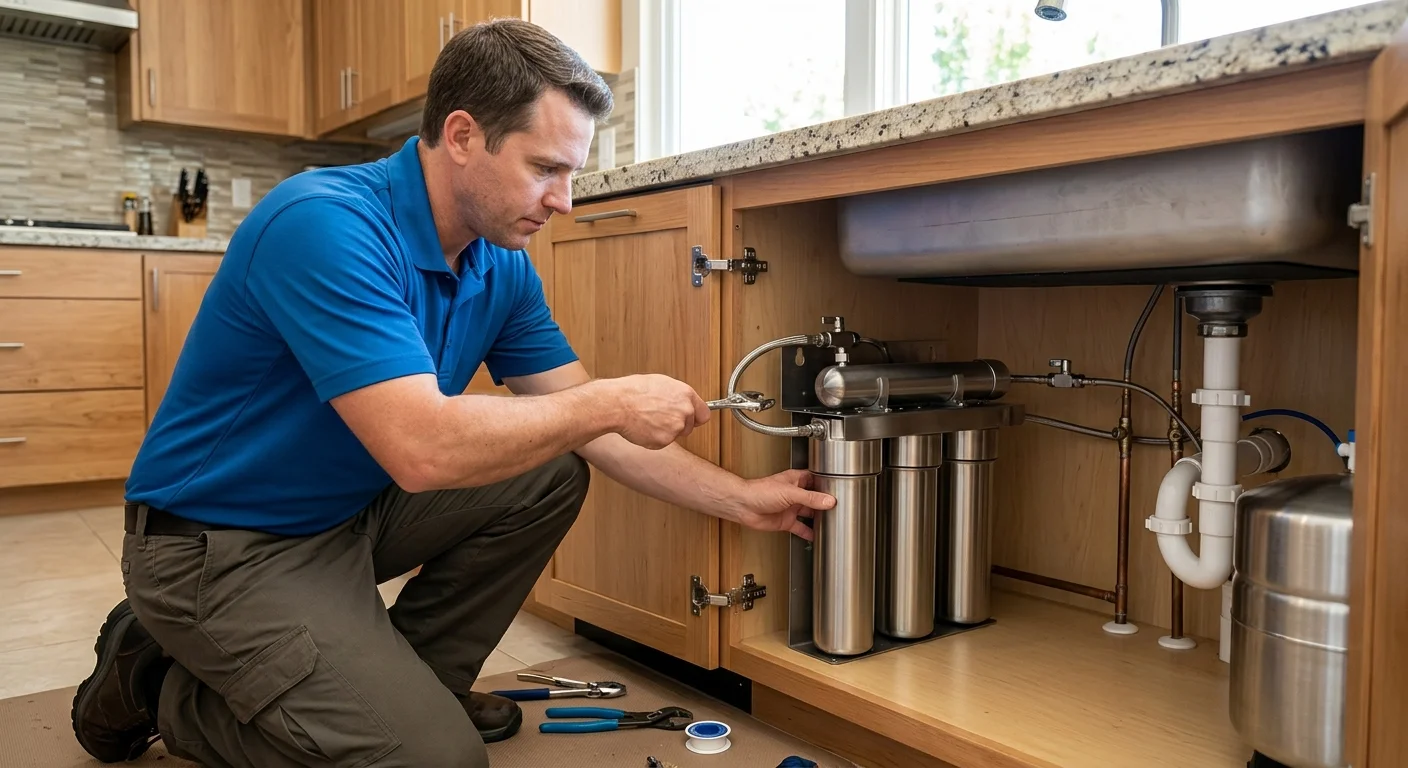
Most under-sink reverse osmosis systems need room for prefilters, the membrane housing, a storage tank, a dedicated faucet hole, and a drain connection. Measure the cabinet with the trash can and plumbing still in place. A deep farmhouse sink, a garbage disposal, and a stacked filter already in the cabinet all steal the same cubic inches.
Tank systems store treated water so the faucet can keep up during cooking. Tankless designs skip that tank and can fit a tighter cabinet. Neither layout is automatically better. The licensed pro checks feed pressure, drain routing, and whether the sink deck can take a second faucet. Follow the model manual for any air charge on a storage tank. One manufacturer’s troubleshooting notes discuss clogged prefilters, low feed pressure, kinked tubing, storage-tank air charge, and auto shut-off faults. Treat those as categories to inspect, not as universal specs.
Do not force a drain saddle onto a garbage-disposal discharge if the manual wants a different connection. Do not open a pressurized tank or work on wet electrical parts. Isolate the supply and call the installer if the unit leaks.
A refrigerator door filter is not a substitute for an under-sink RO system. It is a different certified claim, usually a different flow path, and it does not share the RO faucet. If ice and coffee taste are the goal, tell the pro so the RO line can be planned, or so a simpler filter can be left in place when RO is more than you need.
City of San Diego simple no-plan plumbing rules for water softeners do not travel to Escondido. An Escondido reverse osmosis permit rule could not be confirmed from the sources this site is allowed to cite. Ask the licensed pro and the building department that has the address before anyone cuts a sink hole in a rental, an HOA kitchen, or a historic house.
Leave space for the next filter change. Compare manufacturer maintenance and replacement-filter cost when you compare units. A cheap membrane with an awkward housing costs more once you live with it.
Questions for the separately licensed pro
Bring the water bill, the current Consumer Confidence Report if you are on a public system, and any well lab results. Then ask questions the catalog page cannot answer.
Ask which exact model is on the proposal and which NSF/ANSI 58 reduction claims that model holds. Ask whether fluoride, arsenic, or nitrate reduction is actually certified on that unit, or only discussed in brochure language. Ask for the waste-to-treated ratio the manufacturer publishes, and whether the unit carries a WaterSense label. Ask what pretreatment the well or the municipal tap needs so the membrane is not asked to do a softener’s job.
Ask who pulls any permit if one is required at this address. Filter Pros San Diego does not pull permits and does not perform the install. The separately licensed pro does the licensed work. Confirm that name on the CSLB site before you sign.
Ask how the faucet, tank, and drain will sit in this cabinet, and what happens to an existing garbage disposal. Ask which parts a homeowner may change and which parts stay in the pro’s scope. Ask for replacement-filter part numbers and the manufacturer’s maintenance interval in writing.
Ask for a written scope that names point-of-use versus any whole-house equipment. A kitchen RO does not soften the shower. A softener does not make RO drinking water. If both are on the table, they should appear as two line items with two jobs.
People on a restricted sodium diet sometimes confuse softeners with RO. Ion-exchange softening can add sodium. University of Nebraska–Lincoln Extension describes about 8 mg/L of sodium added for each grain per gallon of hardness removed. That is a softener estimate, not an RO result, and it is not medical advice. Drinking water is often taken from a kitchen cold line. Tell the pro if that line must stay unsoftened.
Then compare ownership cost against the EPA ranges above, the reject water the model will send to drain, and the filter budget. The cheapest box on a shelf is not the quote that belongs under an Escondido sink.
When to call us
Call when you want a reverse osmosis system matched to an Escondido address, a well, or a public meter, and a separately licensed Water Filtration pro to install it. Filter Pros San Diego arranges the free in-home water test and the referral. You contract with that pro directly. Call us at (858) 400-6508 to set up a free in-home water test.