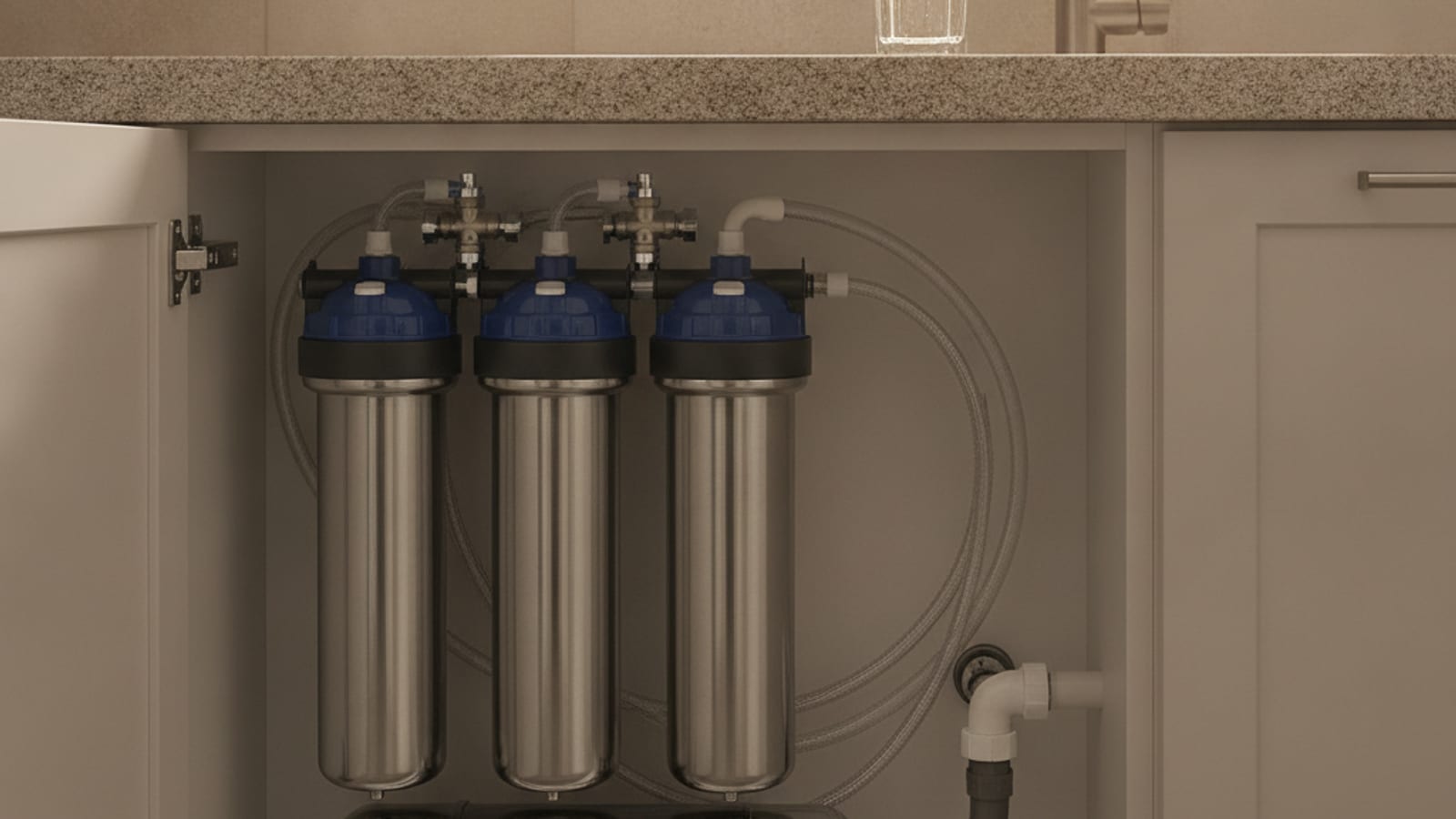
Reverse osmosis produces two water streams: treated water that passes through the membrane and reject water that carries away material the membrane does not pass. The reject stream is part of how the process works, but the amount varies by model and operating conditions.
Do not judge a system from a universal claim such as “one gallon wasted for every gallon filtered.” Compare the exact model’s certified efficiency rating, waste-to-treated ratio, contaminant-reduction claims, installation requirements, and maintenance documents.
Why an RO system sends water to the drain
In a point-of-use RO system, household water pressure pushes feed water against a semipermeable membrane. Some water crosses the membrane and becomes treated water, also called permeate. The remaining stream, called reject water, concentrate, or brine, carries rejected dissolved material toward the drain.
The reject stream helps move concentrated material away from the membrane. An ordinary filter captures material in its media until service or replacement. RO separates the inlet flow into treated and reject streams while it operates.
The EPA WaterSense overview of point-of-use RO uses these same two terms and explains why efficiency matters. It also cautions against installing RO for every application. Start with the actual treatment goal because a filtration technology that consumes little or no water may be enough for some concerns.
Efficiency percentage and reject ratio describe the same flow
An efficiency rating is the percentage of inlet water that becomes available as treated water:
Efficiency = treated water ÷ total inlet water × 100
A waste-to-treated ratio compares reject water with the treated water produced:
Waste-to-treated ratio = reject water ÷ treated water
A higher efficiency percentage is better. A lower waste-to-treated ratio is better. When comparing two products, make sure the figures were measured under the same applicable test method rather than mixing an advertised best case with a certified rating.
Worked hypothetical example
Suppose a model is documented at 50% efficiency under the applicable test conditions and your use produces 2 gallons of treated water.
- Total inlet water: 2 ÷ 0.50 = 4 gallons
- Treated water: 2 gallons
- Reject water: 4 − 2 = 2 gallons
- Waste-to-treated ratio: 2 ÷ 2 = 1:1
This is arithmetic for a hypothetical 50% model. It is not a promise that a particular system in your home will deliver that ratio. Use the exact model’s current certified listing and performance data sheet.
For another hypothetical, a 30% efficiency rating means 30 gallons of treated water from 100 gallons entering under the rated conditions. The remaining 70 gallons are reject water, which converts to roughly 2.33 gallons rejected per gallon treated. EPA’s WaterSense product search explains this conversion and lets buyers filter listed models by efficiency.
What EPA’s WaterSense label tells you
EPA reports that a typical point-of-use RO system can send five gallons or more to the drain for each gallon of treated water, while some inefficient systems can send up to ten. A WaterSense-labeled point-of-use RO system must demonstrate no more than 2.3 gallons of reject water for each gallon of treated water and must be independently certified to EPA’s criteria.
Those are category and label criteria, not the ratio for every unit. Search the exact brand and model in EPA’s current product list. Model numbers can include wildcard characters, so match the full product documentation carefully.
WaterSense also addresses performance criteria such as membrane life, baseline total-dissolved-solids reduction, and verification of additional contaminant claims made by the manufacturer. The label does not mean that every listed model reduces every contaminant. The product search and performance data sheet identify the claims verified for that exact model.
NSF/ANSI 58 is the relevant standard for reverse-osmosis drinking-water systems. Certification to the standard still needs to be read at the model and claim level. A standard name alone does not establish lead, nitrate, PFAS, arsenic, or any other specific reduction for every RO system.
Why the installed result may differ from a headline ratio
The rated figure applies under documented test conditions. Actual production and reject flow can change when the inlet conditions, system configuration, or maintenance state differ from those conditions.
Ask the manufacturer or installer to explain, using the model’s documentation, how these factors apply:
- Feed-water pressure and whether the model requires a pump
- Feed-water temperature range used for rated performance
- Inlet-water quality and any pretreatment requirements
- Membrane condition and replacement schedule
- Flow-control and automatic-shutoff components
- Tank versus tankless configuration
- Whether the quoted figure is certified efficiency or an informal ratio
Do not assume which factor is responsible for poor performance. A licensed professional can measure inlet pressure, observe drain flow, inspect installation, and compare the findings with the manual.
Estimate water use from your own drinking-water demand
To compare models, first estimate how much RO water the household actually uses for drinking and cooking. Then use each model’s documented ratio.
For example, if a household hypothetically uses 3 gallons of treated water per day and a model is documented at a 2:1 waste-to-treated ratio under applicable conditions:
- Treated water: 3 gallons
- Reject water: 3 × 2 = 6 gallons
- Total inlet water: 3 + 6 = 9 gallons
Again, those figures illustrate the calculation. They do not describe an unnamed product or predict a home’s bill. Actual water use, local rates, operating conditions, and model performance determine the result.
More stages do not automatically mean better treatment
Stage count is a poor substitute for verified performance. Identify the contaminant or aesthetic concern first. Then find the exact model’s certification and performance data sheet for that claim.
EPA notes that no single treatment system removes all contaminants. A carbon stage, membrane, remineralization cartridge, or other component has its own purpose and maintenance requirement. Ask what each stage does, what evidence supports it, and what happens to performance when its replacement is overdue.
For a broader technology comparison, see carbon filtration versus reverse osmosis and reverse osmosis versus a filter pitcher.
Do not improvise a reject-water reuse project
The reject stream contains the material rejected by the membrane at a higher concentration than the treated stream. Its composition depends on the feed water and the exact system. Do not route it to another fixture, storage container, irrigation line, or household use based on a generic online idea.
Any reuse plan needs an appropriate water-quality assessment, manufacturer approval, plumbing design, cross-connection protection, and confirmation of local requirements. A container and loose hose can create overflow, sanitation, and plumbing risks. Leave the installed drain and air-gap arrangement as designed unless a qualified professional approves a change.
Do not make a blanket assumption about septic systems either. Give the septic-system manufacturer or a qualified local provider the exact RO reject volume and installation plan, then ask how that flow fits the property’s system.
Compare models with a written checklist
Ask the seller or installer to put these details in the proposal:
- Exact brand and model number
- Point-of-use location and expected daily treated-water demand
- WaterSense listing status and certified efficiency rating
- Waste-to-treated ratio and the test conditions behind it
- NSF/ANSI 58 certification and exact contaminant-reduction claims
- Performance data sheet and replacement schedule
- Minimum and recommended inlet pressure and temperature ranges
- Pretreatment, pump, tank, drain, air-gap, and electrical requirements
- Filter and membrane replacement parts and costs
- How operation and drain flow will be checked after installation
- Equipment, installation, maintenance, and service charges
If a proposal promises a ratio without identifying the model and test basis, ask for the missing documentation. If it promises to remove everything, treat that as a reason to stop and verify each claim.
Keep the system operating as documented
Replace filters and membranes according to the manufacturer’s instructions. Delayed maintenance can reduce performance and may worsen water quality. Watch for changes in production rate, taste, pressure at the dedicated faucet, continuous drain flow, or unusual cycling, then use the model’s troubleshooting guide rather than adjusting valves blindly.
If you are comparing ownership cost, include cartridges, membranes, sanitizing or service procedures, water use, and any powered pump. Our RO filter replacement guide explains the maintenance questions to ask.
Get an address-specific recommendation
Filter Pros San Diego is an independent information and referral site. We arrange free in-home water tests and connect homeowners with separately licensed water-filtration professionals. The homeowner contracts with and pays the selected professional directly.
Schedule a free in-home water test or call (858) 400-6508. The in-home visit can help document the installation and basic water conditions, but it is not a promise to test for every contaminant. Bring the current utility report or certified-laboratory results for the concern you want the system to address.
Frequently asked questions
Does every reverse-osmosis system waste the same amount of water?
No. Efficiency and reject flow vary by model and test conditions. Compare the exact model’s certified efficiency rating and performance data sheet.
Is a 1:1 RO ratio the same as 50% efficiency?
Yes, in a simple flow calculation. One gallon treated plus one gallon rejected equals two gallons entering, so half becomes treated water. Verify that a product’s claimed ratio comes from applicable testing.
Does a WaterSense label mean the system removes every contaminant?
No. It verifies EPA efficiency and performance criteria, while additional contaminant-reduction claims remain model-specific. Check the product listing and performance data sheet.
Should every home install reverse osmosis?
No. Define the treatment goal first. Some concerns can be addressed by a technology that does not create a reject stream. Use your provider’s report or appropriate testing and compare certified claims.
Can I reuse RO reject water?
Do not improvise a reuse connection. The water composition and plumbing risks depend on the source and installation. Get manufacturer approval and qualified guidance for any proposed change.