Add salt to the brine tank only, never to the resin tank. Check the salt level, use only the type your manual allows, and leave headroom. Overfilling can form a crust that keeps the unit from making brine.
Find the brine tank, not the resin tank
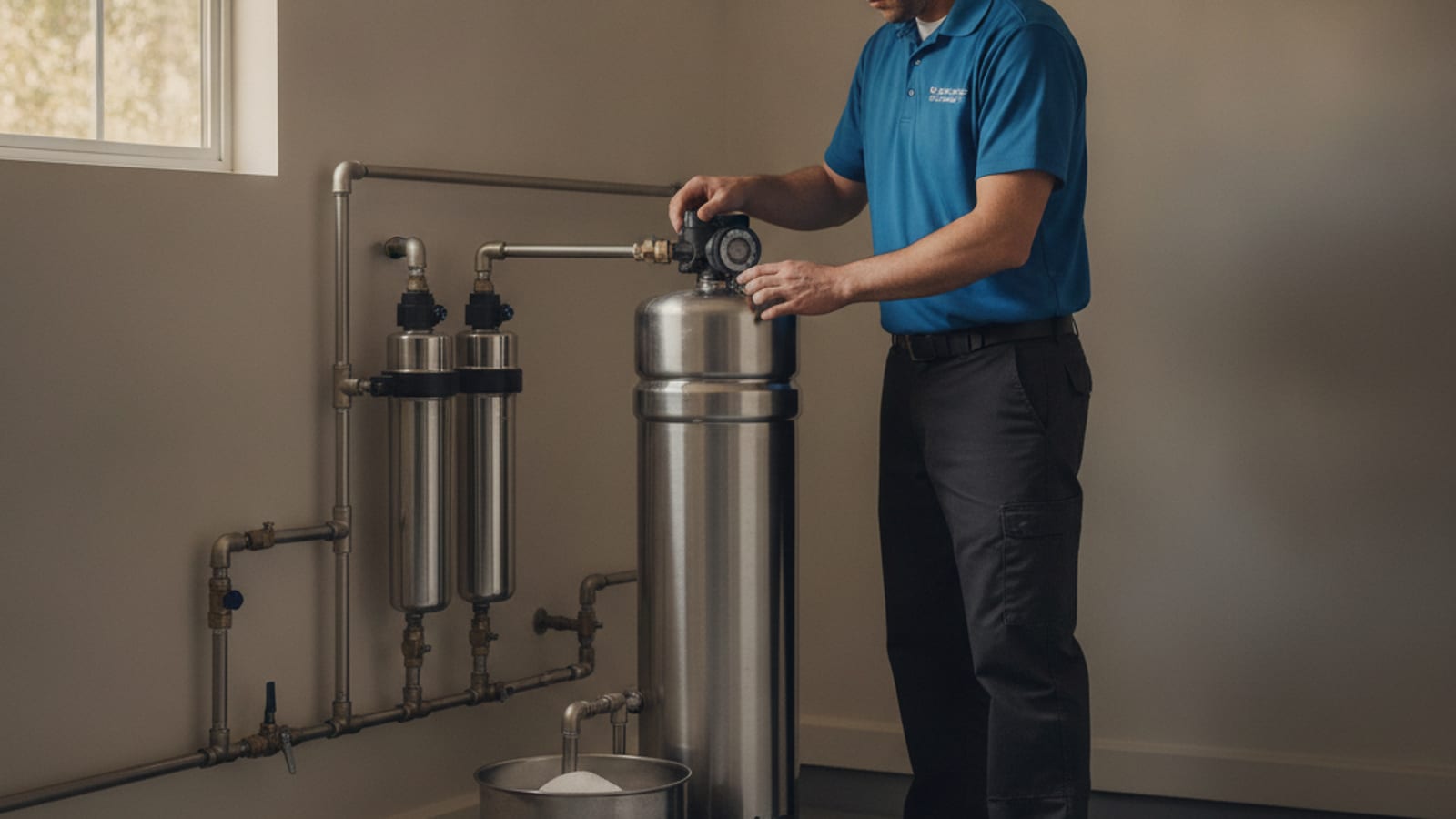
Salt belongs in the brine tank, not the resin tank. Kinetico’s refill instructions start with that split because the two vessels do different jobs. The brine tank is the open cabinet or plastic tub that holds pellets and water. The resin tank is the closed, pressurized vessel tied into the plumbing.
Open the lid that shows salt, not the opening around the control valve. Some brands hide both tanks in one cabinet.
If you cannot tell which tank is which, stop and check the model diagram. Pouring salt into the resin bed is not a refill.
Check the salt level before you pour
Look at the salt and the water before you open a bag. Kinetico says that if water is visible above the salt, add salt or potassium chloride. That cue is for its own equipment. Other brands set their own refill points in the manual.
A tank that looks full is not always ready for more salt. A hard crust can sit above the water and hold loose pellets on top. That’s a water softener salt bridge. The tank looks stocked, but the water below cannot dissolve fresh salt into brine.
Don’t keep dumping bags onto a crust. Don’t treat a broom handle as the one safe fix for every brand. Follow the model manual for inspection and clearing. If the lid, float, or brine well looks damaged, leave the tank alone and request a licensed professional.
Choose salt the manual actually allows
Use only the salt form the model manual names. Kinetico tells owners not to use rock salt. It also says tablet versus block depends on the model, so a bag that worked next door may be wrong here.
Potassium chloride is a possible substitute only when the exact model allows it. University of Nebraska-Lincoln Extension notes that some ion-exchange units can use potassium chloride instead of sodium chloride, with professional guidance. Confirm it in the manual before you buy a different product.
How full is full enough
Full enough means the level the manual sets, not the lid. Kinetico’s own fill guidance is one-half to three-quarters full for medium to high usage, and about one-half full for low usage. It also says not to fill the tank completely, because overfilling can cause bridging. Other brands win when they disagree. Copy their number, not this one.
| What you have | Fill only this far |
|---|---|
| Kinetico, water visible above the salt | Add allowed salt or potassium chloride |
| Kinetico, medium or high usage | About one-half to three-quarters full |
| Kinetico, low usage | About one-half full |
| Any other brand | The fill height in that model’s manual |
| A hard crust with a gap under it | Stop pouring and use the salt-bridge steps for the model |
Harder water uses salt faster because regeneration has more calcium and magnesium to remove. That’s why a San Diego home can empty a tank sooner than a home on softer supply. It’s not a reason to pack the tank to the rim.
The City of San Diego plumbing page reports that drinking water in the City typically averages about 16 grains per gallon (276 ppm). It can range from 16 to 18 grains per gallon depending on area and water demand. Those figures are for the City’s system only. They are not countywide and they do not describe private wells.
The City’s 2025 Consumer Confidence Report is a different publication covering different measurements. For 2025 it lists plant hardness averages of 13.8 grains per gallon at Alvarado, 14.1 at Miramar, and 14.2 at Otay. Purchased treated water averaged 8.5 grains per gallon. For the hardness at your house, start with whether San Diego water is hard and the current report from the utility on your bill.
There’s no honest bags-per-month number that fits every home. How fast salt drops depends on hardness, how many people use water, and how the unit is set. If the level barely moves, see how to know if a water softener is working before you buy more salt.
After you add salt
After you add salt, close the lid and leave the pellets loose. Don’t tamp, pack, or wet the load to settle it. Keep pellets out of the valve opening and off the resin-tank cabinet.
Wait for the next scheduled regeneration unless the manual tells you to start one. Adding salt doesn’t soften water by itself. The unit still has to dissolve brine and recharge the resin.
If you already had a crust, more salt won’t fix it. A refill is also not annual service. Water softener maintenance in San Diego covers brine-tank cleaning, valve checks, and hardness settings, which a bag of salt does not replace.
Request a local referral
Request a local referral when you cannot identify the tanks, a crust won’t clear, or hard water continues after a refill. Filter Pros San Diego is an independent information and referral site. We do not install, repair, or deliver salt. We connect homeowners with separately licensed water-filtration professionals, and the homeowner contracts with and pays the selected professional directly.
Call (858) 400-6508 or use our water softener installation page to request a local match. Share the brand, model number, and what you saw in the brine tank. Response time, diagnosis, price, parts, and warranty must be confirmed directly with the professional.
Frequently asked questions
Can I add salt to the resin tank?
No. Salt goes only in the brine tank. If pellets went in the wrong opening, do not run the unit. Request a licensed professional before the next cycle.
How often should I add salt to a water softener?
When the level drops to the refill point in the manual, not on a fixed calendar. Harder water, more people, and more frequent regeneration all use salt faster.
Can I use potassium chloride instead of salt?
Only if the exact model allows it. Kinetico lists potassium chloride as an option on its refill page. Other brands may not. Confirm the substitute in the manual.
What if the tank looks full but the water is hard?
A salt bridge can hide an empty water space under a crust. Stop adding salt and read the salt-bridge guide. If clearing the crust does not restore soft water, the problem may be bypass, resin, or the control valve.
How full should I fill the brine tank?
Follow the model. Kinetico’s published range is about half full for low use, and half to three-quarters full for medium or high use. Do not fill to the lid.
Does San Diego hard water mean I will use more salt?
Often yes, because regeneration has more hardness to remove. That still is not a countywide average or a monthly bag count.