The lab slip on the kitchen counter is the whole story, not the smell of the tap. A finding of coliform in well water is an indicator that something reached the sample, not a taste diagnosis and not a list of every pathogen. On private wells around Ramona, Valley Center, Fallbrook, and East County, that result starts a confirmation process, and it is not a reason to keep drinking the tap while you wait.
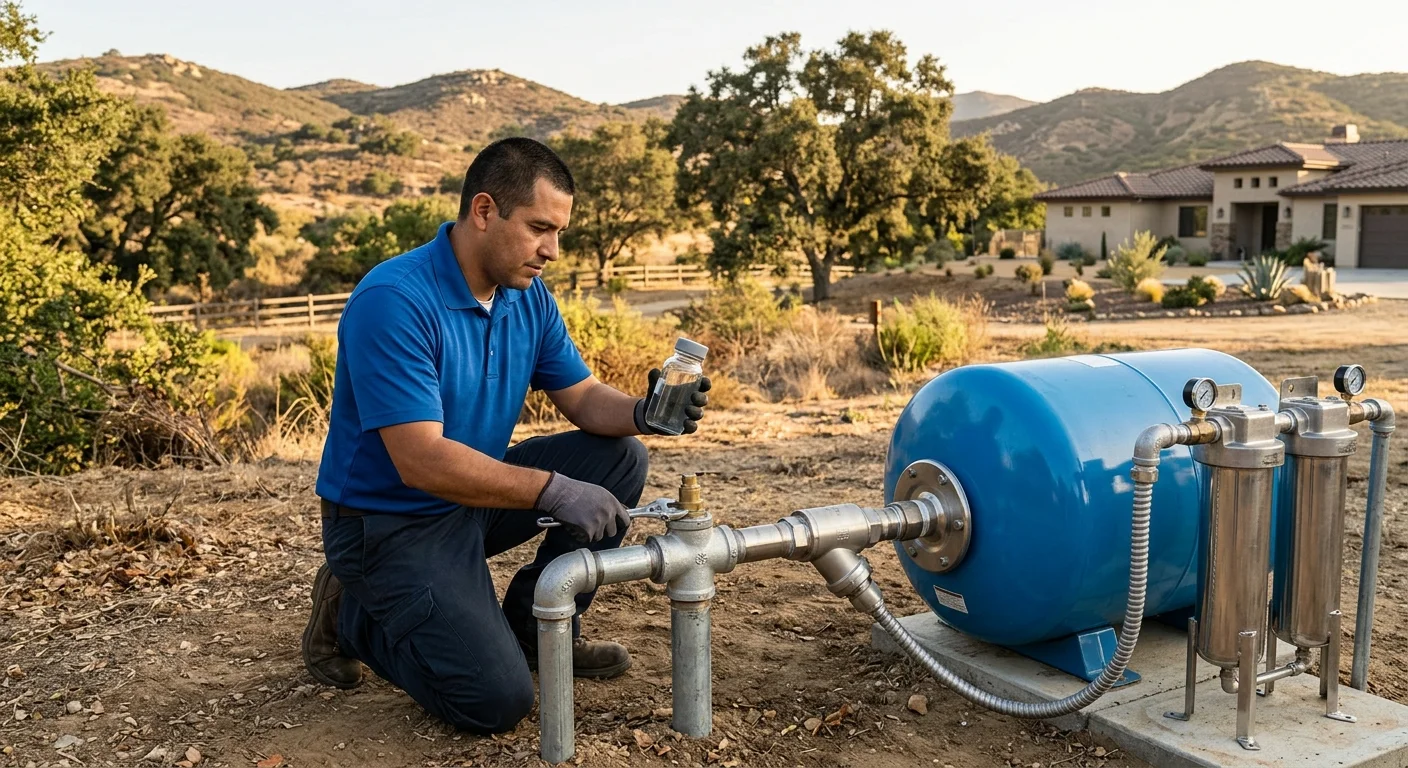
A lab result is not a taste or smell diagnosis
Clear water from a well in Lakeside or a ranch tap in Valley Center can still fail a bacteria test. Coliform bacteria are a group of organisms labs use as a sanitary flag. CDC guidance treats a positive total-coliform result as an indicator, not as identification of every pathogen that might be in the well. The test tells you a pathway may exist. It does not name the organism that would make someone sick.
A glass, a TDS pen, or a hardness strip cannot settle a bacteria question. City of San Diego tap water is a different supply, with a published Consumer Confidence Report and treatment plants behind it. A private well is not on that report. The City’s published hardness figures describe the City system. They say nothing about bacteria in a well off the meter in Ramona or Alpine.
CDC recommends annual testing of private wells for total coliform, nitrate, TDS, and pH. Harmful or suspected contamination is a reason to use another safe water source and to get health-department guidance. Boiling does not remove chemical contamination. A bacteria flag is not a reason to skip nitrate or the other tests that still matter on a rural well. If someone in the house is ill, that is a question for a clinician.
Whether that water is fine for showers, tooth brushing, or washing produce is not a rule we can confirm from San Diego County’s published private-well materials. Ask the local health or environmental office what they want households to do for drinking, cooking, and bathing until the retest comes back.
What private-well owners in rural North County and East County should confirm
Not every home in Fallbrook or Ramona is on a well. Inland North County and East County mix septic tanks, animal yards, groves, and decomposed granite. After the first winter storms, that ground sheds runoff toward low spots. CDC lists animal waste, septic systems, wastewater, flooded sewers, polluted stormwater runoff, fertilizers, farm runoff, and decaying plants as possible nitrate sources. Local geology also affects whether a well has nitrate. Those are possible sources, never the proven cause of your specific sample. A coliform flag still points you at the wellhead, the ground around it, and anything that can wash toward the casing.
Confirm what the lab actually reported. Presence of total coliform is not the same sentence as a named pathogen. Follow the laboratory’s written collection steps on the next bottle. We could not confirm a San Diego County private-well resampling checklist, a required setback in feet, or a county lab fee from county materials we reviewed. The people who set those steps are the local health and environmental authorities. Call them and ask which state-certified labs they recognize and what they want resampled.
Walk the well with a licensed well contractor, not a guess from a blog. Look for a cap that is not tight, ponding at the slab, a cracked sanitary seal, or a sample taken from a dirty hose bib. Do not treat a City page or a San Diego County Water Authority water-quality page as a stand-in for a private well. Those pages describe treated imported supply and retail systems.
Until the health office and a certified retest say otherwise, use another safe water source for drinking and cooking. That is CDC’s direction for harmful or suspected contamination. Leave the pressure tank and piping alone until a licensed pro says what to open. Do not dump chemicals down the casing as a first move.
Separate shock chlorination, filtration, and UV
Clearing coliform in well water is not one product. CDC says to match treatment to the identified problem and to test again to confirm it worked before you resume use. No single technology removes every contaminant.
Shock chlorination is a one-time disinfection of the well and plumbing with a chlorine dose. We are not going to prescribe that dose. Shocking also does not repair a broken cap, a cracked casing, or a septic leak. If the pathway stays open, the next rain can bring the same result back. A one-time disinfection can clear a sample after the pathway is fixed. That is not a promise. It is not finished until a certified lab says the water is clear.
Filtration is not the same as disinfection. A sediment or carbon cartridge can change taste, particles, or chlorine on city water. It is not a verified claim that a generic filter, a softener, or a salt-free conditioner removes coliform. NSF/ANSI 42, 53, 44, and 58 cover aesthetic claims, specified health-effect claims, softeners, and reverse osmosis on the exact model. A standard is not a bacteria ranking. Verify the certified reduction claim. Do not assume a kitchen pitcher made a well safe.
UV water treatment is a separate disinfection approach that acts on water as it passes a lamp. It is not a repair of the wellhead. It is not a claim that UV, carbon, or softening makes the water safe. A licensed pro may discuss UV after the source is understood, with pretreatment if the water is cloudy, because light cannot do its job through dirty water. Whole-house water filtration treats water as it enters the house. Point-of-use devices treat a selected tap. EPA’s home-treatment guidance is to pick the goal from testing, then compare certified claims, maintenance, and water use. When the pros we send talk equipment, ask about medical-grade stainless steel tanks rather than fiberglass tanks with a plastic liner. That is a tank-construction choice. It is not a bacteria-kill rating.
When a certified laboratory retest is required
The first bottle is a snapshot. It can be the well, or it can be a dirty faucet, a hose, or a sample that sat too long. A state-certified laboratory is the authority CDC names for well testing. An in-home screening is not that lab.
Retest when the first result shows total coliform. Retest after any work on the well, pump, or pressure tank. Retest after flooding or heavy runoff around the casing. Retest after you think treatment worked, and do it before you go back to drinking the tap. Test to confirm treatment worked before resuming use.
How often you test in a quiet year is a different question. CDC’s annual list is total coliform, nitrate, TDS, and pH, plus whatever else local authorities say fits the location. Inland wells near livestock or septic may need a broader conversation with those authorities. We did not confirm a San Diego County mandate that names extra analytes or a required season. Wet ground after winter storms can change a well. That is a reason to sample when the soil is wet, not a published county rule. For a fuller testing calendar, see how often to test a private well in San Diego County.
Ask the lab whether the report is presence or absence, or a count, and whether they ran further analysis on the same sample. Do not invent a legal limit for a private well from public-system rules. Public water systems follow federal limits and California Division of Drinking Water limits. If the paperwork is confusing, take it to the health office and to a licensed water-treatment pro. Do not resume use on a hunch.
What an in-home screening can’t replace
Filter Pros San Diego arranges a free in-home water test and connects you with licensed Water Filtration pros. That visit is a screening and a conversation about hardness, taste, and treatment scope. It is not a state-certified bacteria result, and it does not replace the bottle that went to the lab. Ask the pro on site what the screening does and does not measure. We do not invent a list of laboratory analytes for that visit.
A certified coliform test needs the lab’s bottle, the lab’s hold time, and the lab’s method. Home strips, store kits, and a TDS meter are not that method. USGS notes that specific conductance can approximate dissolved solids and that the relation varies with water composition. A conductivity reading is not a constituent-specific laboratory analysis. It is not a coliform answer.
If the well still fails after a disinfection event or a filter change, the problem is still the source or the plumbing. Keep using another safe water source. Keep the health office in the loop. A licensed well contractor owns well construction. A licensed Water Filtration pro owns treatment after the water is understood. Check a contractor’s license on the CSLB license lookup before anyone opens the system. The homeowner contracts with that pro directly. Filter Pros does not perform the licensed work.
When to call us
Call when a certified lab has flagged coliform, when you need a screening that sits beside that lab work, or when a licensed Water Filtration pro should match filtration or UV to a known problem instead of guessing. Call us at (858) 400-6508 to set up a free in-home water test.