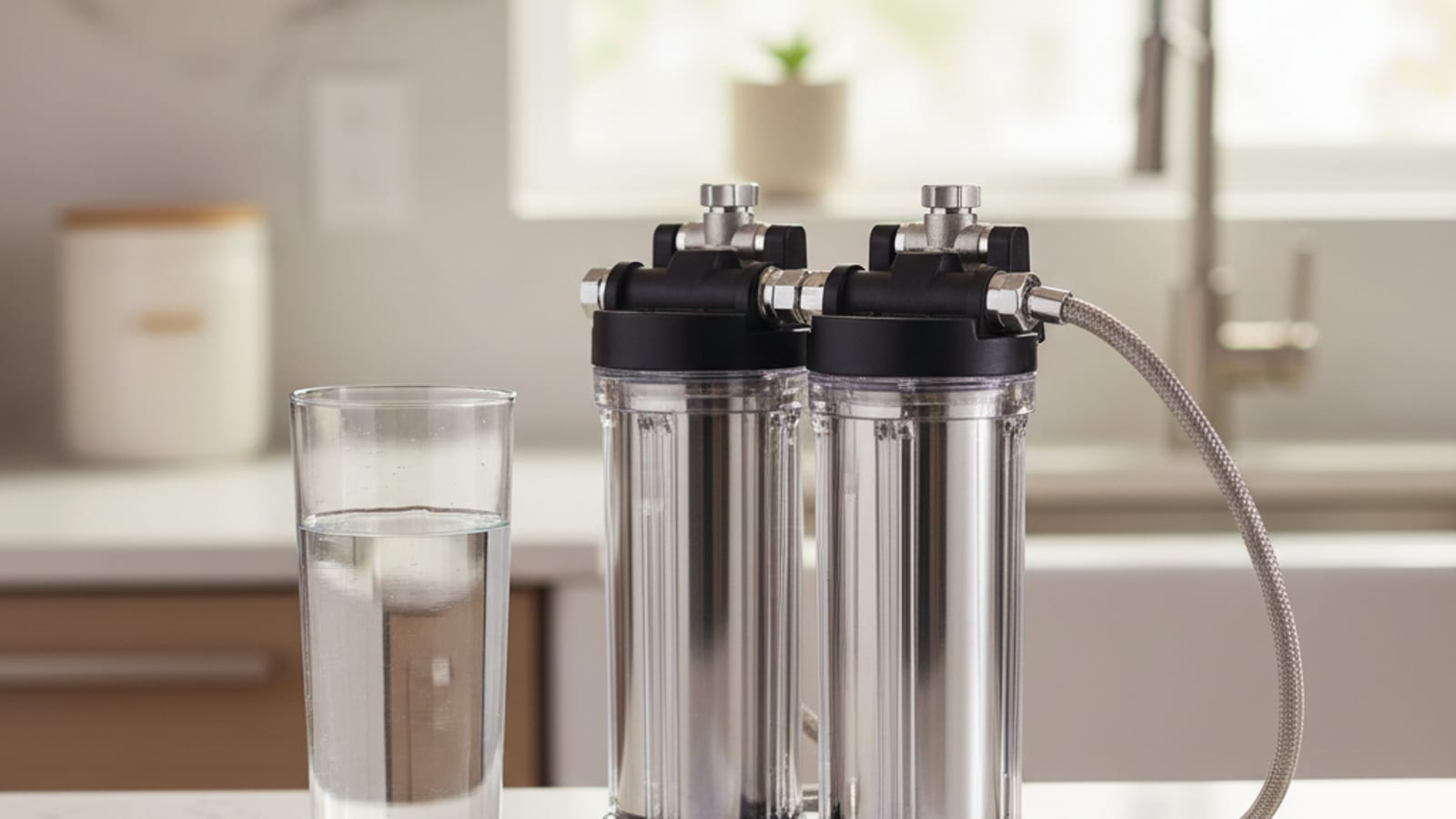
PFAS questions usually lead to two practical decisions: where to find current information for your water supply, and how to evaluate a treatment product without relying on broad marketing claims. The answer depends on your serving utility, the concern you want to address, and the exact model you are considering.
What PFAS are
PFAS stands for per- and polyfluoroalkyl substances. PFOA and PFOS are two names homeowners may see in water-quality reports and treatment-product listings.
Drinking-water contaminant limits are set federally by the U.S. Environmental Protection Agency (EPA) under the Safe Drinking Water Act. California also sets drinking-water requirements through the Division of Drinking Water. Because rules, monitoring, and public notices can change, use those agencies for current regulatory guidance instead of relying on a number or compliance date repeated in an older article.
How to check PFAS information for a San Diego address
San Diego County is served by multiple water agencies, so a result from one system should not be applied to every tap in the county. Start by identifying the utility named on the water bill, then read that utility’s latest Consumer Confidence Report and any current water-quality notices.
For City of San Diego customers, the Public Utilities water-quality portal provides current reports and notices. If another agency serves the address, use that agency’s report instead.
When reading a report, note:
- the utility and system covered;
- the report year and sampling period;
- the sampling locations or water sources described;
- which PFAS were analyzed and how results are reported; and
- any instructions or notices from the utility or drinking-water regulator.
A utility report describes the system and period stated in the document. It does not establish the PFAS result at every fixture, in every building, or for a private well.
If you need a result for a particular tap or private water source, ask an appropriate laboratory whether it offers the PFAS analysis you need. Before ordering, ask which compounds the method covers, how to collect and ship the sample, the reporting limits, the price, turnaround time, and how the result should be interpreted. A field reading such as total dissolved solids or conductivity is not a PFAS analysis.
How to evaluate home treatment for PFAS
No single treatment technology removes every contaminant. Identify the water concern first, then compare the exact product’s independently certified reduction claims, treatment location, maintenance requirements, replacement-filter costs, and water use.
Check the exact certified claim
NSF/ANSI 53 covers specified health-effect contaminant reduction claims. NSF/ANSI 58 covers reverse osmosis systems. Certification to a standard is not a performance ranking and does not mean that every model certified to that standard has a PFAS reduction claim.
For any carbon, reverse osmosis, pitcher, faucet, under-sink, or whole-house product, ask for the exact model number and its current certification listing. The listing should name the applicable PFAS reduction claim for that model and identify any required replacement element. A general statement about the filter material, membrane, brand, or standard number is not enough.
Match the treatment location to your goal
A point-of-use device treats water at a selected tap. A point-of-entry system treats water entering the residence. If the goal is drinking and cooking water at the kitchen sink, compare point-of-use options against that scope. If you are considering whole-house water filtration, confirm that the exact proposed model has the claim you need and ask what water and fixtures its certification and written scope cover.
Reverse osmosis drinking water systems produce treated water and reject water. Their contaminant claims, efficiency, and maintenance needs are model-specific. Ask the provider to show the exact model’s current PFAS reduction listing, expected water use under the relevant conditions, replacement schedule, and total ownership cost.
Plan for maintenance and verification
A certified claim depends on using the product within its listed conditions and following the manufacturer’s maintenance and replacement instructions. Before choosing a system, request the model number, certification listing, replacement-element numbers, service schedule, and written scope.
If a measured PFAS result is the reason for treatment, discuss appropriate follow-up laboratory testing with the laboratory or relevant water authority. A product label, field screen, or change in taste does not provide a PFAS laboratory result or a general safety clearance.
Questions to bring to a provider
Use the utility report or laboratory result to keep the conversation specific:
- Which exact model are you proposing, and where can I verify its current PFAS reduction claim?
- Is it point-of-use or point-of-entry, and which taps or water lines does the written scope cover?
- What replacement elements and maintenance does the manufacturer require?
- How much treated and reject water should I expect for this exact RO model, if applicable?
- What installation, maintenance, and replacement costs are included in the written quote?
- If follow-up PFAS testing is appropriate, which laboratory method and sampling instructions should I use?
You can also begin with a free in-home water test from an independent provider. Confirm which field measurements the provider includes. This visit is not PFAS laboratory analysis and does not prove that the water is safe from every contaminant.
Filter Pros San Diego introduces homeowners to independent licensed providers. The homeowner contracts with and pays the provider directly, and the provider supplies the equipment recommendation, certification information, and written scope.
For questions or to schedule a field screening visit, call (858) 400-6508.
Related: PFAS removal systems for San Diego homes | Whole-house water filtration options