San Diego’s published hardness can scale a tankless heater. City plant figures and a plumbing-page average describe City water, not every county tap or well. Pretreatment compares hardness removal with scale prevention, not a one-size package.
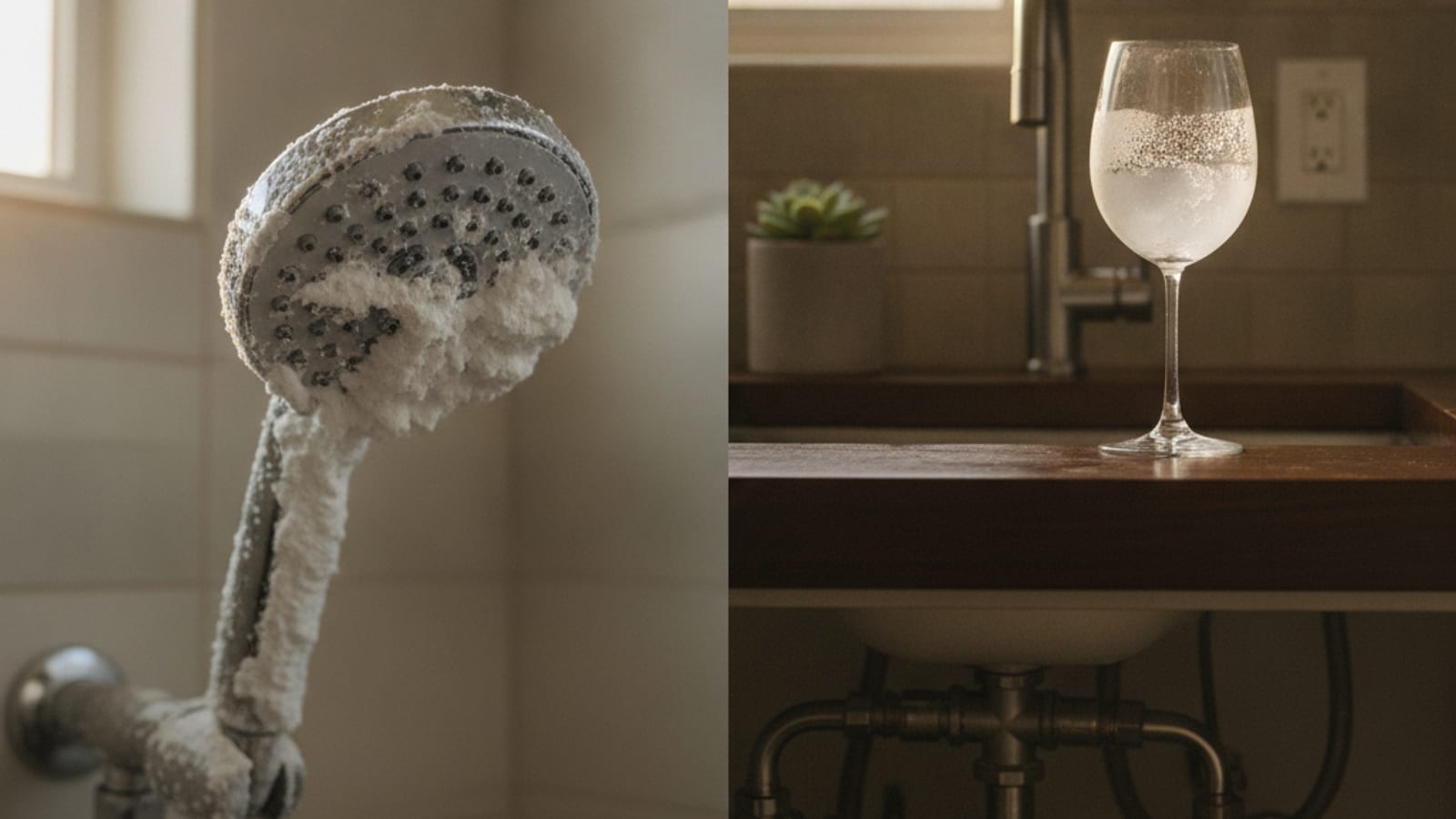
Why tankless units feel hardness faster
A tankless heater warms water as it flows through a compact heat exchanger, so hardness minerals have a small, hot surface to settle on. Scale can restrict those passages, cut heat transfer, and show up as a service issue on inlet screens, flow sensors, and heat-exchanger channels. The same incoming hardness still affects fixtures and plumbing, which our guide to hard water effects on your home covers separately.
Visible scale on a faucet is not a heater diagnosis. Write down error codes, reduced hot-water flow, and the exact brand and model. Then read the manual’s scale and flushing section before anyone opens the unit.
What City of San Diego reports actually say
City publications report hard water in the City system, with plant-level grains in the 2025 Consumer Confidence Report and a separate typical average on the plumbing page. Those figures are not countywide and do not describe private wells.
The City of San Diego 2025 Consumer Confidence Report (Public Water System 3710020) lists total hardness in grains per gallon:
| Plant or source | 2025 average (gr/Gal) | 2025 range |
|---|---|---|
| Alvarado | 13.8 | 11.9 to 15.8 |
| Miramar | 14.1 | 11.7 to 16.6 |
| Otay | 14.2 | 11.7 to 15.8 |
| Purchased treated water | 8.5 | 3.18 to 13.6 |
The City’s home plumbing water page uses a different measurement. It says drinking water in San Diego typically averages about 16 grains per gallon (276 ppm) and can range from 16 to 18 gr/gal depending on area and demand. When both numbers appear, they are different City publications covering different measurements.
Confirm the serving utility on the bill. For address-level context, see whether San Diego water is hard. A well needs a test at that well. A free in-home water test can measure hardness at the tap for planning. It is not a laboratory safety clearance.
Maintenance and warranty language to read
Navien’s published language treats flushing and descaling the heat exchangers as part of tankless maintenance, and it says hard water may require that service more often. That is Navien’s language for Navien equipment. Other brands require you to read their own manuals and warranties. There is no universal descaling interval.
Navien’s tankless maintenance page includes flushing and descaling heat exchangers among required upkeep. The same page says hard water may need more frequent maintenance, and that an anti-scale or water-softener system can reduce mineral buildup. Those are Navien’s published statements, not a household energy-savings result and not a Filter Pros schedule.
Navien’s NHW-SE warranty lists improper maintenance, including scale buildup, among events that void the warranty. It also lists damage from hard water deposits, lime, or mineral build-up. Pull the exact model warranty. Other brands use different documents.
Navien also warns that damaging the heater during owner maintenance may void the warranty. Isolation, flushing chemistry, and service steps belong to a licensed professional unless the manual authorizes an owner procedure for that model.
Softener, salt-free conditioner, or scale-prevention device
A water softener removes hardness minerals. A salt-free conditioner does not. Scale-prevention devices such as Navien PeakFlow-type products have their own certified claims and feedwater limits.
Ion-exchange softening swaps calcium and magnesium for sodium or potassium. Compare the exact model’s NSF/ANSI 44 certification, rated working capacity, and water and salt efficiency. Water-softener installation is the path when the goal is actually softened water.
Salt-free conditioners leave hardness in the water. They are intended to reduce scale formation under the conditions in their documentation. EPA consumer guidance points to IAPMO/ANSI Z601 for evaluating scale-reduction devices. Do not treat a salt-free conditioner as a softener. See our water softener vs salt-free conditioner comparison and salt-free water conditioning.
Navien PeakFlow-type devices are scale-prevention products, not ion-exchange softeners. Ask for the exact certified claim, the feedwater limits, and whether the heater warranty still requires flushing.
How to compare a pretreatment quote
Ask for the measured hardness, the heater model, the exact pretreatment model, and the written maintenance and warranty effect before comparing price. A one-size package that ignores those four items is not a comparison.
Request this in writing:
- Serving utility or well status, plus the hardness result and test method
- Tankless brand, full model number, and the manual or warranty pages that mention scale
- Pretreatment type: ion-exchange softener, salt-free conditioner, or scale-prevention device
- Exact manufacturer and model, with the certified claim and feedwater limits
- What heater flushing, if any, the manufacturer still requires after pretreatment
- Plumbing, drain, bypass, permit, access, price, and who is responsible if scale still forms
Do not accept an energy-savings percentage as a household result. Do not accept a salt-free conditioner described as producing soft water. Size a softener from measured hardness and indoor water use, excluding irrigation when appropriate, as EPA’s water-softener guide describes. Heater flushing is heater service. Pretreatment is water treatment. Keep those scopes separate on the quote.
Request a local referral
Filter Pros San Diego is an independent information and referral site. We do not install or service tankless heaters or pretreatment equipment. We connect homeowners with separately licensed water-filtration professionals, and the homeowner contracts with and pays the selected professional directly.
Call (858) 400-6508 or request a free in-home water test match. Share the heater brand and model, any warranty language you have, and whether you want hardness removed or scale reduced. Response time, diagnosis, price, parts, and warranty must be confirmed directly with the professional.
Frequently asked questions
Does San Diego hard water damage tankless heaters?
Hardness can form scale on heat exchangers. Navien’s published NHW-SE warranty language treats scale buildup and hard-water deposits as issues that can void coverage. Damage is not automatic at every address. Confirm the serving utility’s current report or test a well, then read the exact heater warranty.
How often should I flush a tankless water heater?
There is no universal descaling interval. Navien’s published maintenance page includes flushing and descaling as part of upkeep and says hard water may need more frequent service. Follow the manual for your brand and model.
Will a salt-free conditioner protect a tankless heater the same way a softener does?
No. A softener removes hardness minerals. A salt-free conditioner leaves them in the water and is intended to reduce scale formation. Compare the exact certified claim and the heater manufacturer’s pretreatment notes.
Do City hardness numbers apply to my tankless heater?
Only if the City of San Diego serves the address, and even then they are system or plant figures, not a tap measurement. Other districts and private wells need their own report or test.
Can pretreatment replace heater flushing?
Not unless the heater manufacturer says so for that model. Navien still lists flushing and descaling as maintenance and says hard water may require it more often. Read the exact manual.