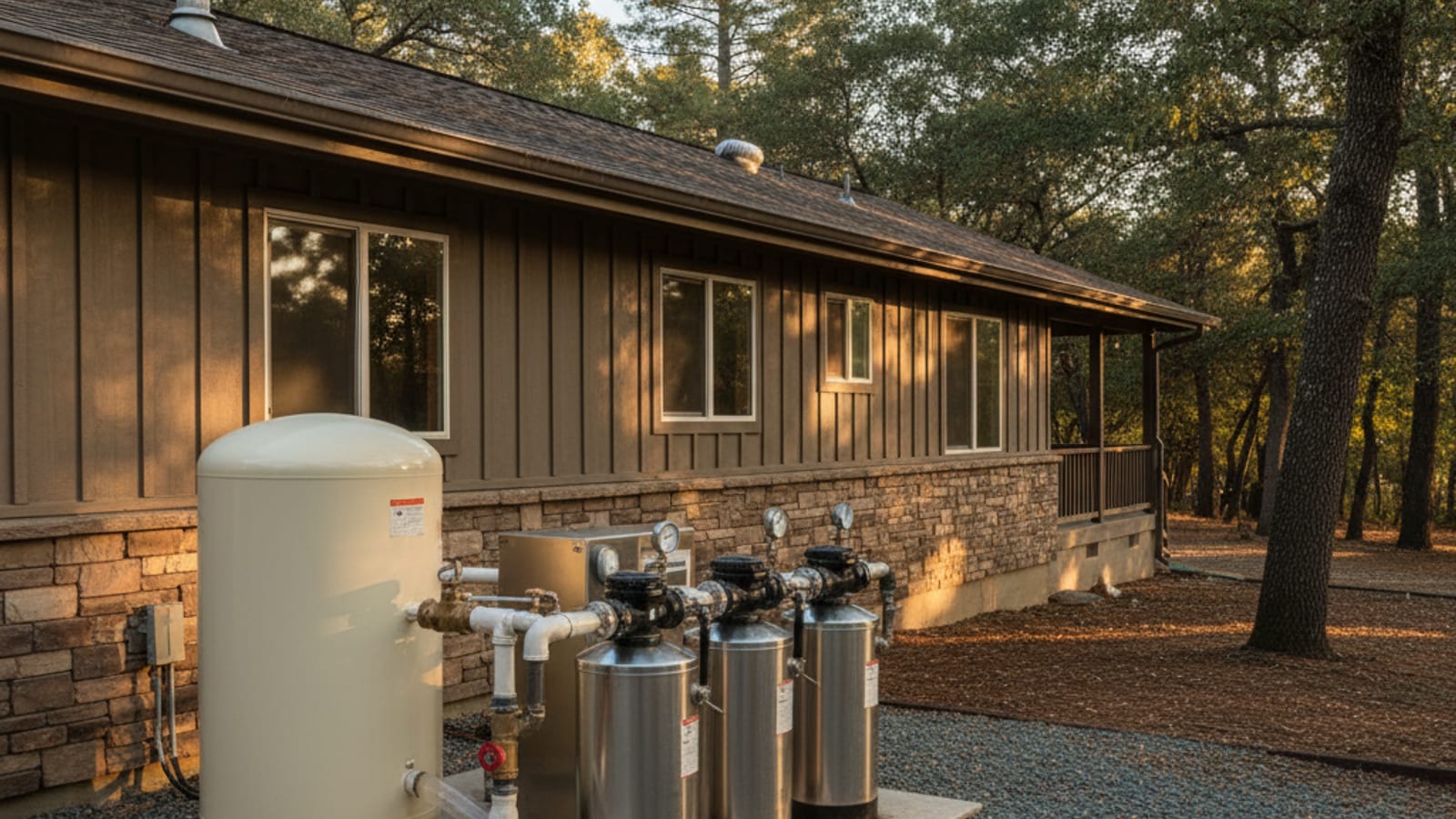
Well water treatment in San Diego County starts with a state-certified laboratory, not a standard equipment package. A private-well owner is responsible for testing the source, understanding the report with the appropriate health or environmental department, correcting problems at the well when possible, and verifying that any treatment works.
Two nearby wells can have different results. Visible sediment, staining, odor, scale, or a change in taste can justify testing, but none identifies a contaminant by itself. A free in-home screening can document limited field conditions. It cannot declare well water safe or replace certified laboratory analysis.
Build a testing record before choosing treatment
The CDC well-testing guidance recommends testing private wells at least annually for total coliform bacteria, nitrate, total dissolved solids, and pH. CDC also recommends asking the local health or environmental department what other germs or chemicals fit the location and circumstances.
Use a state-certified laboratory and follow its collection instructions. Keep the complete report with:
- Well and property identification
- Analyte name, units, result, reporting limit, and qualifiers
- Sample date and exact collection point
- Whether existing treatment was operating or bypassed
- Recent flooding, well work, plumbing changes, or treatment service
Do not use a City of San Diego or another utility’s water-quality report to describe a private well. Do not apply a neighbor’s result to your property.
What common observations can and cannot tell you
Orange or reddish staining can support testing for iron. EPA’s secondary guidance associates iron at 0.3 mg/L with rusty color, sediment, metallic taste, and reddish or orange staining. A stain still does not measure the concentration or select a treatment model.
Rotten-egg odor can justify investigating the well, plumbing, water heater, and appropriate laboratory analysis. Smell alone does not prove hydrogen sulfide or identify its source.
Sediment or cloudiness can come from several conditions. Record when it appears and ask the laboratory or well professional what sampling and mechanical inspection are appropriate.
Scale or poor soap performance can support a hardness test. Do not rank a private well against coastal or public water without measurements. Use the result from this well.
Metallic taste or blue-green staining can justify testing water chemistry and plumbing-related metals. A field pH reading or appearance cannot establish a health conclusion.
No visible change does not rule out bacteria, nitrate, arsenic, or another chemical. Those decisions require the correct analysis.
If a result shows harmful or suspected contamination
CDC provides a clear sequence:
- Stop drinking or using the well water as directed. Use bottled water or water from another safe source.
- Contact the local health department. Ask for result-specific advice, including which household uses are affected and whether more testing is needed.
- Confirm the result through a state-certified laboratory. Follow its instructions for analyte, sample point, containers, timing, and transport.
- Investigate and correct the source where possible. A licensed well professional may need to inspect the cap, casing, seal, drainage, nearby abandoned wells, or other pathways.
- Select model-specific treatment for the confirmed problem. No single technology protects against every germ or chemical.
- Retest before returning to normal use. Use the sample locations and schedule given by the laboratory or health department.
Boiling can kill germs when public-health guidance calls for it, but boiling does not remove chemical contamination. Do not use boiling for nitrate, arsenic, or another chemical result.
What a positive coliform or E. coli result means for the next step
Total coliform is an indicator that the well or sampling process needs investigation. E. coli or fecal-coliform findings require prompt public-health guidance. Do not diagnose the pathway from the result alone.
Use another safe source while following the health department’s instructions. Ask whether a confirmation sample is needed and whether it should be analyzed specifically for E. coli or other organisms. The laboratory may require a new sterile bottle and a different collection point.
Then have the well and surrounding area inspected. Relevant questions include whether the cap is secure, the casing or seal is damaged, surface water can collect nearby, recent work opened the system, or another route allows contamination to enter. Repairing the entry path matters because treatment equipment does not repair a damaged well.
Disinfection should follow current local guidance and be performed by an appropriately qualified professional. Do not improvise a chemical dose from an online formula. Well volume, construction, treatment equipment, chemical handling, flushing, and wastewater concerns all affect the procedure.
Finally, retest through a state-certified laboratory before using the water normally. A clear appearance, missing odor, completed disinfection, or operating UV lamp is not proof that the result is negative.
Design treatment from the confirmed goal
Treatment is a sequence only when the laboratory results and equipment requirements justify those stages. There is no universal five-stage well system.
| Confirmed goal | Technology that may be discussed | What must be verified |
|---|---|---|
| Particles or sediment | Appropriate mechanical filtration | Particle conditions, flow, pressure loss, filter rating, service interval |
| Iron-related staining | Iron-specific treatment | Iron result and form, pH, other water chemistry, flow, backwash and maintenance |
| Odor concern | Source-specific treatment | Confirmed cause, hot versus cold water, whole-house versus fixture source |
| Hardness | Ion-exchange softener or scale-control system | Measured hardness, household use, working capacity, exact performance claim |
| Bacteria or other germs | Source correction, disinfection, and possibly UV or another certified process | Organism, pretreatment, flow, dose or performance conditions, power and monitoring |
| Nitrate or arsenic | Exact certified chemical-reduction system | Analyte, units, water chemistry, point-of-use or whole-house scope, capacity and retesting |
CDC notes that UV can address germs when properly applied but does not remove chemicals. Reverse osmosis may reduce some chemicals, but every claim is model-specific and RO creates treated and reject streams. A water softener primarily removes hardness. A sediment or carbon filter should not be assumed to remove bacteria, nitrate, arsenic, or every dissolved chemical.
For chemical-result workflows, see nitrate in well water treatment options and arsenic in well water.
Compare the exact model and complete installation
Ask for a written proposal that identifies:
- The laboratory finding each stage addresses
- Exact manufacturer and model
- Applicable certification and exact reduction claim
- Feed-water limits, rated flow, capacity, and pressure needs
- Pretreatment and stage order required by the manufacturer
- Drain, backwash, reject-water, power, bypass, and alarm requirements
- Filters, lamps, sleeves, membranes, resin, media, and replacement schedules
- Sampling points before and after treatment
- Startup and ongoing laboratory-testing plan
- Equipment, installation, permits, supplies, testing, and service charges
- Warranty terms and who performs service
The most useful design drawing labels untreated water, each treatment stage, sampling valves, bypasses, drains, and treated-water destinations. It should also explain what happens during power loss, maintenance, or bypass.
Maintain and verify the system
All treatment systems require maintenance. An overdue filter can restrict flow. A UV system depends on lamp output, sleeve condition, flow, and pretreatment. An RO system needs filter and membrane service. Regenerating or backwashing equipment needs correct settings and a working drain.
Keep a log of service dates, parts, settings, alarms, bypass events, and laboratory results. Retest after repairs or treatment changes when the laboratory or health department recommends it. Installation is the beginning of verification, not the end.
Get help planning the next step
Filter Pros San Diego is an independent information and referral site. We arrange free in-home water tests and connect homeowners with separately licensed water-filtration professionals. We do not operate a laboratory or perform the installation. The homeowner contracts with and pays the selected professional directly.
Schedule a free in-home water test or call (858) 400-6508. Bring your certified laboratory reports and current public-health guidance. Confirm equipment capability, price, schedule, and follow-up testing directly with the professional.
Related reading: