A reverse osmosis system for a Mira Mesa home should match two things: the water at that address and the available kitchen space. Start with evidence, then compare systems and installation plans. Don’t choose from a countywide water claim or a seller’s broad removal promise.
Identify the water provider for the Mira Mesa address
Start with the water bill for the exact Mira Mesa property. It should identify the utility responsible for that account. Don’t infer the provider from a ZIP code, a nearby house, or a general San Diego search result.
The approved sources for this page don’t confirm one provider for every Mira Mesa address. That gap matters because the provider’s Consumer Confidence Report is the local authority for water hardness and source mix. Those conditions can vary by service area and season within San Diego County.
Use this short process:
- Find the provider’s name on the current water bill.
- Visit that provider’s official website.
- Locate its current Consumer Confidence Report.
- Confirm the reporting year before using any contaminant figure.
- Contact the provider when an address or report remains unclear.
The San Diego County Water Authority can provide regional context. However, a regional resource shouldn’t replace the report tied to the billing utility.
Use the report from the utility serving your address rather than one hardness number for all San Diego County. If hardness matters to the equipment decision, obtain a measurement for the water at the property.
Provider identification keeps the buying process grounded. It tells you which official report to read before comparing equipment. It also gives the licensed pro a better starting point for discussing your drinking-water goal.
Keep a copy of the report or its direct link. Bring it to the in-home appointment. That makes it easier to separate reported utility data from results collected at the kitchen tap.
Separate provider reports from tap-specific results
A Consumer Confidence Report and an in-home result answer different questions. The provider report describes the water covered by that report. A tap-specific test addresses water collected from the home at that moment.
Use the provider report as a baseline, not a diagnosis of one faucet. The approved facts say hardness and source mix vary across service areas and seasons. That’s why a general San Diego claim can’t settle the Mira Mesa buying decision.
Federal drinking-water contaminant limits are set by the EPA under the Safe Drinking Water Act. California adds its own limits through the Division of Drinking Water. Those authorities provide regulatory context, while the local provider’s report supplies address-relevant starting information.
Before accepting a recommendation, ask the pro to separate three evidence sources:
- What appears in the provider’s current report
- What was observed or measured at the home
- What the proposed system’s documentation says it can reduce
The third point needs precision. Don’t accept “removes everything” or “removes 99.99% of contaminants.” That performance claim isn’t approved. Ask for documentation tied to the exact make and model being proposed.
Testing also needs a clear purpose. Tell the pro whether the concern involves taste, odor, visible residue, or a substance named in the provider report. Don’t let an unconfirmed concern become a health claim.
Filter Pros San Diego arranges a free in-home water test and connects homeowners with separately licensed pros. The homeowner contracts with and pays the selected pro directly. The test is the beginning of the discussion, not a substitute for official laboratory analysis when that level of confirmation is needed.
Choose treatment for the confirmed drinking-water goal
Choose a treatment scope after defining the goal. An under-sink drinking-water setup focuses on a selected faucet. A broader household concern needs a different conversation because the treatment point and plumbing scope change.
Our reverse osmosis drinking water service page explains the referral option for homeowners considering this approach. If you’re still comparing equipment categories, review under sink drinking water filtration before selecting a configuration.
Ask the licensed pro to connect every proposed component to a stated goal. The proposal should identify the exact model and where treated water will be delivered. It should also explain replacement parts, maintenance steps, and the documentation supporting each reduction claim.
Avoid choosing by system size or sales language alone. More stages don’t automatically prove better performance for your water. A product label also doesn’t establish that the system addresses a substance found at your tap.
Use these checks before deciding:
- Name the drinking-water concern in plain language.
- Identify the evidence behind that concern.
- Ask which exact component addresses it.
- Review the model-specific performance documentation.
- Confirm what the system doesn’t claim to reduce.
- Get the maintenance plan in writing.
Materials deserve the same evidence standard. If a seller compares stainless steel tanks with fiberglass or plastic-lined tanks, request the exact product specifications. This page has no approved basis for claiming a particular tank material lasts longer or performs better.
The right Mira Mesa drinking water system is the one supported by the address information, the tap-specific findings, and the chosen product’s documentation. Those three pieces should agree before installation begins.
Plan the cabinet, faucet, and drain connection
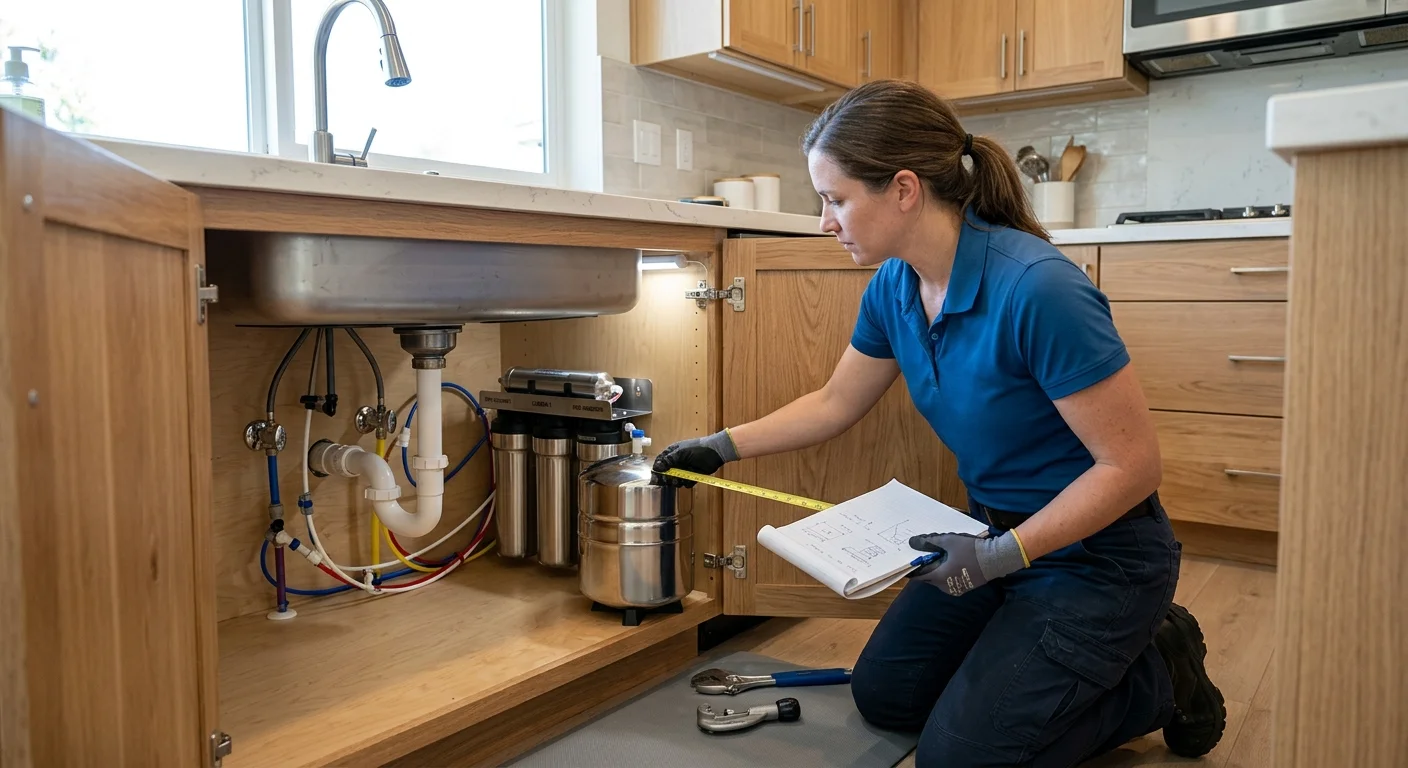
The kitchen cabinet determines whether the proposed system fits without creating access problems. Measure before signing an installation agreement. Include the space occupied by plumbing, stored items, and any equipment already under the sink.
Don’t measure only the empty floor area. The pro needs room for each component in the proposed design. That may include a membrane assembly, storage tank, tubing, filter housings, and service access. Ask where every part will sit.
The plan should address three physical connections:
- The incoming water connection
- The dedicated drinking-water faucet or approved delivery point
- The drain connection required by the selected design
The faucet location deserves an early decision. Some sinks or counters may already have a suitable opening. Others may require a different installation plan. A separately licensed pro should inspect the material and explain the proposed work before making changes.
Ask how filter changes will be handled inside the cabinet. A system that technically fits may still be awkward to service. Doors, drawers, disposal equipment, and drain piping can limit useful access.
The exact installation rules for a Mira Mesa address couldn’t be confirmed from the approved material for this page. Have the pro identify any current requirements that apply to the property and explain which authority sets them. Don’t rely on an uncited permit claim from a sales page.
For more preparation details, read our guide to water filter installation in San Diego. It covers the practical questions to settle before a pro changes the plumbing.
Photograph the open cabinet before the appointment. Include the sink underside, shutoff area, drain piping, and nearby electrical equipment. Those images help frame the conversation, but they don’t replace an on-site inspection.
Questions to ask the separately licensed pro
The final comparison should focus on evidence, scope, and responsibility. Ask each pro the same questions. Consistent questions make proposals easier to compare.
Start with licensing. Use the California Contractors State License Board lookup to check the license presented for the work. Confirm that the business name on the proposal matches the information you reviewed.
Then ask:
- Which finding from my provider report affects this recommendation?
- Which tap-specific result affects the system choice?
- What exact make and model are you proposing?
- Where can I review its performance documentation?
- Which drinking-water concerns does it address?
- Which concerns does it not claim to address?
- Where will the tank, membrane, tubing, and filter housings go?
- How will the faucet and drain connections be completed?
- What cabinet access is needed for future service?
- Which replacement parts will I need?
- Who provides those parts?
- What written warranty comes from the manufacturer?
- What written warranty, if any, comes from the installer?
- Does any approval apply to this address, and who sets that rule?
- What work is included in the written agreement?
No price figure is approved for this page. Installation cost depends on the selected equipment and the actual scope proposed for the home. Ask for a written, address-specific quote rather than relying on an uncited average. Our guide to reverse osmosis costs in San Diego explains which proposal details to compare without inventing a market price.
Filter Pros San Diego is the referral service, not the installing contractor. We arrange the test and connect you with a separately licensed pro. You’ll review the agreement, contract with that pro, and pay that pro directly.
Don’t accept missing model numbers or verbal-only performance promises. A clear proposal should let you trace the recommendation from the water evidence to the equipment and installation scope.
When to call us
Call when you want tap-specific information and a licensed Water Filtration pro to inspect the cabinet, faucet location, and proposed drain connection. Call us at (858) 400-6508 to set up a free in-home water test.