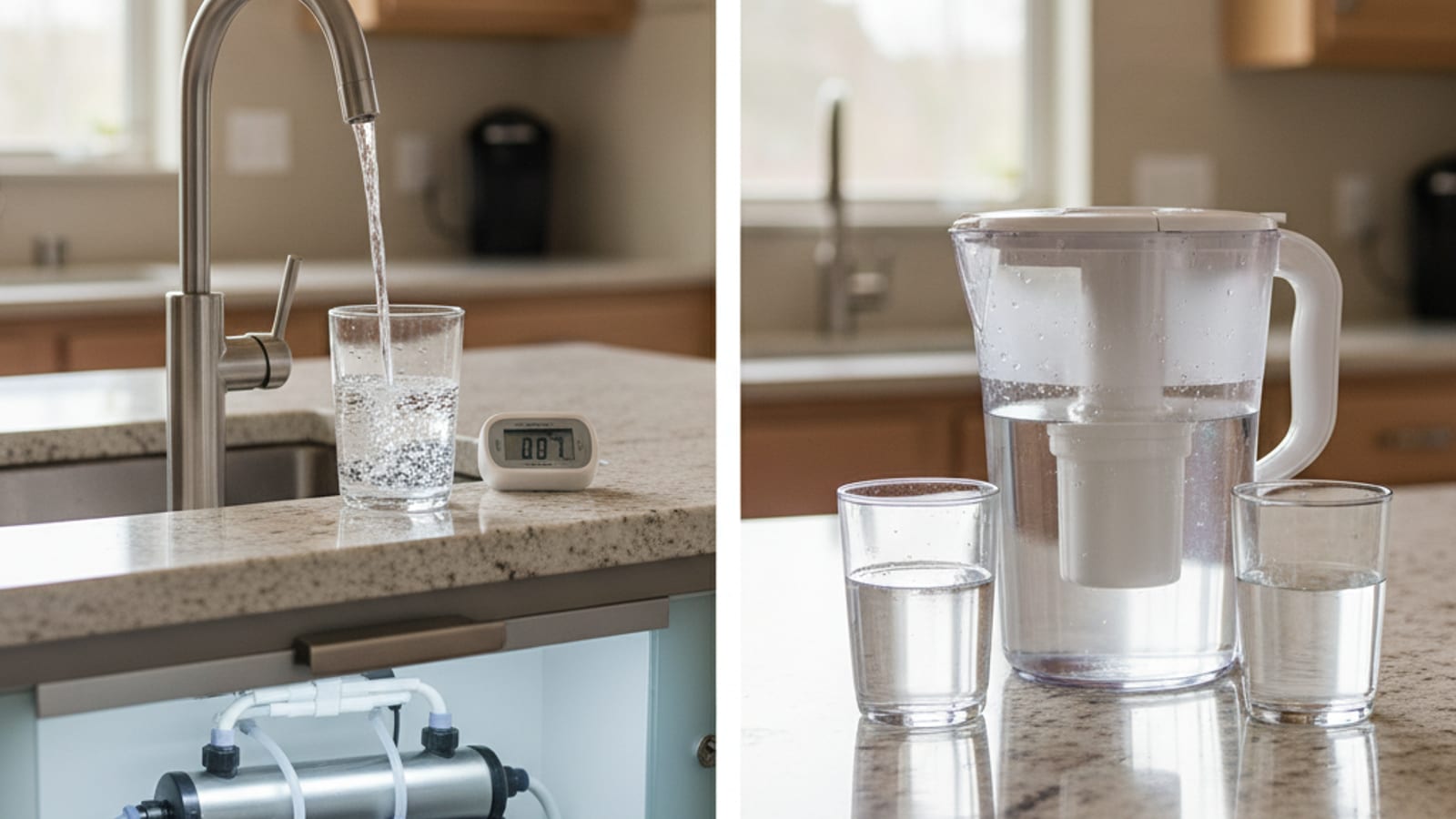
A filter pitcher and an under-sink reverse osmosis system serve different scopes. The useful comparison starts with the concern identified in your serving utility’s current report or appropriate testing, then checks the exact model’s certified reduction claims, maintenance, efficiency, and written cost.
How a filter pitcher works
A pitcher filter typically contains a cartridge filled with activated carbon, often granular activated carbon (GAC) or a compressed carbon block. Some pitchers add an ion-exchange resin to the carbon stage to further reduce certain minerals and metals.
Water pours slowly through the cartridge by gravity. Contact with the carbon surface reduces free chlorine and the taste and odor compounds associated with it. Some longer-chain organic compounds are also partially adsorbed onto the carbon.
Cartridge design and certified claims vary by model. NSF/ANSI 42 covers specified aesthetic claims, while NSF/ANSI 53 covers specified health-effect contaminant claims. Neither standard means that every pitcher addresses every substance. Read the exact listing, capacity, replacement interval, and operating conditions instead of excluding or crediting the whole category.
How reverse osmosis works
Reverse osmosis uses pressure and a semipermeable membrane as part of its treatment process. A system may combine that membrane with other stages. Compare the exact model’s certified reduction claims, operating conditions and replacement requirements; the general label or a size-based comparison with carbon does not establish performance.
A typical residential RO system includes three to five stages:
- Sediment pre-filter: removes particulates that could foul the membrane
- Carbon pre-filter: reduces chlorine or chloramine before the membrane (membrane life is shortened by oxidant exposure)
- RO membrane: the primary reduction stage for dissolved contaminants
- Post-filter/polishing carbon: final taste and odor improvement
- Storage tank: holds filtered water ready for use at the dedicated faucet
Performance depends on the complete system, feedwater, pressure, temperature, maintenance, and exact certified claim. NSF/ANSI 58 covers reverse osmosis systems, but certification to the standard is not a promise that every model reduces every dissolved substance.
What each system removes (and doesn’t)
This is where the two systems diverge significantly.
Compare the two exact products rather than using a category-wide contaminant list:
| Check | Pitcher | Under-sink RO |
|---|---|---|
| Treatment scope | Claims listed for the exact cartridge | Claims listed for the exact complete system |
| Standard to inspect | NSF/ANSI 42 and/or 53 when applicable | NSF/ANSI 58 and any contaminant-specific claims |
| Capacity and maintenance | Rated capacity and cartridge schedule | Prefilter, membrane, postfilter, and sanitizing schedule |
| Water use | Treated volume and cartridge life | Treated and reject water under rated conditions |
| Installation | Counter space and filling | Plumbing, drain, pressure, and under-sink space |
For local context, consult the current report from the utility serving the address. Do not infer the property’s TDS, disinfectant, PFAS, lead, or other chemistry from a countywide assumption. A TDS or conductivity reading also cannot identify individual contaminants or prove safety.
Third-party certification: what to look for
Both categories have certification standards that matter when comparing products.
For pitchers, NSF/ANSI 42 covers specified aesthetic claims and NSF/ANSI 53 covers specified health-effect contaminant claims. For RO systems, NSF/ANSI 58 is the relevant system standard. In either category, use the certification directory and product documentation to verify the exact model and replacement element, the named substance, rated capacity, test conditions, and maintenance. A general certification badge is not an all-contaminant claim. NSF maintains a product certification directory.
Compare ownership cost
EPA’s November 2024 home-treatment guide describes basic pitchers and tap filters as typically costing under $100, while RO and distillation systems tend to cost a few hundred dollars and may require professional installation. These are broad national planning categories, not current San Diego installed prices.
For a useful comparison, calculate cost from the exact model’s purchase price, rated cartridge or membrane schedule, local water use, installation, service, and replacement parts. Ask the provider for a written scope and price. Those inputs determine the ownership cost; a category alone does not establish a five-year total or payback period.
Convenience and daily use
A pitcher requires filling and counter or refrigerator space. Compare its fill rate and rated capacity with the household’s actual use.
An under-sink RO system can supply a dedicated faucet, but it requires suitable space, pressure, plumbing, a drain connection, and model-specific maintenance. RO produces treated and reject water. EPA gives national examples of five or more gallons of reject water per gallon treated for a typical point-of-use unit and up to ten for some inefficient units; WaterSense-labeled models must demonstrate no more than 2.3 gallons under the label criteria. Check the exact model’s independently certified efficiency rather than assuming field performance.
When a pitcher filter makes sense
A filter pitcher is a reasonable choice when your primary goal is taste and odor improvement in a rental where you can’t install under-sink equipment, when budget constraints make any upfront installation cost impractical right now, or as a temporary solution while you evaluate permanent options.
For a specific concern such as PFAS, lead, nitrate, fluoride, or TDS, do not decide by product category. Verify the exact model and replacement element’s currently listed claim for that concern.
When RO makes sense
An under-sink RO system may fit when appropriate testing identifies a concern addressed by the exact model, the point-of-use scope matches the household’s goal, and the installation and maintenance requirements are acceptable. A system cannot provide certainty about substances outside its certified claims and should not be selected on a medical promise.
The exact system matters as much as the category. For reverse osmosis drinking water systems, compare NSF/ANSI 58 certification, the exact contaminant-reduction claims, efficiency, replacement costs, and maintenance. Tank material alone does not establish treatment performance or water quality.
Start with knowing what’s in your water
Before buying anything, review the serving utility’s current report and decide whether the concern requires property-specific laboratory testing. Utility data cannot establish lead at an individual tap or the condition of private plumbing, and a field TDS reading cannot identify PFAS or other trace contaminants.
A free in-home water test from an independent provider can screen selected field measurements. It is not a laboratory analysis and cannot establish lead, PFAS, trace contaminants, or safety from every contaminant. Filter Pros San Diego introduces homeowners to independent licensed providers; the provider supplies the recommendation and written scope.
Call (858) 400-6508 to request an introduction to an independent licensed provider serving your area.
Related: Reverse osmosis drinking water systems | PFAS removal for San Diego homes | Reverse osmosis cost in San Diego