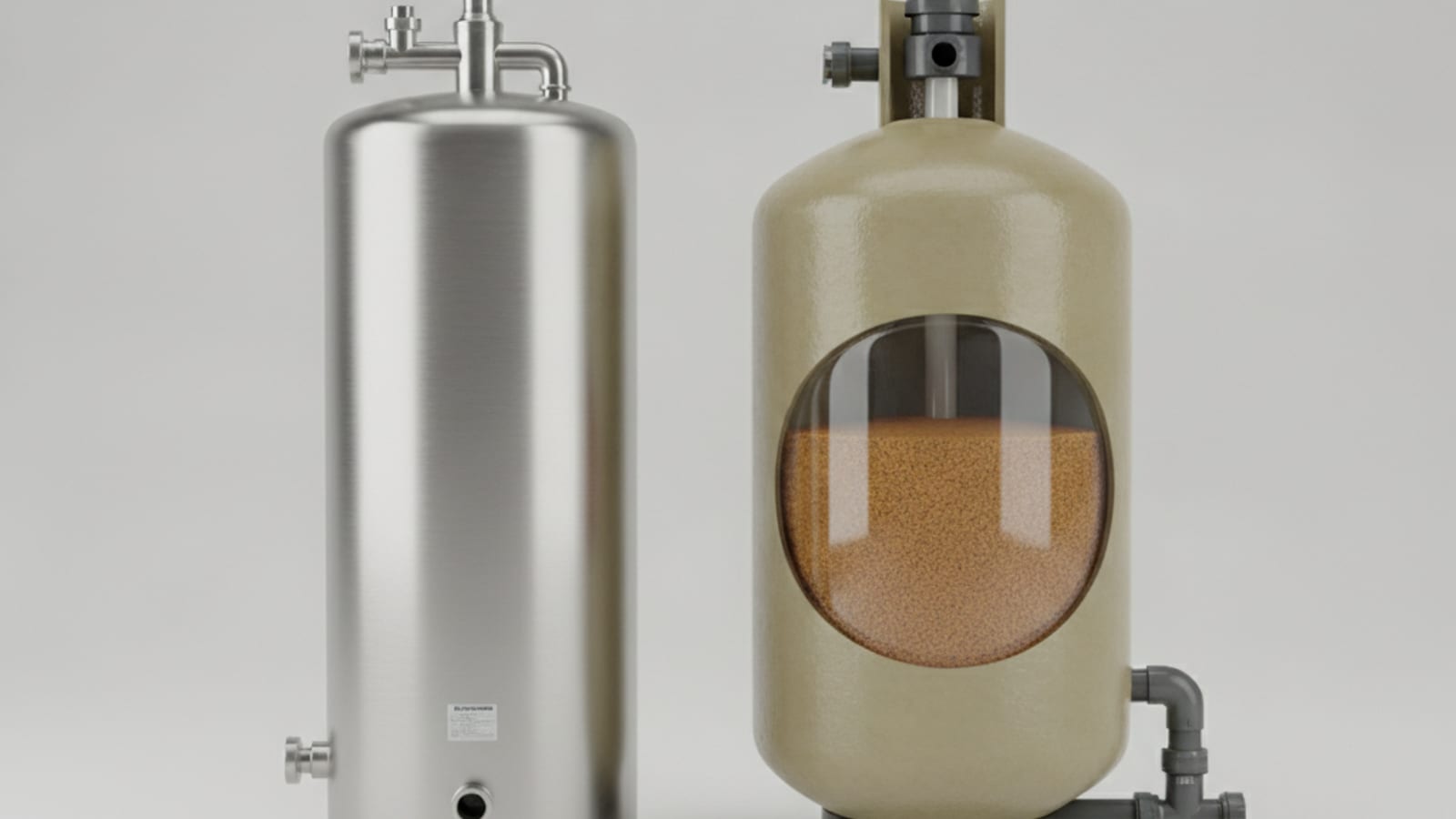
The pressure vessel is one part of a whole-house treatment system. Residential vessels may use a composite or fiberglass shell with an inner liner, or stainless-steel construction. The useful comparison starts with the exact model rather than a claim that one material is always better.
What the tank does
A pressure vessel holds treatment media while water moves through the system under pressure. Its rated pressure, dimensions, connections, compatible media, installation requirements, and certification all matter. The vessel material by itself does not establish what the system reduces or how well it performs.
Comparing stainless steel and fiberglass vessels
Ask the supplier to identify the exact tank model and all water-contact materials. Review the manufacturer’s documentation for pressure and temperature ratings, applicable certifications, maintenance requirements, warranty exclusions, and compatibility with the property’s water chemistry and selected treatment media.
Terms such as “medical-grade,” “food-grade,” or “premium” do not substitute for model documentation. A steel grade does not prove contaminant reduction, freedom from corrosion, or a particular service life. Likewise, the presence of a liner does not by itself prove that a vessel will leach, shed particles, or fail early.
Water chemistry and treatment performance
Start with the current report from the utility serving the address. The City of San Diego reports its drinking water typically averages about 16 grains per gallon (276 ppm) and ranges from 16 to 18 depending on area and demand. Do not apply those figures to another utility or a private well.
If a substance is a concern, compare it with the exact system’s certified reduction claim. NSF/ANSI 42 covers specified aesthetic claims, NSF/ANSI 53 specified health-effect claims, and NSF/ANSI 58 reverse-osmosis systems. No standard means every certified model reduces every contaminant.
For a whole house water filtration system or salt-free conditioning unit, ask for complete model numbers for the vessel, valve, and media. Salt-free conditioning does not remove hardness ions; evaluate an exact model’s applicable IAPMO/ANSI Z601 claim rather than assuming performance from the tank material or PF1025 name.
A practical buying decision
Compare complete systems on documented performance, flow, pressure loss, maintenance, replacement-media cost, installation needs, and warranty terms. The provider’s written estimate determines the actual price.
A free in-home water test from an independent provider can screen selected field measurements. It is not laboratory analysis or proof of safety from every contaminant. Filter Pros San Diego introduces homeowners to independent licensed providers; the provider gives the recommendation, contract, and warranty details.
Related reading: