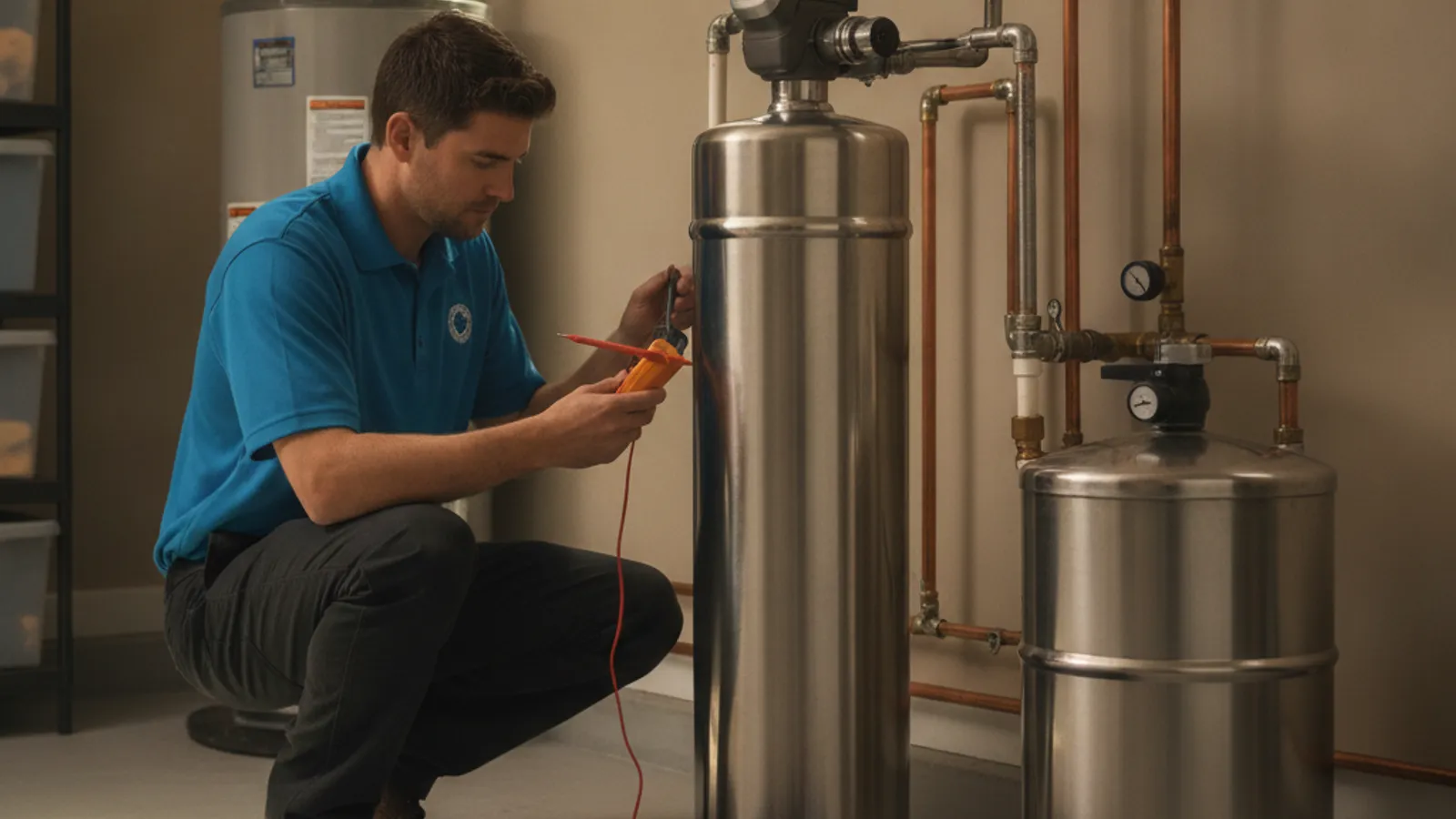
If a water softener is leaking, protect the surrounding area and stop water from flowing through the equipment before trying to diagnose a part. Use the bypass or shutoff procedure in the manual for your exact model. If water is spreading quickly, you cannot identify the correct control, or electricity is exposed to water, keep clear of the wet area and call a licensed plumber or the equipment manufacturer for instructions.
Once the flow is controlled, dry the outside of the unit and look for the first place water returns. A puddle at the base does not prove the tank is cracked. Water can travel down from a connection at the top, collect from condensation, escape from the brine tank, or come from a nearby drain or appliance.
What to do immediately
- Keep people and belongings away from the water. Move items only if you can do so without entering water near electrical equipment.
- Follow the model’s manual to use its bypass. Bypass routes household water around the softener. Control designs differ, so do not force a handle, turn an unfamiliar valve, or assume a diagram for another brand applies.
- Use the softener supply shutoff if the manual calls for it or bypass does not stop the leak. If you cannot safely isolate the equipment, use the home’s main shutoff only if you know where it is and can operate it safely.
- Disconnect power only as the manual directs and only when the plug and your path to it are dry. Do not reach through standing water.
- Arrange a professional inspection. Bypass or shutoff can limit additional leaking, but it does not repair the cause.
GE Appliances’ leak guidance tells owners of its softeners to turn off the unit’s water supply, use the installed bypass, and contact the installer or plumber. That is useful general context, but your own manual controls the correct procedure for your model.
Is it a leak, condensation, or normal drain flow?
Start with observation instead of disassembly.
Wipe the tank, valve cover, bypass area, hoses, nearby pipes, and floor dry. Place dry towels around separate areas without blocking a drain or moving equipment. Watch where moisture appears first.
Condensation can form on a cold tank or pipe in a warm, humid garage or utility space. The surface may be broadly damp without one clear drip point. Dry it and watch whether beads of moisture form again across the surface.
Normal drain flow occurs during regeneration. The manual should explain when regeneration happens and where the drain line terminates. Water on the floor is not normal, and flow that continues outside the model’s expected cycle may indicate a fault. EPA guidance says persistent drain flow can be a sign of a malfunction.
An external leak produces water where it should remain contained. The source may be a plumbing connection, bypass assembly, valve area, brine tank, overflow hose, drain hose, or tank. Culligan’s overview of water around a softener also recommends tracing the source because water at the base may have started higher on the unit or outside it.
Check the water heater, washing-machine hoses, whole-house filter, nearby pipes, floor drain, and wall behind the equipment. A nearby plumbing leak can collect under the softener and create the wrong diagnosis.
What the leak location can tell you
You can gather useful evidence without removing covers or fittings.
| Where water appears first | What to observe | Safe next step |
|---|---|---|
| Plumbing connections or bypass | Exact wet fitting, drip rate, whether bypass changes it | Leave isolated and call the installer or plumber |
| Top or valve area | Water under the cover, around the valve body, or tracking down the tank | Do not open the valve assembly; document and request service |
| Brine tank | Water level, overflow hose, salt residue, or water over the rim | Do not disturb the float or internal tubing; keep the unit isolated |
| Drain hose or floor drain | Loose-looking hose, overflow, backup, or flow outside regeneration | Do not disconnect or reroute the hose under pressure |
| Side or body of resin tank | Whether water starts at the tank body or runs down from above | Treat a possible tank leak as a professional repair decision |
| Floor only | Nearby appliance, pipe, wall, drain, or broad condensation | Dry separate areas and trace the first return of moisture |
This is a location checklist, not a diagnosis table. For example, Rheem’s external-leak guide routes owners to different model-specific instructions depending on whether water appears at the valve head, bypass, overflow hose, drain hose, or resin tank. The same visible location can involve different parts on another design.
Do not force or take apart the controls
A softener is connected to pressurized plumbing and may include powered controls. Avoid removing the valve head, opening the bypass assembly, loosening supply fittings, disconnecting the drain line, patching a tank, or reaching into the brine mechanism while troubleshooting.
Do not repeatedly start regeneration to “test” an active leak. A cycle moves water through additional flow paths and can make the situation harder to control. Leave the equipment isolated until the manual or a qualified professional provides the next step.
If resin beads appear in household plumbing, at a drain, or around damaged equipment, stop using the softener and report exactly where you found them. Do not assume that a leaking tank, distributor, or valve is the cause without an inspection.
Information to collect for the repair call
Good notes can shorten diagnosis and help a professional bring the right documentation or parts:
- Manufacturer, complete model number, and serial number
- Approximate installation date, if known
- First place water reappears after the area is dried
- Whether the leak is a drip, spray, overflow, or continuous drain flow
- Whether it occurs all the time or only during regeneration
- Current bypass and power status
- Any recent salt refill, maintenance, plumbing work, outage, freeze, or pressure change
- Photos of the full installation and a close view of the wet area
- Error code or display message, copied exactly
Also find the owner’s manual and warranty. Do not buy a generic seal or valve kit until the part is matched to the model and the failure is confirmed.
When professional service is the right next step
Call a licensed professional when water continues after bypass, the source is inside a valve or tank, the drain or overflow is involved, a connection is under pressure, resin is escaping, the unit cannot be isolated, or the source remains unclear. Water near wiring, outlets, or powered equipment also needs appropriate electrical caution.
A technician should identify the actual source before recommending repair or replacement. Ask for the failed component, exact replacement part, labor, warranty effect, and full price in writing. There is no reliable universal repair price because a loose external connection, valve problem, damaged tank, and nearby plumbing leak are different jobs.
For related symptoms, see why a water softener keeps running or draining and when to repair or replace a water softener.
Request a local referral
Filter Pros San Diego is an independent information and referral site. We do not perform repairs. We connect homeowners with separately licensed water-filtration professionals, and the homeowner contracts with and pays the selected professional directly.
Call (858) 400-6508 or use our water softener repair page to request a local match. Share the model number, leak location, and whether the unit is isolated. Response time, diagnosis, price, parts, and warranty must be confirmed directly with the professional.
Frequently asked questions
Why is my water softener leaking from the top?
The water may be coming from a valve, bypass, plumbing connection, or seal, but the exact construction varies by model. Put the unit in bypass according to its manual, do not remove the control assembly, and have the source confirmed.
Does water under the softener mean the tank is cracked?
No. Water can run down from above, come from the brine or drain system, collect as condensation, or originate from nearby plumbing. Dry the area and observe where moisture first returns.
Is drain water during regeneration normal?
Drain flow is part of ion-exchange regeneration. Water on the floor is not normal, and persistent drain flow outside the expected cycle can indicate a malfunction. Check the model’s manual and arrange service when the behavior does not match it.
Can I keep using a leaking water softener?
An active external leak should be isolated rather than left operating. Follow the manual’s bypass or shutoff procedure and have the equipment inspected before returning it to service.
Can I repair the leak myself?
Observation and model-specific bypass are reasonable first steps. Avoid opening pressurized valves, loosening plumbing, or improvising a repair. Whether a part is owner-serviceable depends on the manual, warranty, tools, and confirmed source.