The kitchen tap is not the shower, and the shower is not the washing machine. Choosing a whole house vs under sink water filter is a point of entry vs point of use filter decision. In San Diego County, that choice has to match the water at your address, not a generic ranking.
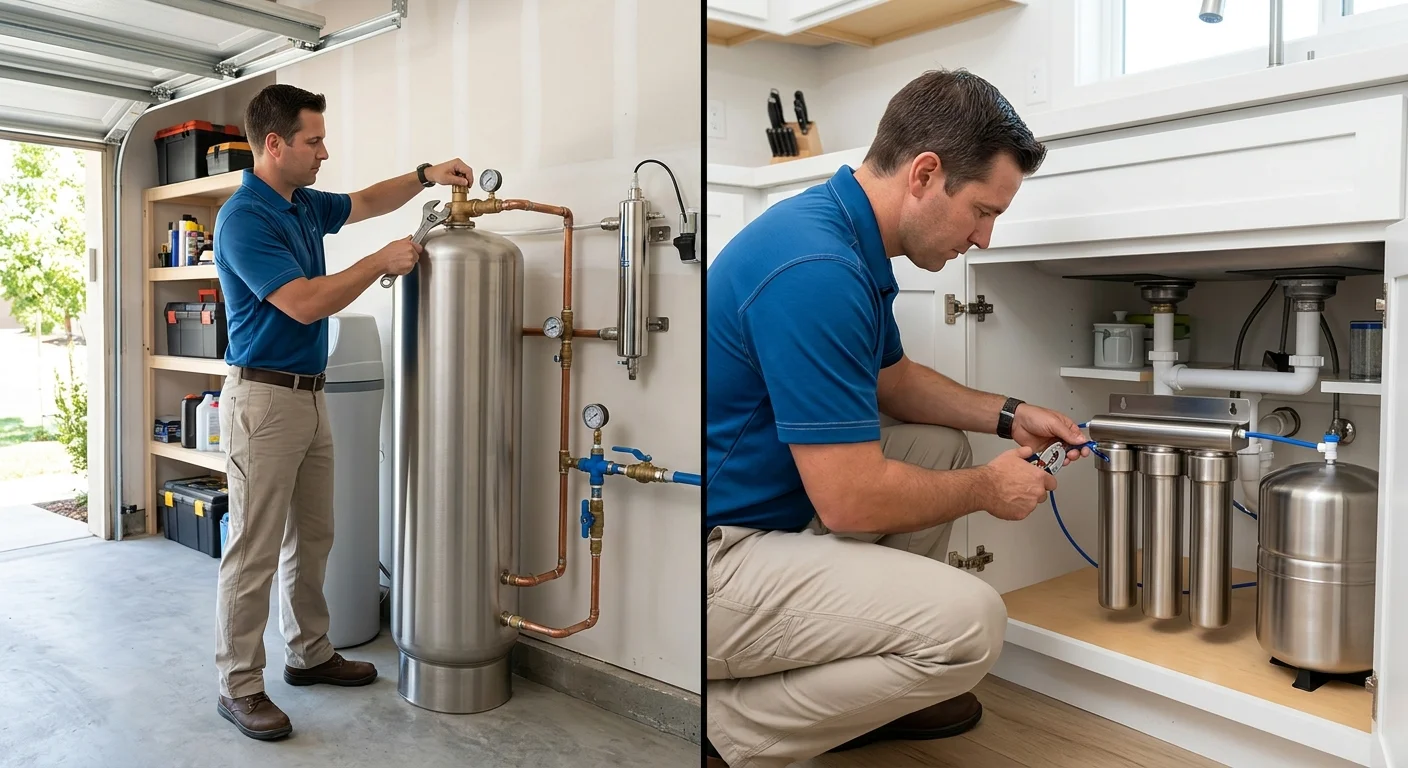
What each system is built to treat
A whole-house water filtration system is a point-of-entry setup. A licensed pro places it on the main line, usually in the garage or at a side-yard manifold, before water splits to the rest of the house. Showers, laundry, hose bibs, and every tap then see that treated water. NSF describes point-of-entry systems as treating water that enters the residence.
An under-sink drinking water filter is a point-of-use device. It treats one selected tap, almost always the kitchen cold line, after water has already traveled through the home’s pipes. NSF describes point-of-use devices as treating a selected tap. You get filtered water where you cook and drink. You do not get it in the hall bath, the washer, or the shower.
Neither box is a catch-all. The EPA’s November 2024 home-treatment guide is blunt: identify the goal from the serving utility’s report and from testing that fits the property. No single technology removes every contaminant. Compare whole-house scope against point-of-use scope, then compare the exact model’s certified reduction claims, maintenance, and water use.
Certification is a claim on a model, not a ranking of a category. NSF/ANSI 42 covers certified aesthetic reduction claims, such as taste and odor. NSF/ANSI 53 covers specified health-effect contaminant claims. NSF/ANSI 58 covers reverse osmosis systems. A standard does not prove reduction of every contaminant. Read the exact model’s certified reduction claim before you buy.
Hardness is a different job from filtration. The City of San Diego Public Utilities page says drinking water in the City typically averages about 16 grains per gallon (276 ppm) and can range from 16 to 18 gr/gal (272 to 284 ppm), depending on demand and the area of the City. That figure is for the City system only. It is not countywide, and it does not describe private wells. Helix Water District, which publishes for La Mesa, El Cajon, and Lemon Grove, says water at 10 or more grains is considered hard, and that imported Colorado River and State Water Project supply averages about 14 grains. That is a statement about the imported supply, not about every tap.
The City’s 2025 Consumer Confidence Report for Public Water System 3710020 lists hardness by plant, which is a different measurement than the plumbing-page typical figure. Alvarado averaged 13.8 gr/Gal (11.9–15.8), Miramar 14.1 (11.7–16.6), Otay 14.2 (11.7–15.8), and purchased treated water 8.5 (3.18–13.6). A Mira Mesa tract, an Otay-fed South Bay home, and an East County well are not interchangeable. Confirm the serving agency for the address. If the white crust on glass is hardness, a carbon housing is the wrong tool.
If you are comparing carbon media with a reverse osmosis membrane, that is a separate decision. Read carbon filter vs reverse osmosis instead of forcing that argument into this one.
Skin, plumbing, and drinking-water goals are different jobs
Search results mash three jobs into one product page. They are not the same job in a Clairemont ranch, a Chula Vista two-story, or a condo off the 163.
Drinking and cooking live at one faucet. If the complaint is taste, odor, or a contaminant listed on a certified point-of-use claim, an under-sink system can be the right size. CDC notes that water disinfected with chlorine can taste and smell different from untreated water or from chloramine-treated water. Your serving utility’s current report is the place to see which disinfectant that system uses. Do not guess from a neighbor’s tap.
Bathing, laundry, and every other fixture are house-wide. An under-sink unit leaves those taps untreated. If the same odor shows up in the master shower and the kids’ bath, or if staining shows up in more than one sink, you are looking at a point-of-entry job, not a kitchen cartridge. That still is not a medical claim about skin, hair, or eczema. Those outcomes depend on the person, the supply, and the exact treatment. A filter category does not treat a diagnosis.
Plumbing and appliances sit in the middle. Sediment and iron staining are house-wide aesthetic problems. The EPA’s secondary drinking water standard for iron is 0.3 mg/L and is tied to rusty color, sediment, metallic taste, and reddish or orange staining. That is a nuisance guideline, not a health cutoff and not a promise that any whole-house housing will clear it. Hardness scale on a tankless heater is a softener or conditioner question, not a drinking-water filter question. NSF/ANSI 44 is the standard for ion-exchange softeners that reduce calcium and magnesium hardness. Salt-free conditioning does not remove hardness ions. Evaluate the exact scale-reduction claim.
A whole-house tank treats water before it enters the home’s pipes. It does not treat what later leaches from those pipes. An under-sink unit treats water at the tap, after that run of plumbing. If a model carries a certified reduction claim for a plumbing-related contaminant, that claim is on the model, not on every under-sink box on a shelf.
So, do you need a whole house water filter. You need one when the problem is present at more than the kitchen tap, and when the media matches that problem. You may not need one if the only water you care about is the glass you drink. There is no healthiest category. The EPA line still holds: match treatment to the identified concern, then verify the exact certified claim.
Whole-house reverse osmosis versus an under-sink RO unit is a third fork. RO produces treated water and reject water. Performance and efficiency are model-specific. That comparison belongs on reverse osmosis vs whole-house filtration, not in a POE-versus-POU shopping shortcut.
Space, maintenance, and drain needs
Most San Diego houses do not have basements. Whole-house tanks live in garages in Mira Mesa, Kearny Mesa, and Santee, or along a tight side yard on older coastal lots from Ocean Beach through Encinitas. Outdoor sun, salt air, and a cramped meter set all change how a licensed pro places the bypass and the tank. Condos and some South Bay townhomes may not have a workable main to interrupt. In those buildings, under-sink is often the only practical path.
Cabinet space is the under-sink constraint. The unit shares the sink base with the garbage disposal, the shutoffs, and whatever the last remodel left behind. Some under-sink carbon systems use the existing faucet. Many RO systems add a dedicated drinking faucet and a drain connection, because reject water has to go somewhere. EPA’s WaterSense page on point-of-use reverse osmosis explains that labeled units demonstrate at most 2.3 gallons of reject water per gallon treated under its criteria. That is a label criterion, not field performance for every system. EPA also gives national examples of five or more reject gallons per treated gallon, and up to ten for some inefficient units. Those are national examples, not a measurement of a San Diego install.
A typical whole-house carbon or sediment housing does not dump to a drain the way an RO unit or a salt-based softener does. That is one reason people pick it when they want house-wide aesthetic treatment without a drain line. It still needs a bypass, clear access, and a tank that will sit on that main for years. When a licensed pro sizes that tank, ask about medical-grade stainless steel versus a fiberglass tank with a plastic liner. The liner is the part that ages out of sight.
Maintenance is model-specific. NSF’s consumer guidance says to include manufacturer maintenance requirements and replacement-filter costs when you compare ownership cost. Do not shop on a made-up cartridge life. A clogged whole-house cartridge can drop pressure at every fixture. A neglected under-sink cartridge only fails at one tap, which is easier to miss if you still use the unfiltered side.
The EPA’s November 2024 guide describes broad cost categories, not a San Diego quote and not a Filter Pros price. Basic pitchers and tap filters are typically under $100. Reverse osmosis and distillation tend to cost a few hundred dollars and may need professional installation. Point-of-entry systems cost thousands and generally need professional installation. The written scope from the licensed pro you hire is what you actually pay.
Whole-house disadvantages are real. You need space at the main. Installation is usually a pro job. You treat water you will never drink. The unit will not catch what your plumbing adds after the tank. The wrong media, chosen without a test, is an expensive bypass in a garage.
Under-sink disadvantages are real too. You only treat one tap. Showers and laundry stay on the raw line. RO needs a drain and sends reject water with it. You have to remember which handle is the filtered one.
Check the installer, not the brochure. Confirm a CSLB license for the pro who will cut the main or the kitchen line.
When a combined setup makes sense
A combined setup is not an upsell by default. It is two jobs on one property.
The common San Diego pattern is a point-of-entry filter for house-wide taste, odor, or sediment, plus a point-of-use unit at the kitchen for drinking and cooking claims the whole-house media is not certified to make. That pairing shows up in older City homes where the shower and the kitchen bother people for different reasons. It also shows up when a household wants filtered ice and coffee without treating toilet water with a reverse osmosis membrane.
It does not make sense when the only complaint is the kitchen tap, and the bathrooms are fine. It does not make sense in a rental or a condo where the main is not yours to cut. It does not make sense if the real issue is hardness scale. Pairing a filter with a softener or a salt-free conditioner is a design choice after a test, not a bundle you add because a product page said “complete protection.”
Ask the licensed pro to draw the order of equipment. A sediment stage before carbon, a bypass that actually isolates the tank, and a kitchen RO that still has feed pressure all matter more than the number of boxes in the garage.
Test before you choose equipment
Buy the test, not the category. Filter Pros San Diego arranges a free in-home water test and connects you with a separately licensed water filtration pro. That pro recommends and installs the equipment. You contract with the pro directly.
Start with the serving utility’s current report, not a countywide rumor. The San Diego County Water Authority and the City’s water-quality pages point you to the report for that system. Do not transplant City plant data onto a Helix address, a private well, or a building that buys water from someone else. The EPA’s guide says the same thing: do not transplant utility data to other service areas.
If the property is on a private well, use a state-certified laboratory. CDC recommends annual testing for total coliform, nitrate, TDS, and pH, and says to ask local health or environmental authorities which extra tests fit the location. A TDS reading is not a contaminant-by-contaminant lab result. The EPA secondary TDS guideline is 500 mg/L for aesthetic and technical concerns. It is not a drinking-safety cutoff.
Match treatment to what the test and the report actually show. Then confirm the model’s NSF claim covers that goal. Then price replacement filters and, for RO, water use. That sequence is how you decide whether a whole-house filter, an under-sink filter, or both is the honest answer at that address.
When to call us
Call when you want house-wide treatment, a kitchen drinking tap, or a licensed pro to read both against a real test instead of a product page. Filter Pros San Diego will set up the free in-home water test and connect you with a separately licensed water filtration pro for the recommendation and the install. Call us at (858) 400-6508 to set up a free in-home water test.