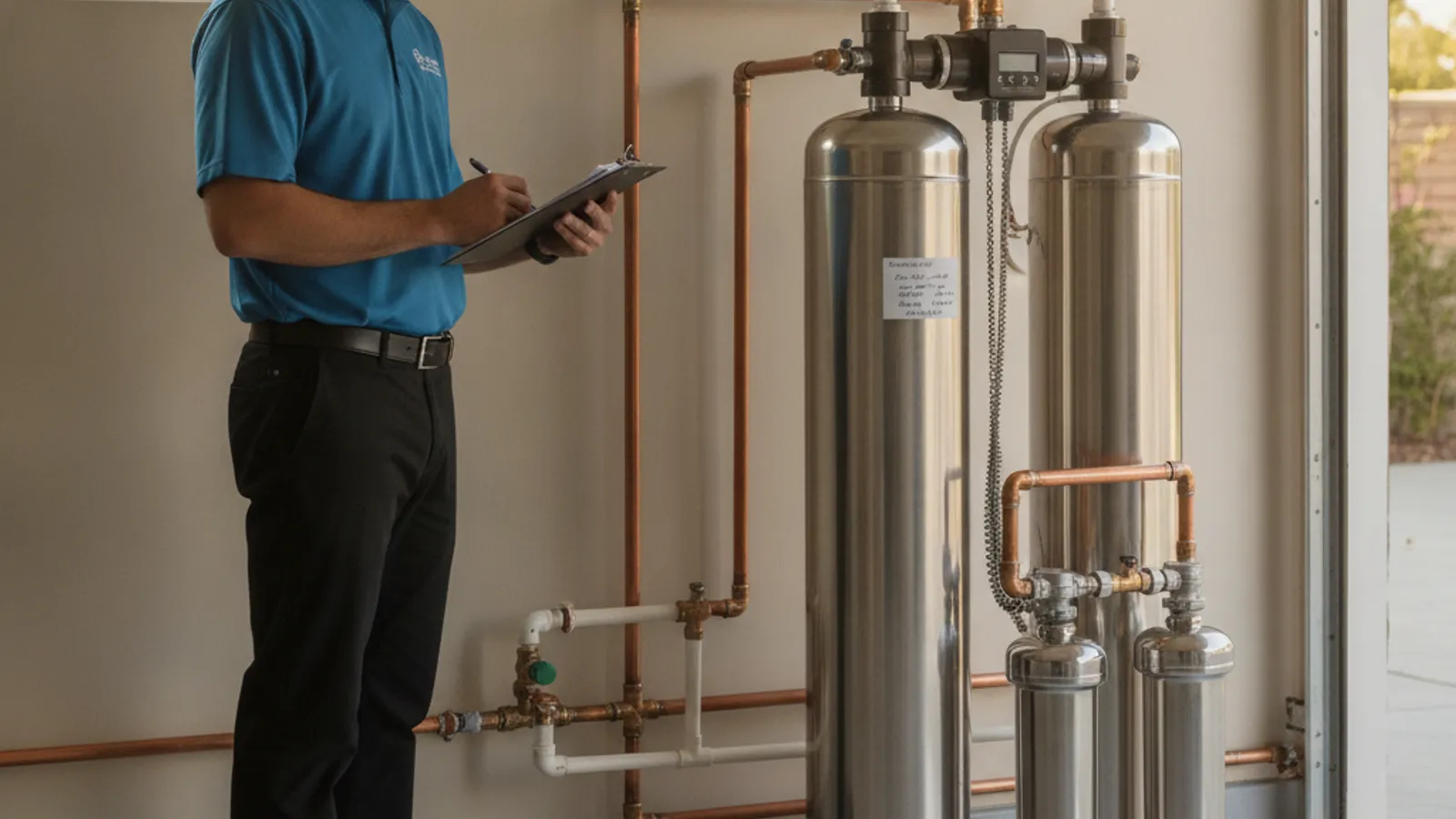
The best water softener for a San Diego home is the one that can handle the hardness and indoor water use measured at that property without regenerating more often than necessary. A brand name or advertised grain number does not answer that question by itself.
Start with the hardness at your tap and your household’s actual water use. Then compare the exact model’s rated working capacity, regeneration controls, water and salt efficiency, certification, installation needs, and maintenance terms. That process produces a useful shortlist and exposes vague proposals quickly.
Start with the water delivered to your address
San Diego County has multiple water providers and changing supply blends, so a countywide hardness estimate is a poor sizing input. Find the provider on your water bill and read its current water-quality report. If the property uses a private well, ask a qualified testing provider which analysis fits that source rather than borrowing a nearby city’s number.
The City of San Diego says water in its own system typically averages about 16 grains per gallon and can range from 16 to 18 grains per gallon depending on water demand and the area of the city. That is useful context for customers of the City system, but it is not a substitute for an address-specific reading and should not be applied to every home in the county.
A free in-home test can provide a hardness reading for sizing. It should not be treated as a promise to identify every possible contaminant. If your concern involves lead, nitrate, arsenic, PFAS, bacteria, or another health-related contaminant, define the concern first and use the utility report or appropriate certified-laboratory testing.
Size a softener from hardness, water use, and working capacity
The basic calculation is straightforward:
Measured hardness in grains per gallon × gallons of water to be softened per day = grains of hardness to remove per day.
Use recent water bills and household routines to estimate demand. Separate irrigation and other water that does not need softening when the plumbing layout allows it. Also discuss peak flow, simultaneous showers, and large fixtures with the installer, because total daily use and service flow are different sizing questions.
Do not choose a unit from a generic household-size table. Two four-person homes can use very different amounts of indoor water, and two systems sold with the same nominal capacity can have different working capacities at their programmed salt settings.
Ask for these figures in writing:
- The hardness value used for sizing and where it came from
- The estimated gallons treated per day and which uses are excluded
- The exact model and its rated working capacity at the proposed salt setting
- The expected regeneration basis and the assumptions behind it
- The service flow used to check pressure during peak demand
Oversizing is not harmless. EPA guidance warns that an oversized system can use water inefficiently. The goal is an appropriate operating margin, not the largest tank a salesperson can fit in the garage.
Prefer regeneration based on demand
An ion-exchange softener removes calcium and magnesium as water passes through a resin bed. The system periodically regenerates the resin with brine, which consumes salt and water and sends wastewater to a drain.
EPA recommends demand-initiated regeneration rather than a fixed timer. A demand-based control uses metered water use or a hardness sensor to regenerate when needed. That makes the control strategy, settings, and usable capacity more important than a large number on a product label.
For the exact model, compare:
- NSF/ANSI 44 certification for a residential ion-exchange softener
- Rated working capacity at the proposed settings
- Water used during regeneration
- Salt efficiency
- Whether demand-initiated regeneration is included and how it is programmed
- Manufacturer instructions for installation, bypass operation, cleaning, and service
NSF/ANSI 44 certification is valuable evidence for the scope it covers. It is not a ranking of brands and does not prove that a softener reduces chlorine, PFAS, lead, or every other contaminant. Any additional treatment claim needs exact-model documentation for that claim.
Decide whether you want softening or scale control
A salt-based ion-exchange softener removes hardness minerals and produces softened water. A salt-free conditioner leaves calcium and magnesium in the water and aims to reduce scale formation. These are different outcomes.
Choose a softener when the goal is hardness removal and the property can support its drain, brine, maintenance, and installation requirements. Consider a salt-free conditioner when the goal is scale control without salt or regeneration discharge, but ask for evidence supporting the exact model’s scale-reduction claim at your conditions. Do not accept “salt-free softener” as proof that the product produces soft water.
Our water softener versus salt-free conditioner guide explains the tradeoffs in more detail.
Check the property before choosing equipment
The installer should inspect the main-line location, available space, drain route, power needs, bypass arrangement, outdoor-water branches, and service clearance. A product can be correctly sized on paper and still be a poor fit for the available plumbing.
Do not rely on a countywide statement about salt-based systems. Requirements can depend on the authority and property. Confirm current permit and discharge requirements for the address with the applicable authority and the licensed professional doing the work. The City of San Diego currently lists eligible water-softener installations among work that may use its Simple No-Plan plumbing permit process, subject to the City’s scope and property rules.
Compare complete written quotes
A useful quote lets you compare the same facts across providers. Ask each provider to include:
- Exact manufacturer and model
- Treatment goal and what the equipment does not treat
- Hardness and water-use inputs used for sizing
- Working capacity, flow basis, and regeneration control
- Exact third-party certifications and certified claims
- Equipment, labor, permit, drain, electrical, startup, and disposal charges
- Salt, water, filter, media, and service requirements
- Warranty terms, exclusions, and who provides service
- What will be measured after installation to confirm operation
Avoid proposals built around an unverified tank-material label, a generic lifetime claim, or a promise that one system solves every water-quality concern. Product documentation and certification records are more useful than broad marketing language.
Plan for maintenance before you buy
A softener needs ongoing attention. Follow the model’s instructions for salt level, resin and brine-tank cleaning, bypass use, and regeneration settings. Periodically inspect connections, valves, and the drain. Persistent water flow to the drain can indicate a malfunction.
Ask who will service the unit, what routine work the owner must perform, and what replacement parts or supplies cost. Those details belong in the buying decision, not in a surprise after installation.
Get an address-specific recommendation
Filter Pros San Diego is an independent information and referral site. We arrange free in-home water tests and connect homeowners with separately licensed water-filtration professionals. The homeowner contracts with and pays the selected professional directly.
Schedule a free in-home water test or call (858) 400-6508. Bring your water bill, current provider report, and any existing equipment documents so the professional can explain the sizing inputs and quote in writing.
Frequently asked questions
What size water softener does a San Diego home need?
There is no reliable answer from household size alone. Use measured hardness, the gallons that will actually be softened, the home’s peak-flow needs, and the exact model’s rated working capacity at the proposed settings.
Is a larger-capacity softener better?
Not automatically. Too little working capacity can cause frequent regeneration or hardness breakthrough, while too much can waste water and raise purchase cost. Ask the provider to show the sizing calculation.
Should I buy a salt-based softener or salt-free conditioner?
Choose based on the desired outcome. Ion exchange removes calcium and magnesium. A salt-free conditioner does not remove those ions and should be evaluated for its exact scale-reduction claim. Property requirements, maintenance, drainage, and water use also affect the decision.
Does an NSF-certified softener filter every contaminant?
No. NSF/ANSI 44 applies to residential ion-exchange softeners and their covered claims. It does not establish that a model treats every contaminant. Verify each additional reduction claim for the exact model.
What should a free in-home water test tell me?
For softener sizing, it should provide the hardness reading taken at the home and identify the test method. It is not automatically a comprehensive contaminant analysis. Use the serving utility’s current report and appropriate laboratory testing for other concerns.