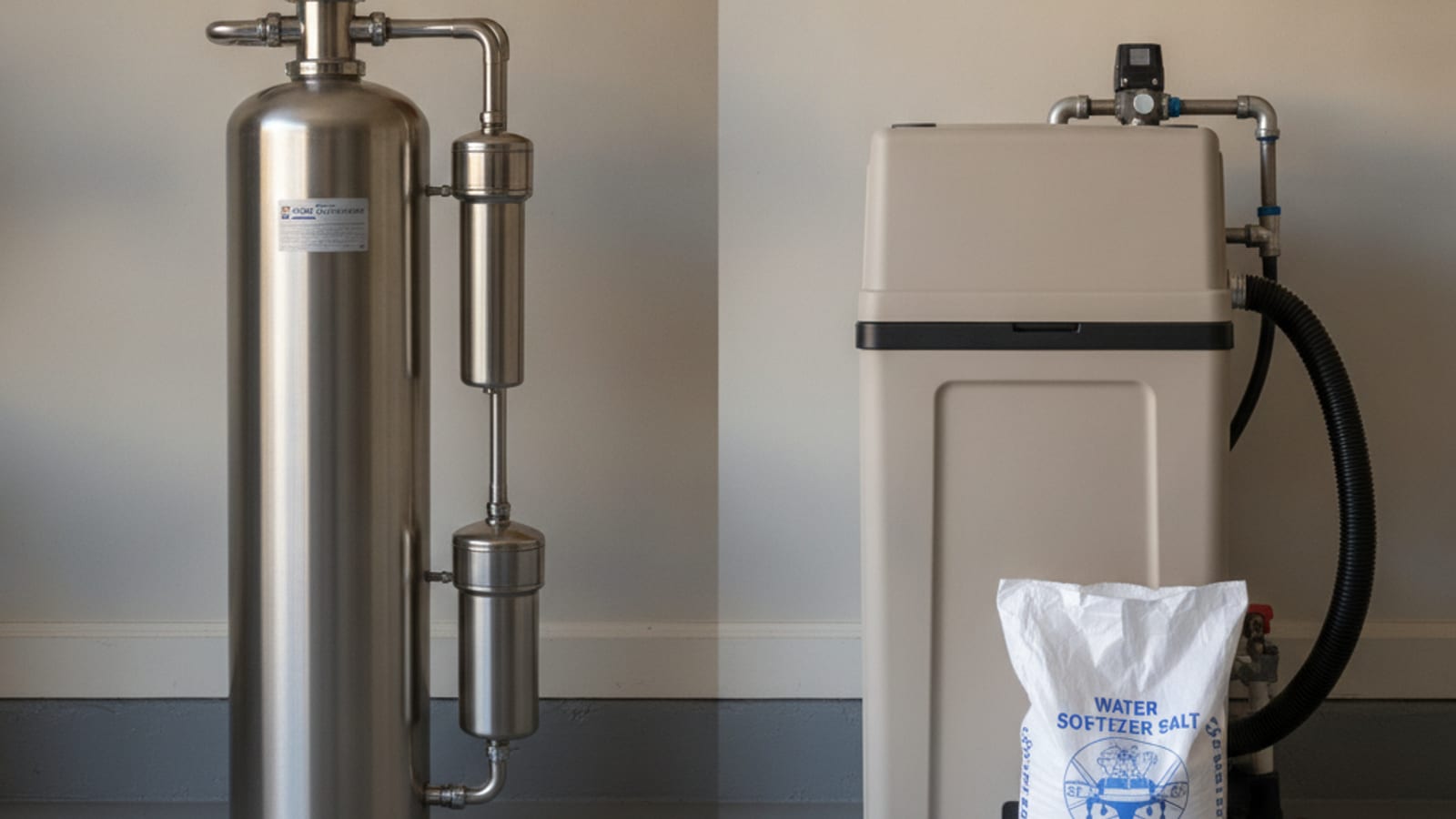
A water softener removes calcium and magnesium hardness through ion exchange. A salt-free conditioner leaves those minerals in the water and is intended to reduce scale formation. That difference should drive the decision.
If you want measured hardness reduced and the familiar behavior of softened water, compare ion-exchange softeners. If you want scale control without salt, brine, or regeneration water, compare salt-free conditioners and verify the exact model’s scale-reduction claim. Neither choice automatically treats unrelated drinking-water concerns.
What an ion-exchange softener does
Water passes through a resin bed that exchanges calcium and magnesium ions for sodium or potassium ions. Once the resin’s working capacity is used, the system regenerates with brine and sends regeneration water to a drain.
The result is softened water because the hardness ions have been removed. That can reduce scale, water spots, soap scum, and the extra soap needed in hard water. Performance depends on measured hardness, household water use, rated working capacity, flow, regeneration settings, installation, and maintenance.
For an efficient comparison, look for demand-initiated regeneration. EPA guidance recommends this approach because it responds to use or hardness instead of regenerating only because a timer has elapsed. Then compare the exact model’s water and salt efficiency at the settings being proposed.
What a salt-free conditioner does
A salt-free conditioner does not remove calcium and magnesium and does not produce softened water. It uses a scale-control process intended to make the minerals less likely to form deposits under the conditions covered by that product’s performance claim.
There is no brine tank, salt refill, or ion-exchange regeneration cycle. That can make a conditioner attractive when the homeowner wants lower routine involvement or when drain and discharge considerations make a softener impractical.
The limits matter. You may still measure hardness after treatment, and you should not expect every effect of ion-exchange softening. Ask what test standard applies to the exact conditioner. EPA points consumers to IAPMO/ANSI Z601 for scale-reduction devices. A technology name such as TAC is not a substitute for exact-model certification or performance documentation.
Direct comparison
| Decision point | Ion-exchange softener | Salt-free conditioner |
|---|---|---|
| Primary goal | Remove calcium and magnesium hardness | Reduce scale formation while hardness remains |
| Produces softened water | Yes | No |
| Uses salt or potassium for regeneration | Yes | No |
| Uses water during regeneration | Yes | No ion-exchange regeneration cycle |
| Drain requirement | Typically required for regeneration | Depends on the exact equipment and installation |
| Routine owner tasks | Salt checks plus model-specific cleaning and service | Model-specific inspection and media or component service |
| Standard to examine | NSF/ANSI 44 | IAPMO/ANSI Z601 for scale-reduction devices |
| Best evidence | Working capacity and efficiency at proposed settings | Exact certified or independently verified scale-reduction claim |
This table compares treatment categories. It does not establish that every model in either category performs the same way.
Which result do you actually want?
Write down the problem before shopping for equipment.
Choose hardness removal when you want calcium and magnesium reduced throughout the treated plumbing and are prepared for regeneration, salt handling, and maintenance. Choose scale control when keeping the hardness minerals is acceptable and the exact conditioner has support for the scale outcome you need.
If the concern is taste, odor, lead, nitrate, PFAS, bacteria, or another contaminant, a softener-versus-conditioner comparison does not settle it. Start with the serving utility’s current water-quality report and appropriate testing. EPA notes that no single home treatment technology removes every contaminant. Compare each exact certified reduction claim with the specific concern.
Use address-specific water information
The City of San Diego says its own system typically averages about 16 grains per gallon and can range from 16 to 18 grains per gallon depending on demand and location within the city. Other providers and private wells require their own evidence. Do not apply the City’s figures to the whole county.
For softener sizing, test hardness at the property and review actual indoor water use. Exclude irrigation when appropriate and possible. Compare the result with the exact model’s rated working capacity rather than choosing from a generic table based only on household size.
For a conditioner, measured hardness still helps define the operating conditions. Ask the seller to show that the model’s scale-reduction documentation covers those conditions and the home’s flow needs.
Check installation and local requirements
An ion-exchange system needs an appropriate location, main-line connection, bypass, and drain arrangement. A conditioner may have fewer utility requirements, but it still needs correct sizing, flow, orientation, and service clearance according to its manual.
Do not accept a blanket countywide statement about softener rules. Confirm current permit and discharge requirements for the property with the applicable authority and the licensed installer. The City of San Diego currently identifies eligible water-softener installations as work that may use its Simple No-Plan plumbing permit process, subject to its rules and exceptions.
If the home uses a septic system, give the septic-system manufacturer or local service provider the exact proposed discharge and equipment information. EPA recommends checking whether a softener could overload the system, affect performance, or affect its warranty. Septic status alone does not prove that every softener will fail or that every conditioner is suitable.
Compare maintenance and operating demands
Softener maintenance can include checking and adding the correct salt, watching for bridging or clogging, cleaning the resin and brine tank as the manufacturer directs, confirming settings after a power outage, and checking for leaks or persistent drain flow.
A salt-free conditioner also has model-specific maintenance. Ask when media or components need service, who performs it, what it costs, and how you will know the device is still delivering the claimed result. “No salt” does not mean “no maintenance forever.”
Get these answers in the written quote
Before choosing either system, ask the provider to document:
- The water problem the system is intended to address
- Hardness reading, test method, and water-use assumptions
- Exact manufacturer and model
- Working capacity and regeneration settings for a softener
- Exact scale-reduction evidence for a conditioner
- Applicable certification and a link or record for the exact model
- Flow requirements and expected pressure impact
- Plumbing, drain, power, bypass, permit, and discharge requirements
- Equipment, installation, supplies, maintenance, and service charges
- Warranty terms and responsibility for future service
- The post-installation check used to confirm performance
Be cautious when a proposal promises that a conditioner prevents all scale damage, removes old deposits, or protects every appliance without conditions. Be equally cautious when a softener is sold as a complete contaminant-removal system. Ask for the exact claim, scope, and evidence.
Get help comparing the options
Filter Pros San Diego is an independent information and referral site. We arrange free in-home water tests and connect homeowners with separately licensed water-filtration professionals. The homeowner contracts with and pays the selected professional directly.
Schedule a free in-home water test or call (858) 400-6508. The hardness result can support sizing, while your provider report and any appropriate laboratory results should guide separate contaminant decisions.
Related: The best water softener for San Diego hard water | Water softener maintenance guide
Frequently asked questions
Does a salt-free conditioner soften water?
No. It leaves calcium and magnesium in the water. Evaluate it for a supported scale-reduction claim rather than expecting the measured hardness to disappear.
Does a water softener prevent scale?
Ion exchange removes the calcium and magnesium that cause hardness, which reduces hardness-related scale. Actual results still depend on sizing, operation, installation, and maintenance.
Which option uses less water?
A conventional ion-exchange softener uses water during regeneration. A salt-free conditioner does not have that regeneration cycle. Compare the exact model’s full operating and maintenance requirements.
How much maintenance does each option need?
Neither should be purchased on that assumption. A softener needs salt and model-specific cleaning and checks. A conditioner may need media or component service and performance checks according to its manufacturer.
Can either system remove every contaminant?
No. Treatment claims are model-specific. Identify the concern, consult the current utility report or appropriate testing, and verify the exact certification and reduction claim before adding treatment.