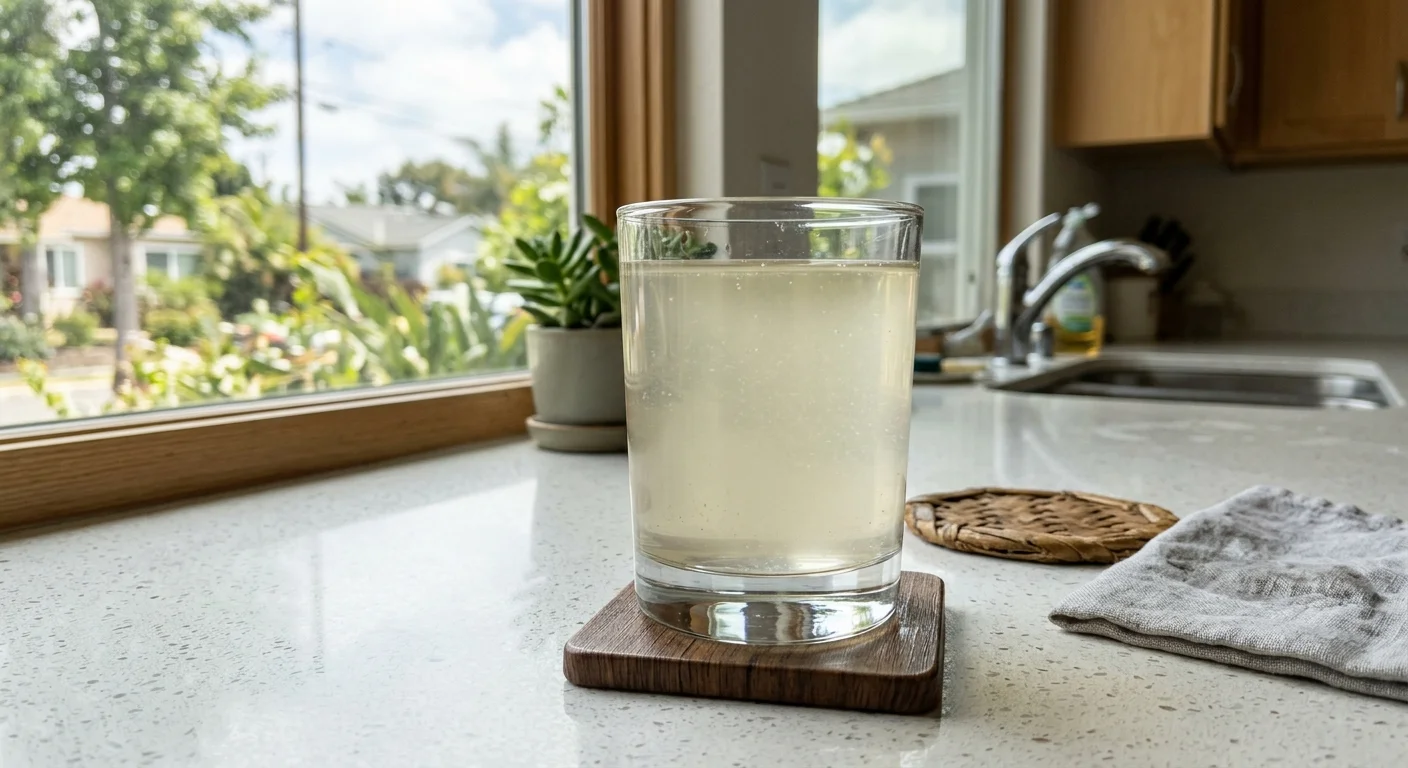
Pour a glass in Clairemont or National City and the water can look white, like milk mixed in. Cloudy tap water in San Diego is usually dissolved air leaving the water as it hits the glass. Give it two minutes on the counter before you treat it as dirt in the pipes.
Why bubbles can look like cloudy water
The milky look is often tiny air bubbles, not a stain you can name from color. City water sits under pressure in the main and in your plumbing. When that water hits an open faucet, the pressure drops. Dissolved air comes out of solution as a fine haze. Cold water holds more air than warm water, so the first glass from a cold tap can look the worst. A pressure change after a fixture swap, a new shutoff, or work on the street can do the same thing.
That haze is not a lab result. It is not proof the water is unsafe, and it is not proof it is fine. It only tells you the cloud is moving, not sitting as grit.
Run the glass test before you call anyone. Fill a clear glass from the cold tap you actually drink from. Set it on the counter and do not stir it. Watch for two to three minutes. If the cloud lifts from the bottom and the water turns clear, you are looking at bubbles. They rise and pop. The glass is empty of particles you can see.
Check more than one tap. If every cold faucet does this and then clears, the air is in the water as it arrives, or it is being pulled in at the house. If only one faucet does it, unscrew the aerator on that spout and rinse the screen. A clogged aerator mixes air and water in a way that looks like milk. If only the hot side is cloudy, leave the cold-water test in place and treat the heater as a separate plumbing question. Do not guess a contaminant from that pattern.
Taste is a different issue. A chlorine or chloramine smell can show up in water that looks clear or cloudy. The CDC notes that water treated with chlorine can taste and smell different from water treated with chloramine, and that the serving utility’s report is how you see which disinfectant is in use. Appearance does not tell you that. If the glass clears and you still dislike the taste, that is a treatment question, not a bubble question.
Do not skip the wait. People dump the glass, refill it, and decide the water is dirty because it never had time to clear. Two minutes is the whole test. If it clears, you have your first answer.
When cloudiness points to sediment or plumbing
The glass test has a second outcome. If the haze does not lift, or if it drops and leaves grit, you are not looking at air. Particles settle. The water may clear from the top down. You may see a film or specks on the bottom of the glass. That still does not name the particle. It only tells you something solid was in the water.
Start at the fixture. Remove the aerator and look at the screen. Sand, pipe scale, and bits of gasket collect there, especially after a plumber opens a line or after the street main is disturbed. Rinse it. Run the cold tap into a fresh glass. If the cloud is gone, the screen was the problem. If it is still there at every tap, the issue is farther back: the service line, the house plumbing, or the water as it is delivered.
Color matters, and it still is not a diagnosis. White or gray grit is not the same as orange or brown water. Orange or rust-tinted water is a different symptom cluster. See our guide to rusty tap water in San Diego for that path. The EPA’s secondary guideline for iron is 0.3 mg/L and is tied to aesthetic effects such as rusty color, sediment, metallic taste, and reddish or orange staining. That figure is not a health cutoff, and it does not let you read iron from a milky glass.
Hard water is easy to blame and often the wrong target. Hardness is dissolved calcium and magnesium. It shows up as scale on fixtures and as spots on glass. The City of San Diego Public Utilities Department reports that drinking water in the City’s system typically averages about 16 grains per gallon, or 276 ppm, and can range from 16 to 18 gr/gal (272 to 284 ppm) depending on demand and where you live in the City. That is the City system only. It is not a countywide number, and it does not describe a private well. Helix Water District, which serves East County cities such as La Mesa, El Cajon, and Lemon Grove, states that water at 10 or more grains is considered hard, and that imported Colorado River and State Water Project supply averages about 14 grains. USGS classifies hardness above 180 mg/L as very hard. None of that proves your cloudy glass is hardness. Do not treat milky water as a softener sales cue.
If sediment returns after you clean the aerator, stop guessing. A free in-home water test is a screening, not a lab report. Persistent particles are when a licensed plumbing or water-treatment pro should look at the house side, not when you invent a cause from the color of the glass.
How to check the serving water provider
San Diego County is not one tap. Coastal north county, the central city, East County, and the South Bay sit on different retailers, different pipe ages, and different blends. A page that treats Encinitas and El Cajon as the same glass is guessing. Your water bill names the retailer. That name is the one that publishes the report for your meter.
Start there. The City of San Diego posts water-quality information and its Consumer Confidence Report through Public Utilities. If you are in the City, that report is the authority for hardness and source mix at the system level. It does not describe the pipes inside your walls. It does not describe a well. If Helix, Otay, Olivenhain, or another district is on the bill, use that district’s current report. Do not copy a City number onto a Helix tap.
Much of the county’s imported supply is purchased through the San Diego County Water Authority. Helix’s published note on imported Colorado River and State Water Project water averaging about 14 grains is a statement about that supply, not about the glass in your kitchen. Blends change with demand and season. The current report for your address is the document that matches your meter.
Look for notices from that same retailer, not from a social post. If crews are flushing a main or a nearby break is stirring the line, the utility is the one that can confirm it. This page cannot confirm a boil-water notice, a main break, or a safety limit that is not in the current report. If nothing is posted, call the number on the bill and ask whether work is happening on your street. Do not treat silence on a blog as an all-clear.
Private wells are a separate system. This ledger does not establish how many homes in any neighborhood are on wells. If you are not on a public retailer, the Consumer Confidence Report does not apply. The CDC’s well guidance is to use a state-certified laboratory and to ask local health or environmental staff which extra tests fit the location. CDC recommends annual testing for total coliform, nitrate, TDS, and pH. A cloudy glass is not that test.
People ask whether San Diego tap water is safe to drink. Drinking-water limits are set by the EPA under the Safe Drinking Water Act, and California adds its own limits through the Division of Drinking Water. Compliance is reported by the serving utility, for the system it operates. It is not a clearance for every building, every well, or every tap after the meter. Appearance does not answer the safety question. The report on your bill, plus testing at the tap when you have a reason to test, is the honest path.
What a tap test can and can’t confirm
A screening at the house and a certified lab report are not the same tool. Keep them apart.
Filter Pros San Diego arranges a free in-home water test. That visit is a first look at what is showing up at your taps: hardness, basic aesthetic issues, and whether the pattern matches air, sediment, or something that needs a closer test. It is not a state-certified laboratory analysis. It does not name every contaminant. It does not clear water as safe to drink. Read what an in-home water test can tell you before you treat a handheld reading as a health decision.
EPA’s home-treatment guidance is to identify the goal with the serving utility’s report and with appropriate testing. No single device removes every contaminant. A TDS meter is especially easy to over-read. The EPA secondary guideline for total dissolved solids is 500 mg/L. That figure addresses aesthetic and technical concerns. It is not a drinking-safety cutoff, and it does not prove a contaminant is absent. USGS notes that specific conductance can roughly track dissolved solids, and that the relationship changes with the mix of ions. A conductivity estimate is not a lab analysis of a named chemical.
If you need a named contaminant measured, use a state-certified laboratory and ask what the method can actually see. That is the CDC’s well-testing posture, and it is the right posture for a city tap too when you are chasing a specific worry. A positive total-coliform result is an indicator, not a full pathogen list. Boiling does not remove chemical contamination. Match treatment to a confirmed problem, then test again before you trust the setup.
The glass test belongs in this gap. It can tell air from settleable particles. It cannot tell iron from silt. It cannot tell hardness from sediment. It cannot tell you whether the City’s latest report still matches the water at your meter. Use it to decide the next call, not to close the case.
If the haze is air and the report from your retailer has no notice, you may not need treatment for cloudiness at all. If particles persist, or if staining, odor, or taste rides along with the cloud, stop DIY guessing and get a screening plus, when the screening points past aesthetics, a lab.
When a separately licensed pro should inspect filtration
Call for a closer look when the glass does not clear, when grit returns after you clean the aerators, or when cloudy water shows up with staining, a metallic taste, or a smell you cannot place. Call when only some bathrooms are affected and you cannot isolate a single screen. Call when you are on a well and the water stays milky, because a well needs laboratory work, not a guess from color.
Filter Pros San Diego is not the contractor. We answer the phone, arrange the in-home screening, and connect you with a separately licensed water-filtration pro. You contract with that pro, and you pay that pro. Check the license on the CSLB license lookup before anyone opens a line in your house.
Treatment has to follow the problem. NSF/ANSI 42 covers certified aesthetic reduction claims. NSF/ANSI 53 covers specified health-effect contaminant claims. NSF/ANSI 44 covers ion-exchange softeners that reduce calcium and magnesium hardness. NSF/ANSI 58 covers reverse osmosis systems. A standard is not a ranking, and it does not mean a given model reduces every contaminant. Verify the exact model’s certified reduction claim. Point-of-entry systems treat water as it enters the house. Point-of-use devices treat one tap. EPA is plain on this: pick the goal first, then compare certified claims, maintenance, and water use.
Whole-house water filtration is the conversation when sediment is hitting every fixture. A drinking-water device at one sink will not catch particles at the shower. A softener addresses hardness ions. It is not a sediment filter, and salt-free conditioning does not remove hardness ions. Evaluate any scale-reduction claim on the exact model, including IAPMO/ANSI Z601 where that is the claim being made. Ask the licensed pro about tank material when a whole-house unit is on the table. Stainless steel tanks and fiberglass tanks with a plastic liner are not the same product, and that choice is part of the written scope, not a promise from this page.
Do not buy a system because a glass looked white for thirty seconds. Do not accept a claim that one filter removes everything. If the glass test showed air, filtration will not change a thing you can see. If it showed particles, the pro should inspect the house plumbing and any existing filter, then size treatment to what testing actually found.
When to call us
Call when cloudy or milky water does not clear in the glass, when sediment keeps coming back, or when you want a screening before anyone sells you a system. Filter Pros San Diego will set up the free in-home water test and connect you with a separately licensed water-filtration pro. Call us at (858) 400-6508 to set up a free in-home water test.