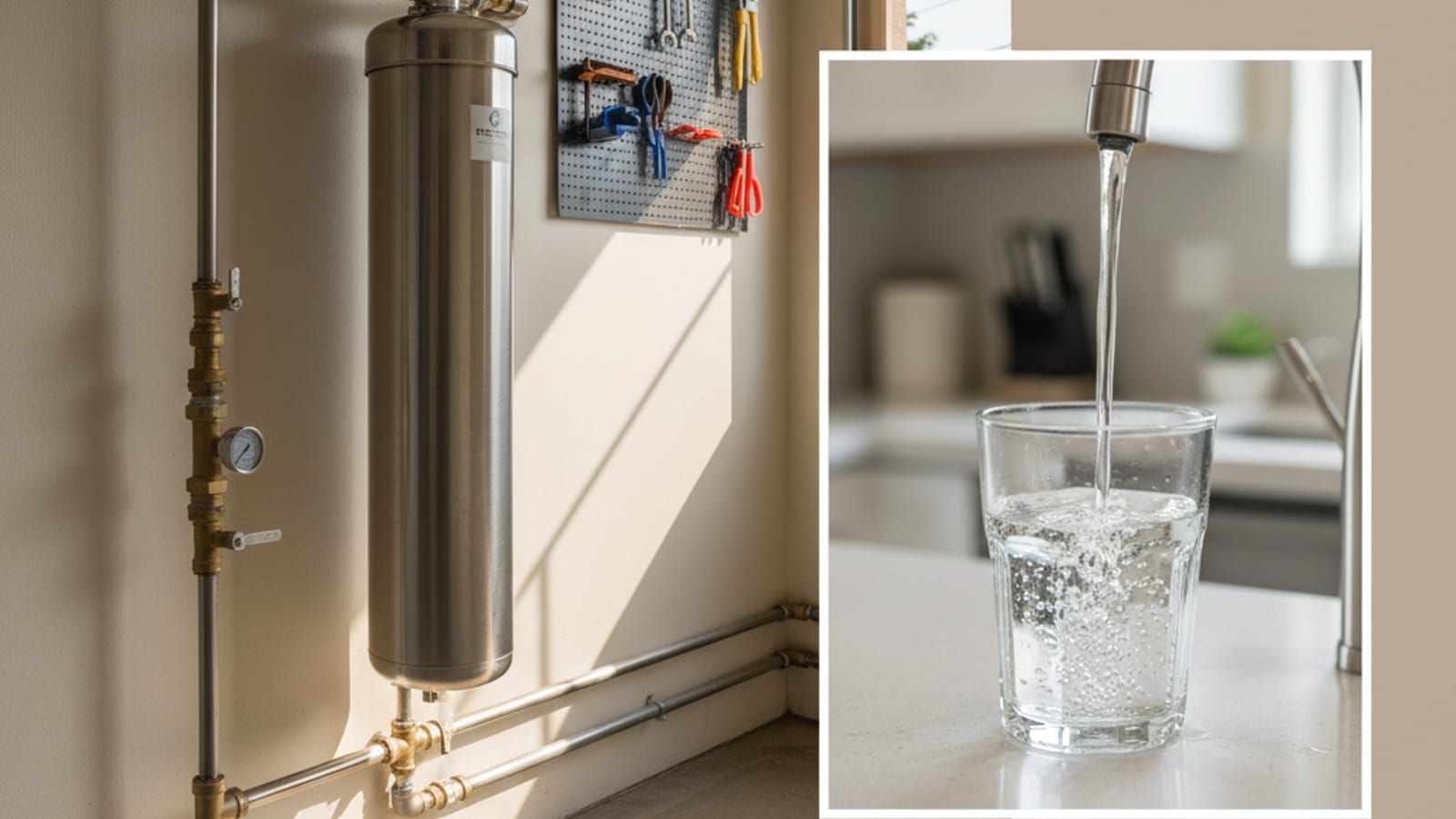
If a taste you associate with chlorine remains after installing a filter, check the water source, exact model, and installation before buying another cartridge. Taste alone does not identify the cause or prove the equipment is broken.
First confirm which disinfectant your utility uses
Water utilities may use free chlorine, chloramine, or change disinfectants during certain operations. Check the current report and notices from your serving utility to identify what it uses. Taste or odor alone does not identify the disinfectant or establish whether water is safe.
A chlorine-reduction claim is different from a chloramine-reduction claim. Compare the label and certification for the exact model with the disinfectant identified by your utility. NSF/ANSI 42 covers specific aesthetic reduction claims, but certification does not mean a device reduces every contaminant. For more context, see chlorine vs. chloramine in San Diego water.
What to check when the taste continues
It is rated for chlorine rather than chloramine
“Reduces chlorine” is a different claim from “reduces chloramine.” Look for a chloramine-specific claim for the exact device and replacement element. Price or the general type of carbon does not establish that performance.
The cartridge is undersized for the flow rate
Compare actual use with the rated flow and conditions for the exact model’s certified claim. Ask the manufacturer or provider to confirm whether the installation meets those limits; filter price alone does not predict performance.
The cartridge has reached its replacement limit
Each cartridge has manufacturer limits and replacement instructions. Actual service life depends on the model, inlet water, and use. Follow the exact model’s instructions rather than applying a generic local schedule.
Water is bypassing the treatment
Ask the provider to identify which lines receive treated water and to inspect the connections using the equipment manual. Do not infer a valve position or change plumbing from a generic diagram.
The cause may not be chlorine
An unusual taste or odor can have several causes. If you notice a rotten-egg odor, for example, Minnesota health guidance says hydrogen sulfide or sulfur bacteria may be present in groundwater, plumbing, or a water heater. Observing where the odor occurs helps guide an investigation, but it does not confirm the source. Check utility notices and request appropriate testing for any health concern.
What to record before contacting a provider
- Note whether the odor or change appears when running cold water, hot water, or both. That observation is a clue to investigate, not proof of the source.
- Find the exact model instructions for identifying the bypass. If you cannot confirm its function or safe position, ask the provider to inspect it.
- Compare the cartridge installation date with its rated months or gallons.
- Note whether the change occurs after several hours without use or during ordinary use as well.
- Identify with the provider which faucets are before and after treatment. Do not taste unknown water to diagnose the system; use appropriate testing for questions about specific constituents.
When another cartridge may not solve it
If a new cartridge with a chloramine-specific claim does not improve the taste, review flow, installation, bypass, and the exact-model instructions. A licensed provider can diagnose the plumbing and compare a chlorine and chloramine reduction system with household flow and the exact model’s certified claim.
Frequently asked questions
Why doesn’t my pitcher filter fix the chlorine taste? Check the claims for the exact device and cartridge. A chlorine-reduction claim is not the same as a chloramine-reduction claim; also confirm the applicable certification, capacity, and use conditions.
How often should I replace a whole-house filter? Follow the interval or capacity specified for the exact model. Use, flow, and inlet-water conditions can affect the interval; there is no single schedule for every home.
Is a chlorine-like taste a safety issue? Taste alone cannot answer that question. Check the current report and notices from your serving utility. If there is a health notice or a sudden unexplained change, follow the utility’s instructions. See is San Diego tap water safe for help locating local information.
Water tastes normal at the kitchen sink but different in the bathroom. Why? Record which faucets show the change and which receive water from the same equipment. Ask the provider to inspect the plumbing distribution, fixtures, and installed treatment. That comparison helps the investigation but does not establish a diagnosis by itself.
Get a defined assessment
Before continuing to replace cartridges, a free in-home water test can provide an initial equipment review and agreed field measurements. It is not a laboratory analysis and does not identify every contaminant. The independent licensed provider explains the scope and provides any price in writing.