Brackish water contains more dissolved salts than fresh water and less than seawater. The term describes salinity, not a complete safety finding. If a San Diego property uses a private well, appropriate laboratory testing is the way to determine which dissolved constituents are present and whether treatment is needed.
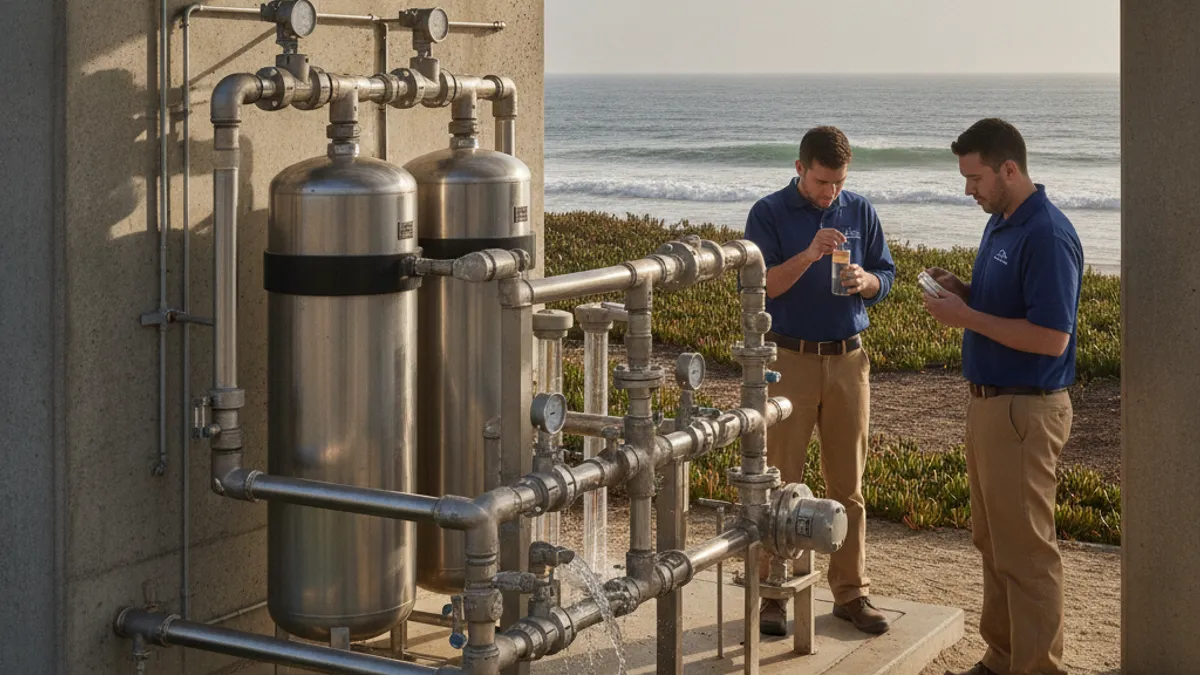
How water can become brackish
Brackish conditions can occur where fresh and saline water mix or where groundwater dissolves salts from surrounding geology. Coastal groundwater can also be affected by saltwater intrusion when pumping and recharge change the balance between fresh groundwater and nearby seawater.
That general process does not establish the conditions at a particular San Diego well. Location, well construction, groundwater conditions, and changes over time all matter. Ask the local health or environmental authority which tests fit the property and use a state-certified laboratory.
A utility report and a well test answer different questions
For a home served by a public water system, start with the serving utility’s current Consumer Confidence Report and notices. Those sources describe the public system; they do not provide an exact analysis of water at every tap or account for changes inside private plumbing.
Private wells are the owner’s responsibility. CDC recommends testing well water annually for total coliform bacteria, nitrate, total dissolved solids, and pH, and asking local authorities which additional tests are appropriate. A salinity concern may call for laboratory analysis of specific dissolved constituents. A TDS or conductivity reading can help characterize dissolved material, but it does not identify each constituent or prove water is safe.
Clues are reasons to investigate
A salty or unusual taste, deposits, corrosion, or changes in plant performance may prompt a well owner to investigate. None of these observations confirms brackish water or identifies its cause. Hardness, iron, plumbing materials, irrigation conditions, and other factors can create overlapping signs.
Do not drink unfamiliar well water as a diagnostic step. If contamination is suspected or a health notice applies, use another safe water source and follow health-department guidance while arranging appropriate testing.
Treatment depends on the laboratory result
Reverse osmosis is one treatment category that may reduce dissolved salts, but the word “RO” does not establish performance for a specific well. Compare the exact model’s certified reduction claims, feed-water limits, recovery or efficiency information, pretreatment requirements, flow, maintenance, and reject-water needs with the measured water conditions.
An ion-exchange softener addresses calcium and magnesium hardness. It is not a general salinity treatment. A complete treatment train may require different steps depending on the constituents found, and treatment should be retested when appropriate to confirm that it worked.
Frequently asked questions
How do I know if my well water is brackish?
Use a state-certified laboratory and ask local health or environmental authorities which salinity-related constituents to include. Taste and a field TDS reading do not provide a complete answer.
Is brackish water safe to drink?
The label alone cannot answer that. Safety depends on the specific constituents and concentrations found. If harmful contamination is suspected, use another safe source and follow local health guidance until testing provides an answer.
Can a standard water softener fix brackish water?
A softener reduces calcium and magnesium hardness. It does not broadly remove all dissolved salts, so select treatment from the actual laboratory results and exact-model claims.
Does every San Diego property have the same salinity risk?
No. Public systems and private wells have different sources and oversight, and private-well conditions can vary by property. Check the serving utility for a public connection or test the specific well rather than applying a regional assumption.
If you are investigating a private well, call Filter Pros San Diego at (858) 400-6508 to connect with an independent licensed provider. A free in-home visit can help define the question and field-test scope, but laboratory testing is required when the concern cannot be established in the field.