Distilled, purified, filtered, and spring: bottled water aisles throw all four words at you like they mean the same thing. They don’t. Each describes a different process, and knowing the difference matters if you’re deciding what to drink, what to run through a humidifier, or what belongs in a CPAP machine or an iron.
What distillation actually does
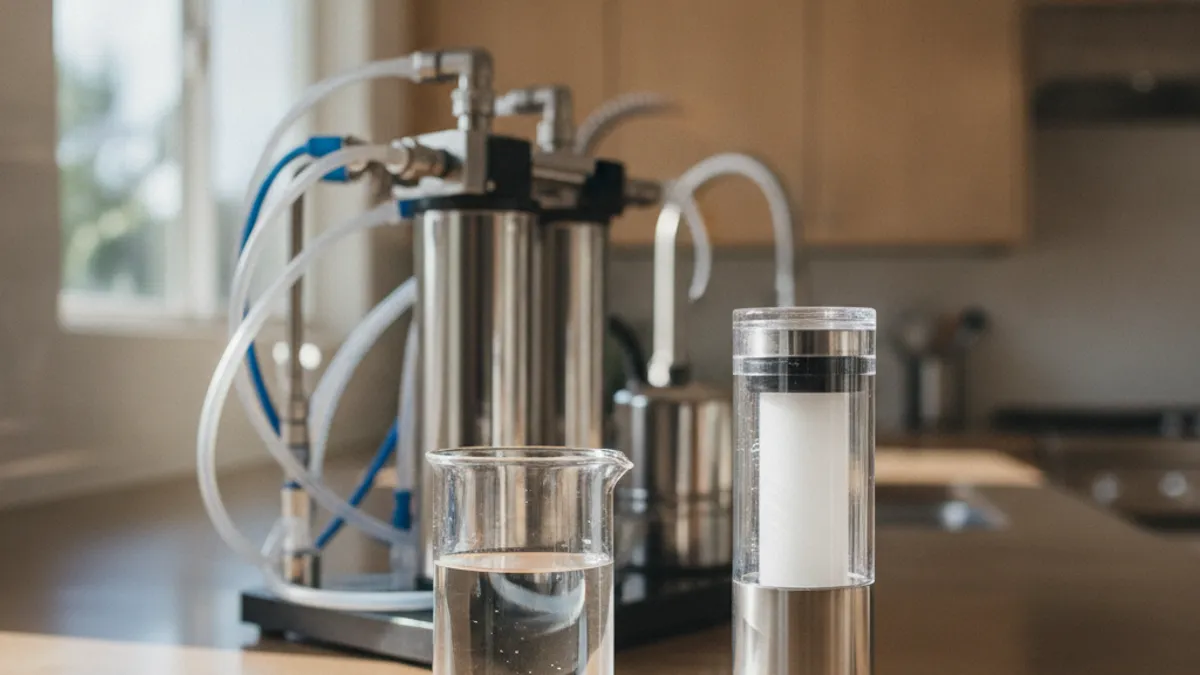
Distillation is the oldest purification method there is. Water gets boiled until it turns to steam, and that steam is captured and cooled back into liquid form in a separate container. Minerals, salts, and most other dissolved solids don’t evaporate with the steam, so they get left behind in the boiling vessel. What condenses on the other end is close to pure H2O, with essentially none of the dissolved minerals that were in the source water.
That process is slow and energy-intensive compared to other treatment methods, which is why you’ll almost never see a whole-house distillation system. Distillers are typically small countertop units that produce a gallon or two at a time, built for a specific use rather than for supplying an entire home.
How it differs from filtration
Filtration doesn’t boil anything. Water passes through a physical or chemical media, activated carbon, a sediment cartridge, a reverse osmosis membrane, and contaminants get trapped, adsorbed, or blocked based on size or chemical affinity. A whole-house filter or an under-sink reverse osmosis system treats water continuously, on demand, at the volume a household actually uses, which is the main practical reason most San Diego homes lean on filtration rather than distillation for everyday water.
Reverse osmosis and distillation both aim at a similar outcome, water with very low mineral and dissolved-solids content, but they get there differently. RO forces water through a membrane under pressure. Distillation changes water’s physical state entirely. Neither one is simply “better” in the abstract. They’re suited to different jobs, and only water testing or your water provider’s published water quality report can tell you what’s actually worth removing from your specific supply in the first place.
Where “purified” and “spring” fit in
“Purified water” is a broad label that can legally describe water treated by distillation, reverse osmosis, deionization, or a combination of methods. It tells you the water met a purity standard, not which process got it there. “Spring water” is different again: it describes the water’s source, a natural spring, rather than any treatment method at all. Spring water may receive minimal filtration or none, and it typically retains more of its natural mineral content than distilled or heavily filtered water.
If you’re comparing bottles at the store, read past the front label. The type of treatment is usually printed in smaller text, and it’s the thing that actually tells you what you’re getting.
Common uses for distilled water specifically
Distilled water shows up most often in appliances and equipment rather than in everyday drinking glasses:
- CPAP machine humidifiers, which are often designed to run on distilled water specifically to reduce mineral buildup inside the machine
- Steam irons, to prevent scale from clogging the steam vents
- Car battery top-offs and cooling systems
- Aquariums, where mineral content needs to be controlled precisely
- Lab and medical equipment that requires consistent, mineral-free water
For everyday drinking water in a San Diego home, most households are better served by a whole house filtration system paired with under-sink reverse osmosis for the kitchen tap, since that setup treats water continuously at normal household volumes rather than a gallon at a time.
What San Diego tap water starts as
San Diego’s municipal water arrives as a blend of imported Colorado River water and State Water Project supply, treated by the county before it ever reaches your home’s plumbing. That baseline treatment addresses things like disinfection and basic filtration, but it doesn’t remove hardness minerals, which is why the region’s water still runs hard by the time it hits your tap. For the specifics of what’s actually in your local supply, your water district’s annual water quality report is the source to check rather than a general assumption either way.
Frequently asked questions
Is distilled water safer to drink than filtered water?
Neither is inherently unsafe. They’re simply processed differently, and the right choice depends on what you’re using the water for and what your baseline water quality looks like. Check your water district’s published quality report if you want specifics on your own supply.
Can I use tap water instead of distilled water in a CPAP machine?
Many CPAP manufacturers specifically recommend distilled water to reduce mineral scale buildup inside the machine. Check your device’s manual for what the manufacturer recommends.
Does a reverse osmosis system produce the same result as distillation?
They’re similar in that both reduce dissolved mineral content significantly, but the process and the resulting water aren’t identical. If you need water at true distilled purity for a specific device, a countertop distiller is the more direct match.
Is San Diego tap water safe without additional filtration?
San Diego’s municipal water meets the treatment standards set for the region, but hardness and taste are common reasons homeowners add a whole-house filter or softener. Your water district’s annual report is the best source for what’s actually in your supply.
If you’re trying to figure out which type of home water treatment actually fits your household, call Filter Pros San Diego at (858) 400-6508 and we’ll walk through your options.