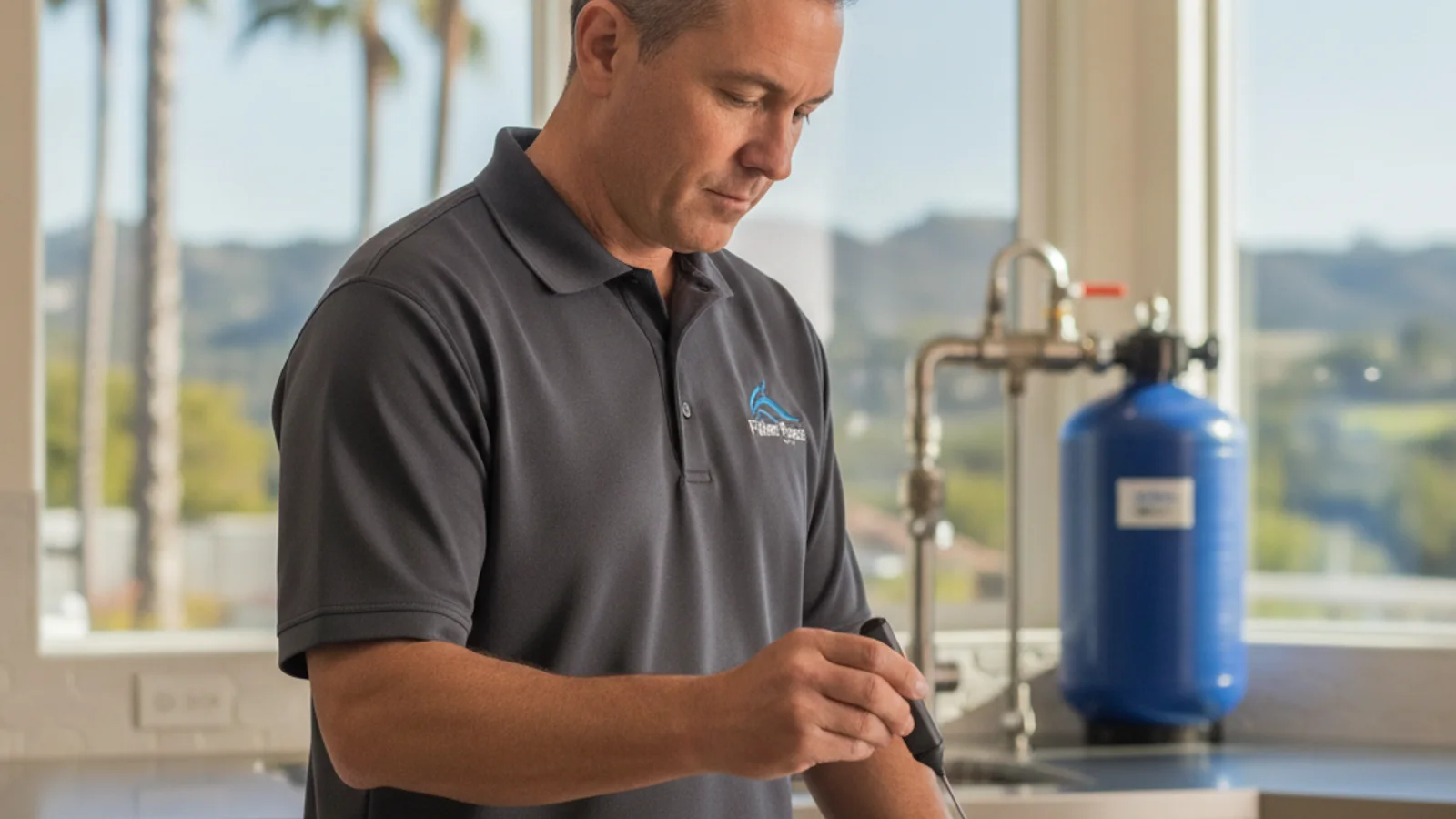
TDS means total dissolved solids. It is a combined measure of dissolved material, not a list of substances and not a drinking-water safety score. A handheld meter usually estimates TDS from electrical conductivity. It cannot tell whether the reading comes from calcium, sodium, nitrate, arsenic, or another dissolved substance.
EPA’s 500 mg/L TDS value is a secondary guideline for aesthetic and technical effects. It is not a health-based cutoff. A result below 500 does not prove water is safe, and a result above 500 does not identify a health hazard.
What does TDS include?
The total may include calcium, magnesium, sodium, chloride, sulfate, bicarbonate, nitrate, and dissolved metals. TDS combines them instead of reporting each separately. Suspended particles are a different measurement.
TDS can help compare a stable source before and after treatment, track a baseline, or flag a change worth investigating. It cannot say which constituent changed or whether a specific contaminant is absent.
What does a TDS meter measure?
Most pocket meters measure conductivity. The USGS explains that conductance depends on the type and concentration of ions and can approximate dissolved solids. The conversion is not constant among water sources and can change with water composition.
The display is therefore an estimate based on a conversion factor. Temperature, calibration, probe cleanliness, sampling method, and the selected factor can affect it. Use the same calibrated meter and method to track a trend. Request laboratory analysis when the exact result matters.
What does EPA’s 500 mg/L number mean?
EPA separates enforceable primary standards for specified contaminants from generally nonmandatory secondary guidelines for aesthetic, cosmetic, or technical effects.
For TDS, EPA lists a secondary guideline of 500 mg/L and associates it with hardness, deposits, colored water, staining, or salty taste. It does not identify what is dissolved and does not replace the primary standard for an individual contaminant.
Avoid calling water “safe,” “unsafe,” “good,” or “poor” from TDS alone. The next action depends on the actual constituent and the reason for testing.
TDS and hardness are different
Hardness focuses mainly on calcium and magnesium. TDS includes a wider group of dissolved substances. A sample can have high TDS for reasons other than hardness.
An ion-exchange softener removes calcium and magnesium by exchanging ions. It can reduce hardness without necessarily lowering a meter’s TDS estimate because other dissolved ions remain. If scale is the concern, request a hardness result. If a chemical is the concern, request analysis for that chemical.
How to interpret a San Diego result
Do not use a countywide “normal” value. San Diego County has multiple public systems and private wells. Identify the utility serving the address and read its current report and notices. The City of San Diego portal applies to the City’s system, not every county tap.
For a useful comparison:
- Record the tap, date, unit, flushing, and whether the sample is before or after treatment.
- Compare treated water with untreated feed water from the same property.
- Repeat an unexpected reading with a clean, calibrated meter.
- Use a laboratory when the identity or concentration of a substance matters.
Which laboratory test should you request?
Start with the concern rather than asking to “test everything.” For a utility notice, ask the utility which analyte and sample method apply. For plumbing concerns, ask about a suitable tap-water test. For a private well, ask local health or environmental officials which additional tests fit the location.
The CDC recommends annual private-well testing for total coliform bacteria, nitrate, TDS, and pH, plus testing after flooding or repairs and when taste, color, or smell changes. Use a state-certified laboratory.
PFAS, lead, nitrate, and bacteria require separate analyses or test groups. Ask for the result, unit, reporting limit, method, sample instructions, and the standard or guidance value used to interpret it.
Does reverse osmosis lower TDS?
Reverse osmosis can reduce dissolved substances, but performance varies by exact model, feed water, pressure, temperature, recovery, membrane condition, and maintenance. Do not apply one percentage to every system.
Compare the complete model’s independently certified reduction claims, treated-water production, reject-water rate, filter and membrane schedule, replacement costs, and pressure or electricity requirements. NSF/ANSI 58 covers reverse osmosis systems, but certification to that standard does not mean every model reduces every contaminant.
See the reverse osmosis comparison for questions to include in a written quote.
What an in-home visit can answer
Filter Pros San Diego is a referral service. We connect homeowners with separately licensed providers who offer a free in-home water test. A provider can take field measurements relevant to the proposed treatment and compare feed and treated water.
The visit cannot identify every dissolved constituent or replace certified laboratory analysis. Bring the utility report and state the exact concern. Ask which field measurements will be taken, which questions need a laboratory, and which certified claim supports the proposed model.
Call (858) 400-6508 or request a free in-home water test to be connected with a separately licensed provider.