A reverse osmosis faucet that is not producing water is often an empty tank, a closed valve, or a restriction in the unit, not a broken spout. Reverse osmosis fills a storage tank slowly, so an empty tank can take hours to recover. If the faucet stays dry after that wait, or you cannot identify the valves safely, stop and call a licensed professional.
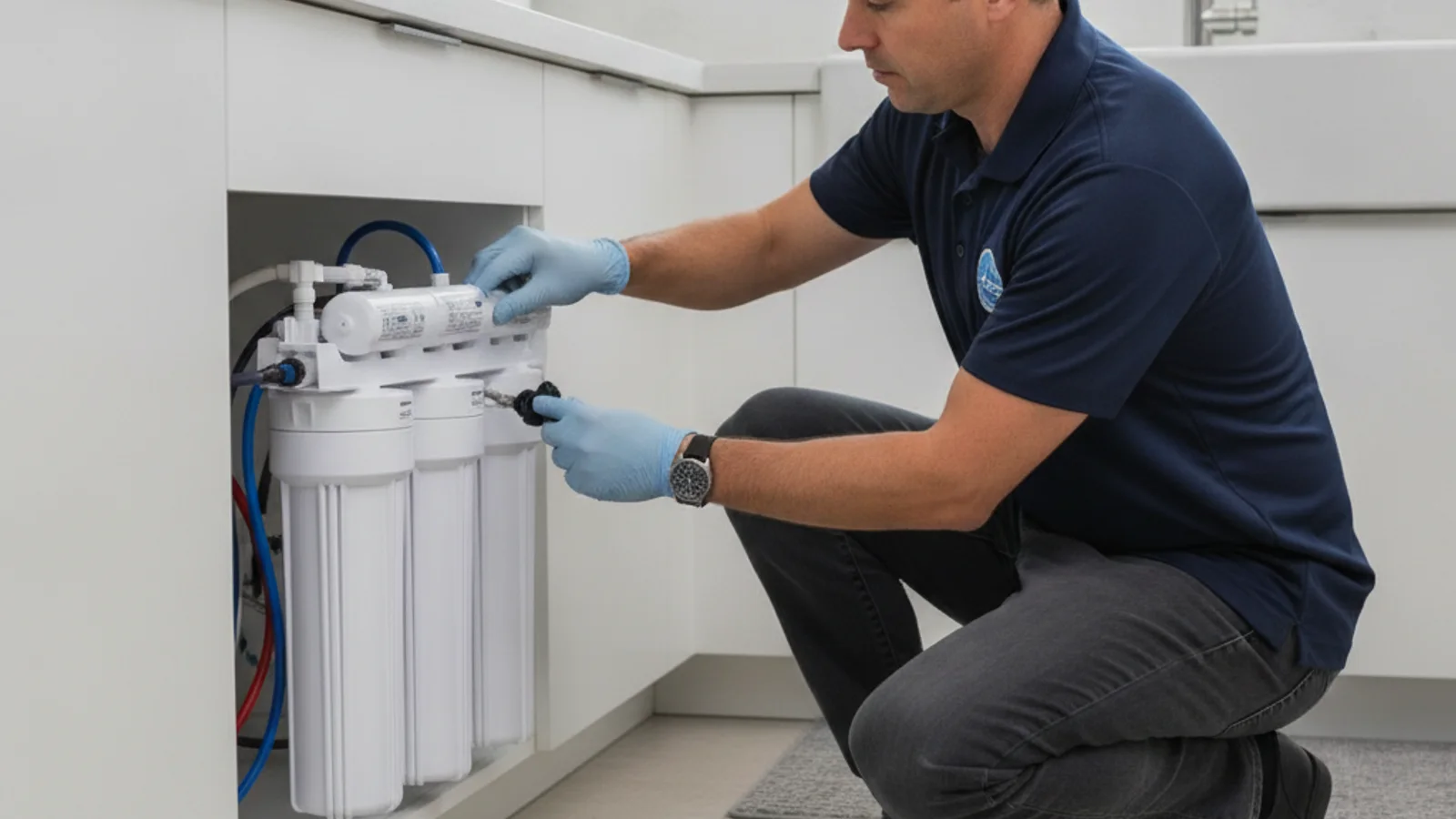
Separate “tank empty” from “no production”
An empty storage tank and a system that is not producing water can look identical at the faucet. The drinking tap draws from the tank. It does not run at kitchen-sink speed.
If you just filled pots, made ice, or drained the tank after a filter change, a dry faucet can be normal. Give the unit time to refill. EPA guidance on point-of-use reverse osmosis treats performance as model-specific. The unit also sends reject water to the drain while it makes treated water. Slow recovery is part of that process.
A production problem looks different. The faucet stays dry or at a trickle after hours of no use, while other cold taps still run. That is not the same as a tank you emptied on purpose. A TDS meter reading does not explain a dry faucet. It estimates dissolved material. It does not measure whether the tank has water to deliver.
Check supply, tank valve, and tubing first
Check the feed supply, the tank valve, and visible tubing before treating the faucet as the failed part. Crystal Quest’s reverse osmosis troubleshooting, and similar manufacturer guides, list a closed feed valve and kinked tubing among common no-flow causes.
Stay outside the housings. Use the exact model’s diagram. Do not force a stuck handle.
- Confirm other cold taps still run. If the whole house is dry or weak, the RO faucet is not the only issue.
- Find the feed valve on the cold line to the RO unit. Open it only if the labels are clear and the manual names that position as open.
- Find the tank valve. It is usually a small valve on the tubing at the top of the storage tank. Confirm it is open per the manual.
- Look at visible tubing from the supply, through the filters, to the tank, and up to the faucet. Note kinks or lines that look pulled out. Do not yank fittings.
- Stop if a valve is unlabeled, stuck, or leaking. Photograph what you see and call a licensed professional.
Filters, pressure, and the storage-tank air charge
Clogged pre-filters, low feed pressure, and a lost tank air charge are common manufacturer-listed causes of a dry or weak RO faucet. Crystal Quest also lists an empty or waterlogged tank and a stuck auto shut-off valve. Treat that as a category list, not a parts diagnosis for your unit.
Crystal Quest discusses a feed-pressure window of 35 to 60 PSI and about 5 to 8 PSI of air on an empty tank, often around 7 PSI. Those figures are that manufacturer’s guidance, not a universal spec. The model label and manual control the real pressure, precharge, and which parts a homeowner may service. Do not add air to a tank that still holds water.
Hard feedwater can load sediment and carbon stages faster than a soft-water market. The City of San Diego reports that its drinking water typically averages about 16 grains per gallon, or 276 ppm, and can range from 16 to 18 grains depending on area and demand. That is City system water, not a countywide figure and not well water. Helix Water District treats 10 or more grains as hard and says imported supply averages about 14 grains. That is a supply figure, not a tap reading.
Chloramine, when the serving utility uses it, can also load carbon pre-filters. CDC guidance on chlorine and chloramine tells you to identify the disinfectant from the water system’s current reports. Confirm yours.
None of that sets a replacement interval. Follow the model manual. For local maintenance, see reverse osmosis filter replacement in San Diego. A remineralization cartridge does not refill an empty tank. Whether to remineralize RO water is a separate choice after flow returns.
What not to take apart
Leave pressurized housings, supply fittings, and tank internals assembled. Opening a housing or pulling a push-fit line can flood the cabinet.
Do not open filter or membrane housings that may still be under pressure. Do not add air to a full tank. Do not disconnect the faucet, drain saddle, or tank fitting to test flow. Do not remove the auto shut-off valve or membrane. Do not force a stuck handle.
If water is spreading, isolate the unit only as the manual directs and call a licensed professional.
Notes to bring to a licensed pro
Write down the model, what you already checked, and when the faucet went dry.
- Manufacturer, complete model number, and serial number
- Whether the faucet is fully dry or a trickle, how long, and whether the tank was just emptied
- Whether other household taps still have normal flow
- Feed-valve and tank-valve positions from the labels you can see
- Any kinked tubing, dripping fitting, or error light
- Last known filter or membrane service, plus photos of the under-sink layout
- The owner’s manual, if you have it
Do not buy a generic filter pack or valve kit until the part is matched to the model.
Request a local referral
Filter Pros San Diego is an independent information and referral site. We do not repair reverse osmosis systems. We connect homeowners with separately licensed water-filtration professionals, and the homeowner contracts with and pays the selected professional directly.
Call (858) 400-6508 or use our reverse osmosis drinking water page to request a local match. Share the model number, whether the feed and tank valves appear open, and how long the faucet has been dry. Response time, diagnosis, price, parts, and warranty must be confirmed directly with the professional.
If you are comparing a new system rather than service on this one, see reverse osmosis cost in San Diego.
Frequently asked questions
These answers cover safe first checks, not a diagnosis or a repair quote.
Why is there no water from my reverse osmosis faucet?
The tank may be empty, a feed or tank valve may be closed, tubing may be kinked, or production may have stopped. Start with the supply, tank valve, and visible tubing. Then wait for a slow refill if the tank was just drained.
How long does an empty RO tank take to refill?
It can take hours. Reverse osmosis produces water slowly and sends some water to the drain while it works. A dry faucet right after heavy use is not the same as a system that never recovers.
Can clogged filters stop RO production?
Yes. Manufacturer troubleshooting often lists clogged pre-filters as a cause of slow or no flow. Do not open pressurized housings. Follow the model schedule and have a licensed professional service overdue filters.
Should I add air to the storage tank?
Not while the tank still holds water. Some manufacturers discuss an air charge on an empty tank, and Crystal Quest cites about 5 to 8 PSI in that state. The model label controls the real spec.
Does Filter Pros repair reverse osmosis systems?
No. Filter Pros San Diego does not install or repair equipment. We refer homeowners to separately licensed professionals. The homeowner contracts with and pays that professional directly.
When should I call a licensed professional?
Call when the faucet stays dry after a reasonable refill wait, a valve is stuck or unlabeled, a housing may be pressurized, the tank will not recover, or you see leaking.