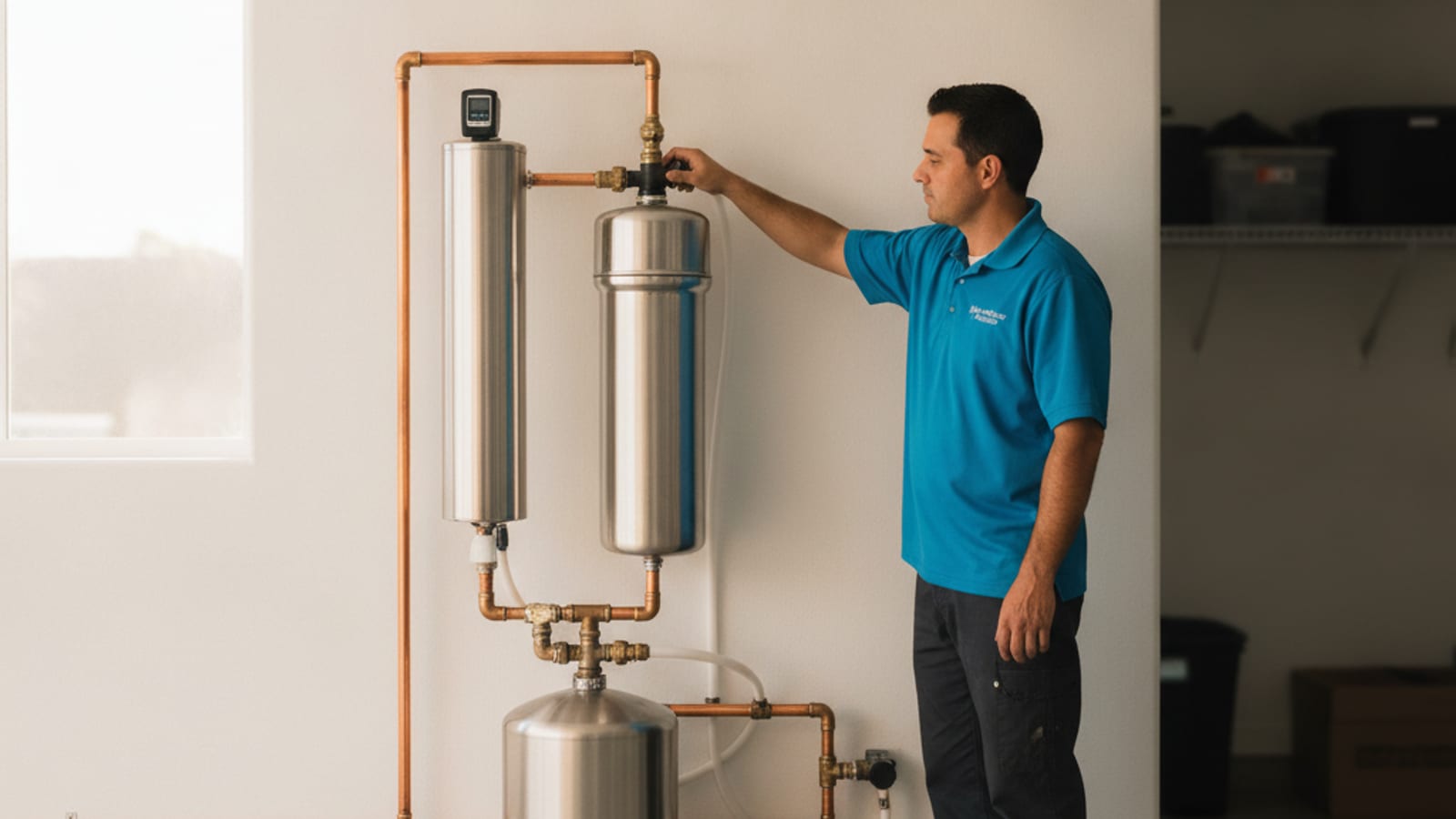
UV water treatment is designed to inactivate specified microorganisms as water passes through a chamber exposed to ultraviolet light. It does not remove hardness, sediment, nitrate, arsenic, PFAS, or other dissolved chemicals.
Whether a San Diego property needs UV depends on its water source, certified laboratory results, vulnerabilities in the well or plumbing, and the exact model’s certified performance conditions. A private well does not automatically need UV, and a public-water connection does not automatically rule it out. Test the actual concern first.
Start with the water source and a defined concern
For a private well, use a state-certified laboratory. The CDC well-testing guidance recommends annual testing for total coliform bacteria along with nitrate, total dissolved solids, and pH. It also recommends asking the local health or environmental department which additional tests fit the property.
For public water, find the provider on the water bill and review its current water-quality report. Do not assume every San Diego County provider uses the same disinfectant or that a public report describes a plumbing problem inside the home. If illness, a cross-connection, a private storage tank, or another site-specific concern is involved, ask the provider and health department what testing is appropriate.
An in-home screening can organize questions but cannot confirm that water is microbiologically safe. UV selection needs the relevant laboratory result and a clear treatment goal.
How UV treatment works and where it stops
Water flows through a chamber containing a UV lamp. The exposure can inactivate microorganisms covered by the system’s verified performance claim. It does not physically strain particles from the water or remove dissolved chemicals.
UV performance depends on the complete installation, not the glowing lamp alone. The exact model documentation should specify:
- Organisms or performance class covered by certification
- Rated flow and required UV dose or operating conditions
- Feed-water quality limits and required pretreatment
- Lamp, sleeve, sensor, alarm, and controller requirements
- Installation orientation and service clearance
- Power-loss behavior and any shutoff or warning device
- Maintenance and replacement schedule
EPA’s home-treatment comparison describes UV as a technology for biological contaminants and lists chemicals as a limitation. Do not buy UV for a hardness, nitrate, arsenic, iron, or taste concern unless another verified treatment stage addresses that separate goal.
What to do after a positive coliform or E. coli result
A positive result requires a public-health and well investigation before it becomes a product recommendation.
- Use another safe source. CDC says not to drink well water that contains harmful germs or chemicals, or is suspected of containing them. Follow the local health department’s instructions for drinking, cooking, brushing teeth, bathing, and other uses.
- Confirm the result as directed. Use a state-certified laboratory and follow its sterile bottle, sample-point, tap-preparation, timing, and transport instructions. Ask whether testing should distinguish total coliform, fecal coliform, and E. coli.
- Inspect the source. A licensed well professional may need to check the well cap, casing, seal, drainage, standing water, recent work, abandoned wells, septic conditions, or other entry pathways.
- Correct the pathway. Treatment does not repair a damaged cap, casing, seal, or drainage problem.
- Disinfect according to current guidance. Do not calculate or apply a chemical dose from a generic article. Well construction, water volume, equipment compatibility, flushing, and chemical safety require property-specific instructions.
- Select ongoing treatment only if justified. Compare UV or another process against the confirmed organism, flow, water quality, and operating conditions.
- Retest before normal use. CDC says treated water should be tested to make sure treatment worked.
If no other safe source is available during a germ-related event, the health department may give boiling instructions. Follow that current guidance exactly. Boiling does not remove chemical contamination and is not a substitute for nitrate or arsenic treatment.
Why source correction comes before permanent equipment
Coliform can enter through a compromised well or can appear because a sample was collected incorrectly. A treatment device installed without investigating the cause can leave the underlying pathway open.
Record recent flooding, well or pump repair, plumbing work, loss of pressure, and changes around the wellhead. Ask the laboratory whether a confirmation sample is needed and where it should be taken. Ask a licensed well professional to document any construction or drainage repair.
After repair or disinfection, use certified laboratory results to confirm the outcome. Only then should a long-term treatment decision be finalized.
Pretreatment is model-specific
Particles and other water conditions can interfere with UV performance or foul the sleeve. This does not mean every installation needs the same sediment cartridge, iron filter, or stage order.
Compare the laboratory report with the UV manufacturer’s feed-water limits. If pretreatment is required, each stage should have its own purpose, sizing inputs, maintenance schedule, and verification method.
A well-treatment train might include particle filtration, treatment for a confirmed mineral or chemical, and UV at the location specified by the manufacturer. Another well may need source repair and no permanent UV. Our well-water treatment guide explains how to build the sequence from results rather than a standard package.
Choose the exact UV model
Ask for a written proposal with:
- Full manufacturer and model number
- Current third-party certification and the exact claim
- Rated flow compared with measured peak household flow
- Feed-water limits and required pretreatment
- Chamber material and plumbing connection requirements
- Lamp and sleeve part numbers
- Sensor, alarm, display, and automatic-shutoff behavior
- What happens during power loss
- Replacement intervals taken from the current manual
- Sampling ports and post-installation laboratory plan
- Equipment, installation, electrical work, permits, parts, and service charges
- Warranty terms and service responsibility
A lamp that lights is not proof of the required UV output. Rely on the model’s monitoring system, maintenance instructions, and laboratory verification.
UV compared with other treatment
| Treatment goal | UV’s role | Separate evidence needed |
|---|---|---|
| Bacteria, viruses, or protozoa | May inactivate specified organisms under verified conditions | Laboratory result, exact certified claim, flow and feed-water limits |
| Sediment or cloudiness | Does not remove particles | Particle analysis and exact filtration design |
| Hardness | Does not soften water | Measured hardness and softener or conditioner documentation |
| Nitrate or arsenic | Does not remove dissolved chemicals | State-certified lab result and exact chemical-reduction claim |
| Taste, odor, or disinfectant | Not a general treatment for these concerns | Provider report, appropriate testing, and exact filter claim |
No single technology protects against every problem. For chemical findings, see nitrate in well water and arsenic in well water.
Maintain and test the installed system
Follow the exact manual for lamp replacement, quartz-sleeve inspection and cleaning, sensor care, filter changes, alarm testing, and startup after service. Do not reuse a lamp interval or reset procedure from another model.
Keep replacement dates, part numbers, alarms, outages, bypass events, and laboratory reports together. If the system loses power, alarms, is bypassed, or operates outside its documented conditions, follow the manufacturer’s instructions and ask the health department whether another sample is needed.
Plan post-installation and ongoing testing with the state-certified laboratory. The sample points should show whether the source and treated water questions are being answered. A completed installation is not a drinking-water safety clearance.
Get help reviewing the options
Filter Pros San Diego is an independent information and referral site. We arrange free in-home water tests and connect homeowners with separately licensed water-filtration professionals. We do not perform the installation or operate a laboratory. The homeowner contracts with and pays the selected professional directly.
Schedule a free in-home water test or call (858) 400-6508. Bring the certified laboratory report and current health-department instructions. Confirm equipment capability, price, schedule, and follow-up testing directly with the professional.
Frequently asked questions
Does every private well need UV?
No. Test the well and investigate its condition. UV is one possible treatment for specified microorganisms when the exact model and installation fit the confirmed need.
Does public water need UV?
Do not decide from the word “public” alone. Review the serving provider’s report and investigate any site-specific storage, plumbing, or health concern with the provider and health department.
Does UV remove nitrate, arsenic, hardness, or sediment?
No. UV addresses biological contaminants under specified conditions. Those other concerns require their own test and treatment evidence.
Can I install UV immediately after a positive coliform test?
First follow health-department guidance, confirm the result as directed, inspect and correct the contamination pathway, and retest. If ongoing UV is justified, select it from the organism, flow, feed-water conditions, and exact certified claim.
How do I know UV is working?
Use the model’s monitoring and alarm features, maintain it according to the manual, and complete laboratory testing on the schedule set by the laboratory or health department. A visible glow alone is not enough.