The City of San Diego adjusts fluoride in its drinking water to a target of 0.7 parts per million (ppm). That answer applies to the City’s system. San Diego County has many retail water agencies and a mix of treated, blended, and other supplies, so a countywide answer can be misleading.
If you want to know what reaches a particular address, first identify the retail water provider and read its current consumer confidence report. If you want to reduce fluoride at one tap, compare exact product certifications rather than relying on a treatment category alone.
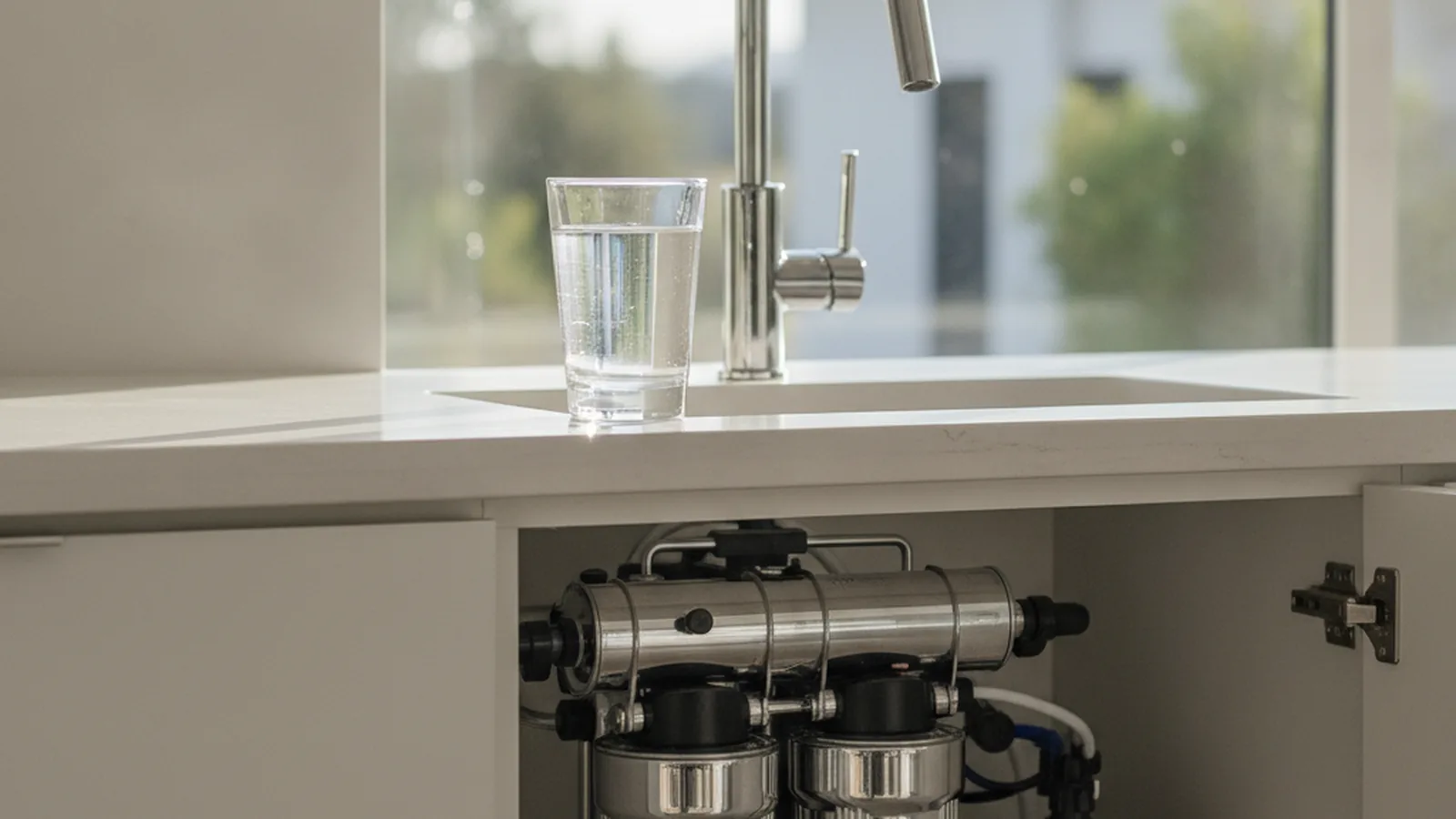
Does City of San Diego tap water contain fluoride?
Yes. The City’s water-quality FAQ says fluoride occurs naturally at low concentrations and that the City adjusts its drinking water to 0.7 ppm.
The regional picture has more variation. The San Diego County Water Authority says agencies receiving all of their treated water from the Water Authority receive optimized fluoride concentrations. Agencies that blend that supply with non-fluoridated sources can have lower levels, while systems receiving no treated Water Authority supply have naturally occurring levels.
That is why the serving utility matters more than a county label. The utility’s current report gives system-level results for its reporting period; it does not guarantee an exact concentration at every tap on every day. Our broader guide to San Diego tap water explains how to use those reports without applying one agency’s data to another.
How to verify fluoride for your address
Use the least complicated source that answers your question:
| Your question | Best source |
|---|---|
| Does my public water provider fluoridate or receive fluoridated supply? | The provider’s current consumer confidence report or water-quality office |
| What did the provider report during its latest reporting period? | The fluoride row in that report |
| What is the concentration in a sample from my tap? | A qualified laboratory using an appropriate fluoride method |
| Does a treatment product reduce fluoride? | The exact model’s certification listing and performance data sheet |
A provider’s free in-home visit may include field screening useful for discussing equipment, but it should not be presented as a laboratory fluoride analysis unless that specific service and method are stated. Ask what is measured, how, and whether a laboratory sample is needed.
What kinds of home treatment may reduce fluoride?
The CDC says reverse osmosis systems may reduce fluoride and tells consumers to check the system label for the specific chemicals it removes. NSF/ANSI 58 covers point-of-use reverse osmosis systems, and fluoride reduction is an optional claim under that standard. Therefore, “NSF/ANSI 58 certified” by itself is not enough; verify that the exact model is certified specifically for fluoride reduction.
This model-specific check avoids two common mistakes:
- Assuming every reverse osmosis system has the same fluoride performance.
- Assuming a pitcher, refrigerator filter, whole-house carbon filter, or softener reduces fluoride because of its general product category.
A product may have useful claims for taste, hardness, or other named substances without having a fluoride claim. Read the performance data sheet and plan for the required cartridge or membrane replacement schedule.
For drinking and cooking water, a certified point-of-use system at the kitchen sink can be a more focused option than treating every fixture. Our comparison of reverse osmosis and filter pitchers explains the ownership differences, and the under-sink filtration guide covers the installation format.
What treatment does not tell you
A fluoride reduction claim does not mean a system reduces every other substance in the water. It also does not establish the output from a neglected or incorrectly installed system. Source-water conditions, installation, pressure, maintenance, and cartridge or membrane condition can affect operation.
For questions about fluoride and personal dental care, supplements, or infant formula, consult a dentist or clinician who can consider the individual situation and the fluoride information from the serving utility.
Frequently asked questions
Is all San Diego County water fluoridated at the same level?
No single figure describes every county water agency. The Water Authority says fully treated supply, blended supply, and supplies that do not receive its treated water can have different fluoride levels. Check the retail provider for the address.
Does reverse osmosis reduce fluoride?
Some systems do. The CDC says RO may reduce fluoride, and NSF/ANSI 58 includes an optional fluoride-reduction claim. Verify that claim for the exact model rather than assuming it from the words “reverse osmosis.”
Does a water softener reduce fluoride?
Do not infer fluoride performance from the product category. Softeners are selected primarily for calcium and magnesium hardness. Check the exact model’s label and certified claims for any additional reduction.
Can a free in-home water test tell me my exact fluoride level?
Only if the provider explicitly offers an appropriate fluoride analysis. A general field screen should not be described as a laboratory result. Use the serving utility’s report for system-level data and a qualified laboratory when an address-specific measurement is needed.
Filter Pros San Diego can introduce you to an independent licensed provider to discuss a free in-home water test and equipment options. The provider should explain the scope of any screening and give the recommendation and quote. Call (858) 400-6508, or read about reverse osmosis drinking-water systems and reverse osmosis cost factors before comparing models. The same utility-first process applies in La Jolla and elsewhere in the county.